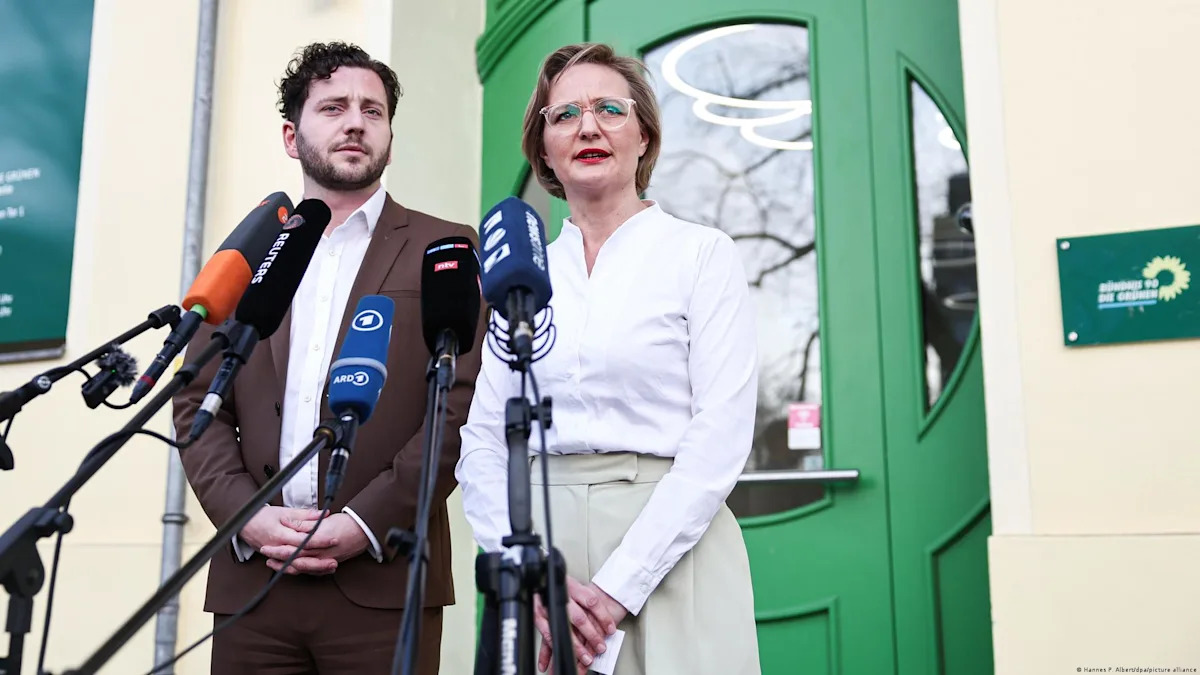
Green Party co-chair Franziska Brantner seemed very uncomfortable when she held a press conference in Berlin this week. She had intended to speak about the flashpoints in international politics, Greenland and Ukraine, and US President Donald Trump, but the journalists present kept returning to the issue of the Mercosur agreement — and how her party scuppered its ratification.
Mercosur, the EU’s major trade deal with the four South American countries of Argentina, Brazil, Paraguay, and Uruguay, was meant to be a sign of hope in a world of increasing nationalism — a boost to trade based on rules, not punitive tariffs.
Negotiations on this agreement had already been agonizingly long, lasting over 20 years. Last week, its entry into force was delayed once again in the European Parliament — with the votes also of the majority of the German Greens — despite Brantner’s personal last-ditch attempt to persuade them to approve it.
Eight of the 11 Green MEPs from Germany voted to have the already negotiated Mercosur agreement reviewed once again by the European Court of Justice. They since admitted that this was a mistake.
While many economists believe it could now take years for the agreement to take effect, Brantner is suggesting that despite the time-consuming legal review, there is a way the agreement can already enter into force: “As soon as a Latin American country has ratified it, EU Commission President von der Leyen has been given the authority and the task of implementing it accordingly,” she said.
Greens and right-wing populists vote together
It is not only the delay of the Mercosur agreement that is damaging to the party leadership, but also the new cooperation with political opponents: The Green MPs voted together with right-wing populists and right-wing extremists in the European Parliament to refer the matter to the court.
It was the Green Party that had protested most forcefully when Chancellor Friedrich Merz’s conservative bloc of Christian Democratic Union (CDU) and Christian Social Union (CSU) one year ago pushed a motion through the Bundestag to limit immigration, together with the far-right Alternative for Germany (AfD).
The Greens argued that a “firewall” needed to be upheld in parliament against right-wing populists, meaning no voting or cooperation with them whatsoever.
This is precisely what the Greens disregarded in the European Parliament.
Greens’ Mercosur skepticism
The EU’s Mercosur trade agreement is intended to create one of the world’s largest free trade zones. While countries in the European bloc export cars and chemical products across the Atlantic, the Mercosur countries primarily supply agricultural products and raw materials to Europe.
Many in the environmentalist Green Party criticized the Mercosur agreement early on. They raised concerns over whether the high environmental standards for German farmers would remain in place if they had to compete in a free-trade zone with farmers from Argentina, Paraguay, Uruguay, and Brazil.
Despite this skepticism, Green Party leaders had put out the message that in times of increasing nationalism, such an agreement between many states is valuable in itself.
The damage to the party is all the greater now. The party leadership in Berlin stands accused of not having coordinated sufficiently with the members of parliament in Brussels.
The Greens have now stressed their commitment to further trade agreements, such as the Trans-Pacific Partnership, which includes Australia, Japan, Canada, Mexico, and several Southeast Asian countries.
And regarding the trade agreement with India, Brantner’s party co-leader Felix Banaszak has vowed that the Greens in the European Parliament would not again throw a spanner in the works.
This article was originally written in German.
While you’re here: Every Tuesday, DW editors round up what is happening in German politics and society. You can sign up here for the weekly email newsletter, Berlin Briefing.