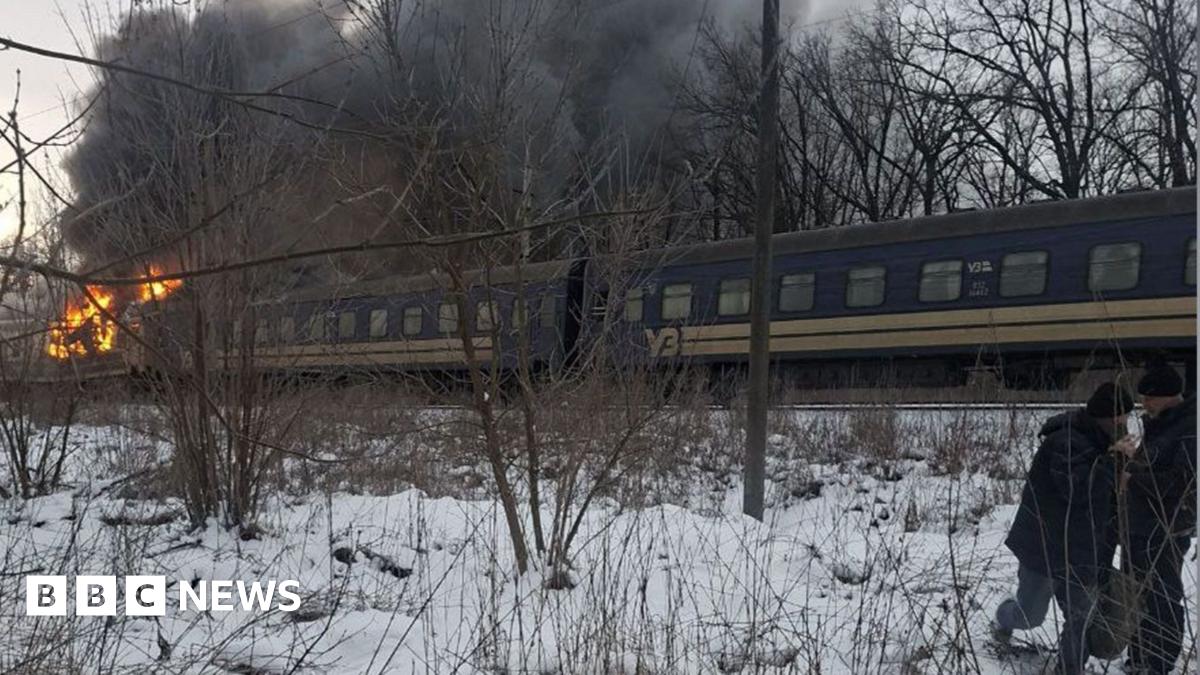
He then went back to the train with some of the other passengers to check if anyone had been left behind. Inspecting the carriages, he saw a body and continued to look for survivors. Five people lost their lives in the attack.
In the final carriage, Omar found a young woman with a baby.
“She was very scared and had no idea what to do but thank God she was alive,” he says.
She barely had time to put on warm clothes, and screamed she needed to go back to the carriage to retrieve her suitcase and documents, the officer says.
“I came here to bring my son,” she told Omar as she was getting off the train. Later, Omar understood she had been travelling to the front line so that her soldier husband could see their child.
The attack on the passenger train was condemned by President Volodymyr Zelensky as terrorism.
It hit the heart of the railway system – a symbol of resilience in a country where the airspace has been closed since Russia launched its full-scale invasion in February 2022.
Millions of Ukrainians rely on the 21,000km-long (13,000-mile) railway network to travel around the country and to cross the border into neighbouring countries, from which they can then catch flights.
Although the railways have been targeted in the past, by and large Ukraine’s Ukrzaliznytsia rail company has been able to keep people moving on its vast network – although escalating attacks on infrastructure and severe weather have led to increasingly long delays.
Trains to the frontline city of Kramatorsk in the Donetsk region were eventually suspended last autumn, once the area became too dangerous due to sustained aerial Russian attacks.
On Wednesday, flags flew at half-mast in railway stations across Ukraine. The daily minute of silence observed across the country was dedicated to the victims of the drone strike on the train.
Hours after the attack had taken place, services were running again on the Barvinkove-Chop line.