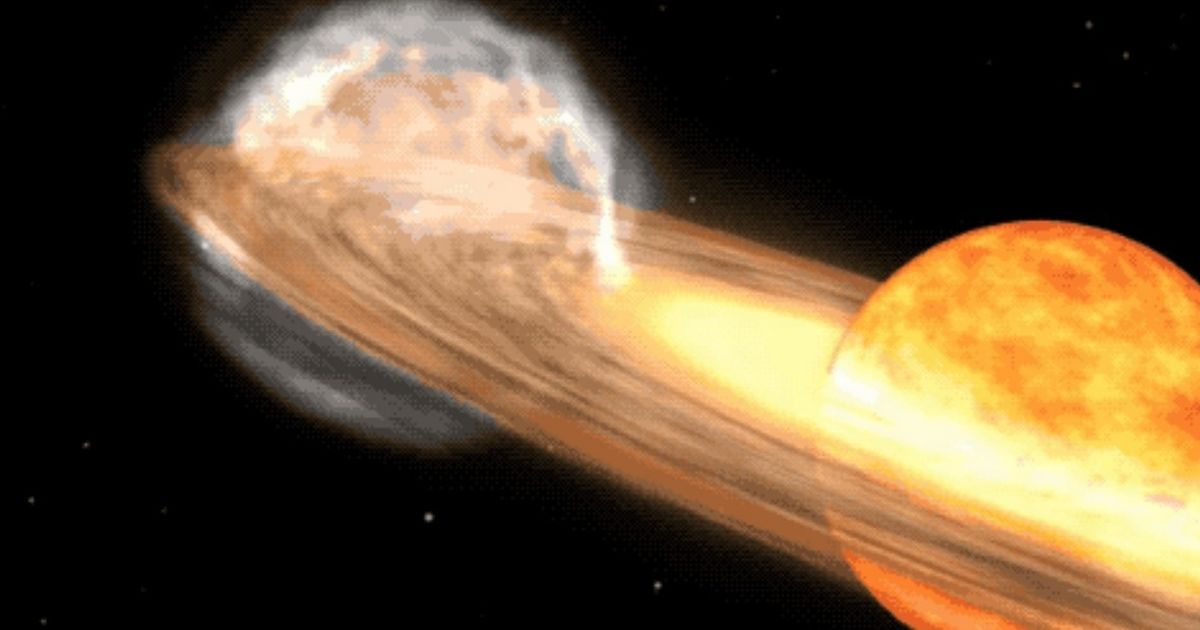
Astronomers have been excitedly waiting for a star system 3,000 lightyears away to explode, forming a ‘new star’ in the night sky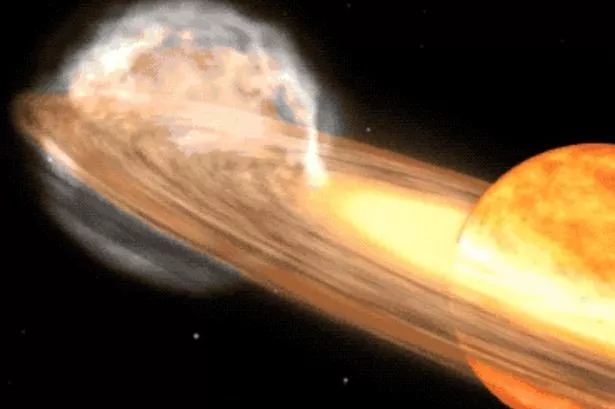 A celestial dance between two stars will result in an outburst so bright, it can be seen by naked eye (Image: PA)
Any day now, a star system 3,000 lightyears away from Earth is set to become visible to the naked eye.
T Coronae Borealis, nicknamed the Blaze Star, is a binary star system made up of a red giant star with a smaller white dwarf star orbiting closely around it.
Every 80 years, the white dwarf – the dense, hot core of a star that is left over after it burns all its fuel – accumulates so much of the other star’s hydrogen that it explodes.
During this spectacular cosmic event, known as a nova, the previously dim star will suddenly reach be bright enough to be visible to the naked eye in the night sky – creating a temporary ‘new star’.
The Blaze Star is expected to jump to magnitude of +2 during this nova event. On the stellar magnitude scale, the higher the number, the fainter the object. Venus, for example, which is the brightest planet in the night sky, has a magnitude of about -4. It would therefore make it similar in brightness to the North Star, called Polaris.
 A nova is an outburst produced by a thermonuclear explosion on the surface of a white dwarf star(Image: NASA)
“Astronomers have been waiting expectantly for light from a distant explosion to reach us here on Earth. An event called a nova is anticipated to occur sometime in the coming months,” NASA said in a YouTube video.
The Blaze Star last brightened nearly 80 years ago in 1946, meaning it is due for another explosion.
Astronomers initially predicted it would brighten again by September 2024, while other research suggested that the star was most likely to explode on March 27 this year.
Writing in the journal American Astronomical Society, Jean Schneider predicted the next eruption could happen March 27 2025, November 10 2025, or June 25, 2026.
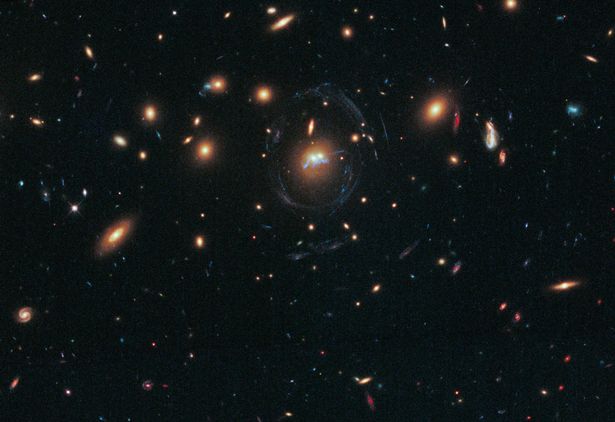 NASA’s Hubble Space Telescope has photographed a dense galaxy cluster constellation Corona Borealis(Image: NASA/ESA)
The paper states: “The investigation is based on the combination of the previous eruption dates and on the orbital ephemeris of the binary system, without any hypothesis on the eruption mechanism.
“Since the last eruption was in 1946, a new eruption is expected soon, from weeks to a few months.”
According to NASA, the stellar explosion is “super rare”.
The space agency added: “Predicting exactly when novas or any sort of stellar outburst will happen is tricky, but excitement began growing when astronomers observed the star to dim suddenly, much as it did right before its previous nova in 1946.
“When the nova finally does occur, it won’t stay bright for long, likely flaring in peak brightness for only a few days. And since it’s not predicted again for another 80 years, you might just want to join the watch for this super rare, naked eye stellar explosion in the sky!”
T Corona Borealis can be spotted throughout the month of May in the eastern sky during the first half of the night.
“You’ll find Corona Borealis right in between the two bright stars Arcturus and Vega, and you can use the Big Dipper’s handle to point you to the right part of the sky,” NASA said.
“Try having a look for it on clear, dark nights before the nova, so you’ll have a comparison when a new star suddenly becomes visible there,” it added.