When it comes to choosing sponsors, pro cyclists aren’t the pickiest bunch. Over the last century, the sport’s pedalling billboard allure has attracted a wide range of backers – some more nefarious than others – willing to exchange cash for publicity, from salami manufacturers and car brands to oil giants, pyramid schemes, and authoritarian regimes.
Still, it’s fair to say that Tadej Pogačar’s new partnership with global cryptocurrency platform KuCoin this week has raised more than a few eyebrows.
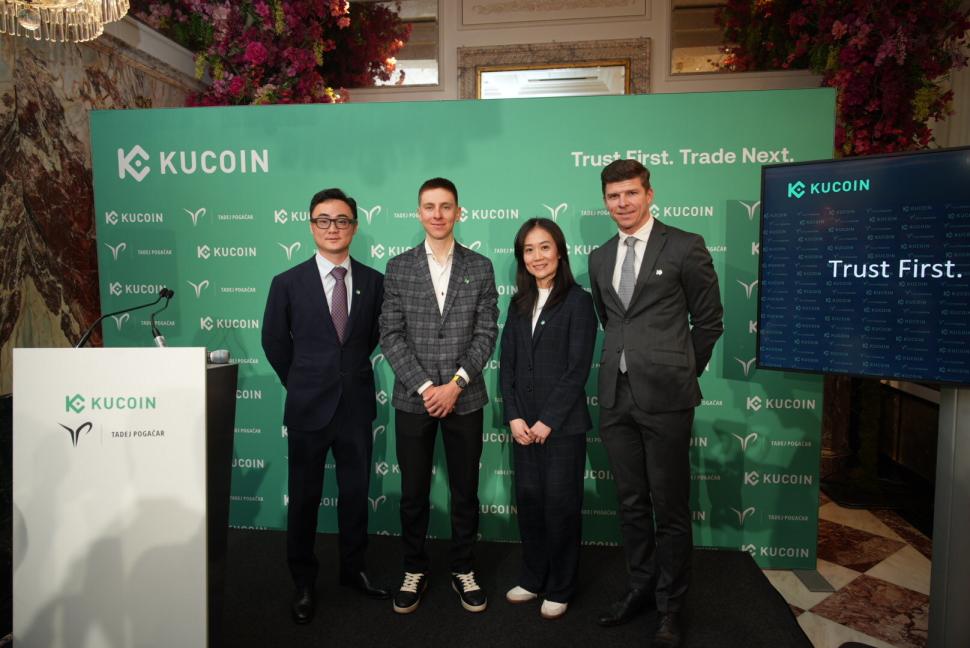
At a launch event in Vienna, attended by some members of the UK’s cycling media, the four-time Tour de France winner was unveiled as KuCoin’s ‘global brand ambassador’, in what the company says is the “first time a top-tier global crypto exchange and a world-class professional cyclist have come together in a value-driven, trust-led partnership”.
Of course, crypto’s involvement in cycling is nothing new. In the early part of this decade, non-fungible tokens (or NFTs) seemed to be all the rage, with everyone from Wout van Aert to Matt Stephens asking fans to shell out some digital, environmentally unfriendly coin for a cartoon image.
Zondacrypto, one of Europe’s largest regulated cryptocurrency exchanges, has backed the Canyon-SRAM women’s team since the start of 2025, while NiceHash sponsors the Slovenian Cycling Federation, appearing pride of place on Pogačar’s green jersey as he inevitably soloes to another world title.
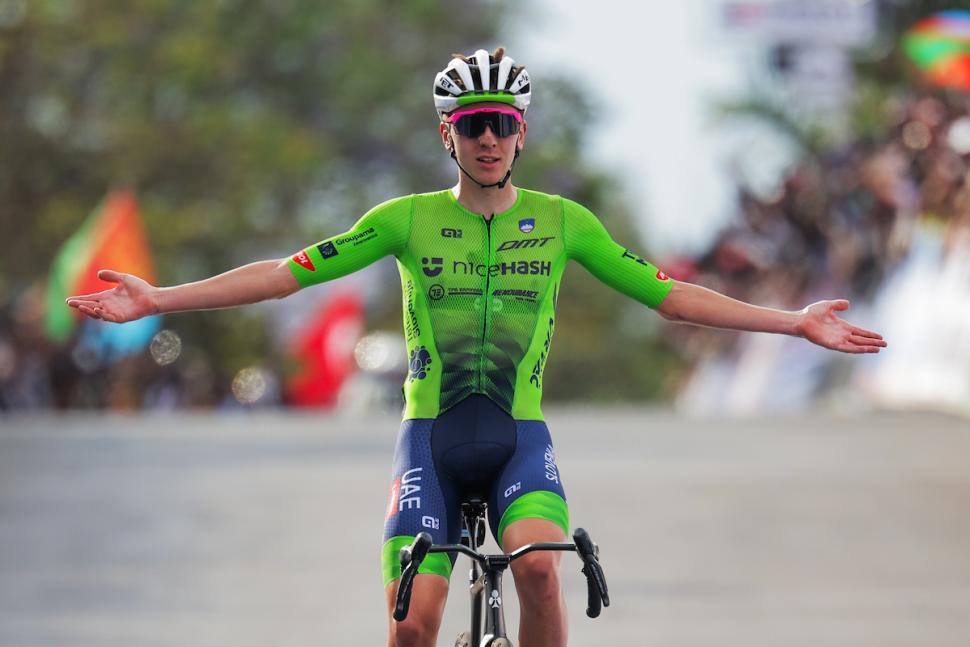 Tadej Pogačar wins 2025 World Championships (credit: Alex Whitehead/SWpix.com)
And Nexthash (yes, they are linked) briefly served as the shadowy, elusive title sponsor of the Qhubeka squad until its collapse in 2021, amid allegations that the company hadn’t coughed up the requisite dough. Team boss Doug Ryder even accused the digital currency company of failing to pay half of what they owed, before simply refusing to answer the phone to him.
> Velon launches “cycling’s first fan universe” – and yes, it involves cryptocurrency
But, according to KuCoin, this week’s deal with the greatest cyclist in the world isn’t like that at all. In their press release, the company says the partnership with Pogačar is built around the theme “Trust, proven by performance”.
The world champion’s global ambassador role, KuCoin says, “reflects a shared belief that trust is not declared, but earned through long-term performance, professionalism, and discipline. Rather than a transactional sponsorship, the collaboration represents a rare alignment of values between two leaders operating at the highest level of their respective fields.”
“At the highest level of cycling, trust is built through preparation, consistency, and a relentless focus on safety,” Pogačar ‘said’ in a statement.
“You earn it over time, through performance and responsible decision-making under pressure. That mindset strongly resonates with how KuCoin approaches trust and security.”
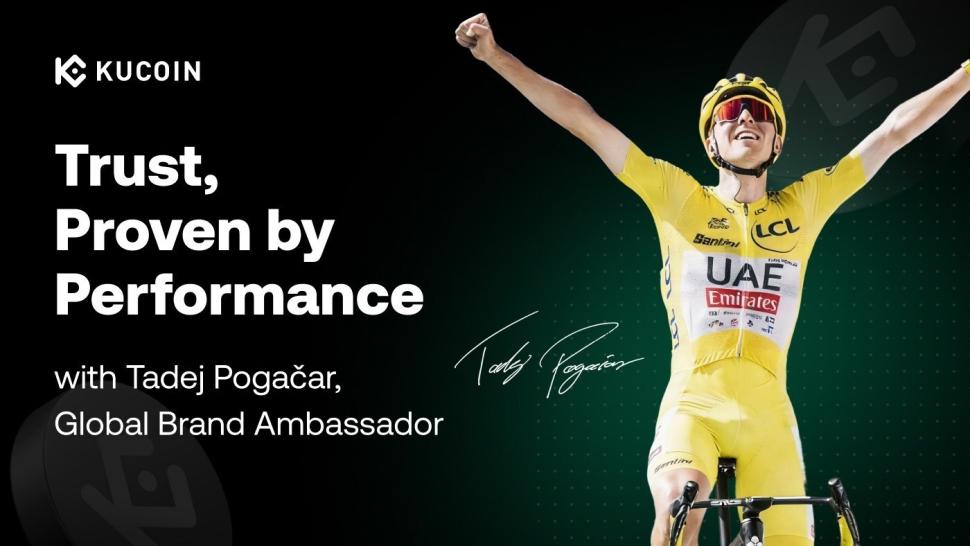 Tadej Pogačar and KuCoin poster (credit: KuCoin)
And KuCoin’s CEO BC Wong added: “This partnership is built on a shared belief that trust is earned through long-term performance and professionalism.
“Tadej represents excellence achieved through discipline and consistency at the very highest level. At KuCoin, we apply the same principles as we continue to strengthen security, compliance, and governance — helping bring crypto to a broader, more mainstream audience.”
Which is all well and good – but what exactly is KuCoin?
Built on trust?
Founded in China in 2017 by Chun Gan, Ke Tang, and Johnny Lyu, KuCoin developed into one of the largest cryptocurrency exchanges in the world, with over 30 million customers and billions of pounds worth of cryptocurrency traded daily.
Its platform allows registered users to trade in a range of cryptocurrencies, including Bitcoin and Ethereum, while also operating its own crypto token, KuCoin Shares.
“For KuCoin, trust has been built over eight years through sustained investment in security infrastructure, regulatory alignment, and operational resilience across global markets,” the company says.
“As regulatory standards continue to evolve, KuCoin has strengthened its compliance framework and governance capabilities, reinforcing its commitment to building a secure and trusted digital-asset platform for a growing global user base.”
However, regulatory alignment, compliance, and trust haven’t always been at the top of KuCoin’s agenda.
Speaking to road.cc, software engineer, writer, and cryptocurrency expert Molly White noted that “like many crypto firms, KuCoin has had no shortage of brushes with regulators in multiple countries”.
Early last year in the United States, the company and two of its founders pleaded guilty to a criminal violation of anti-money laundering laws.
According to the Department of Justice, KuCoin flouted US anti-money laundering laws by failing to implement effective anti-money laundering and know-your-customer programmes (designed to prevent KuCoin from being used for money laundering and terrorist financing) while also failing to report suspicious transactions and register with the Financial Crimes Enforcement Network, despite serving thousands of customers in the US.
The DOJ also alleged that KuCoin handled over $9 billion in illicit and criminal transactions between 2017 and 2024.
“For years, KuCoin avoided implementing required anti-money laundering policies designed to identify criminal actors and prevent illicit transactions,” US attorney Danielle Sassoon said last year.
“As a result, KuCoin was used to facilitate billions of dollars’ worth of suspicious transactions and to transmit potentially criminal proceeds, including proceeds from darknet markets and malware, ransomware, and fraud schemes. Today’s guilty plea and penalties show the cost of refusing to follow these laws and allowing unlawful activity to continue.”
The platform agreed to pay a $300 million fine and withdraw from the US for two years, while the two co-founders also paid fines and left the company under deferred prosecution agreements.
> The angry backlash against NFTs in cycling, and how Bike Club NFT is trying to turn the tide
In 2023 KuCoin paid a $22 million fine and were banned in the state of New York for serving residents of the state without registration, while the year before they also paid a $1.5 million fine to securities regulators in Ontario, Canada for failure to register and offering unregistered securities.
The company was ultimately permanently banned from operating in the province after regulators concluded that they hadn’t complied with the investigation.
And last year, Canada’s national financial intelligence unit FINTRAC fined KuCoin around $14.5 million, again for violations of anti-money laundering and terrorist financing laws.
2025 also saw the platform re-domicile to the unregulated Turks and Caicos Islands, after the Seychelles introduced new legislation that requires virtual asset service providers to obtain a licence to operate legally. That move in September followed two similar relocations, from China and then Singapore, in a bid to avoid more stringent regulatory frameworks.
In the UK, KuCoin was placed the Financial Conduct Authority’s unauthorised firms list in 2023, the government noting that the platform lacked the regulatory approval to provide services in the UK.
Perhaps most worryingly, in September a team of investigative journalists found that KuCoin – described by the journalists as “disgraced” – was linked to a criminal network and crypto empire used to launder $1.5 billion and protected by former Thai prime minister (and ex-Manchester City owner) Thaksin Shinawatra.
According to the reporters at Whale Hunting, the company has connections to an alleged ‘pig butchering’ scam across south-east Asia, involving human trafficking, torture, and forced detention.
Whale Hunter also claimed that Thailand’s Securities and Exchange Commission “has done absolutely nothing” about KuCoin’s control of Finansia X PCL, a licensed Thai broker at the centre of a $1.5 billion Chinese-Cambodian money laundering network.
This, the reporters say, has “staggering” national security implications, with the exchange “potentially facilitating terrorist financing”, along with Cambodian scam centre targeting Americans, all positioned within the legitimate financial system.
KuCoin, Whale Hunting also reported, has been “systematically providing infrastructure” for Iran to evade sanctions “through a network of front companies”. The reporters concluded that the platform operates as a “global gateway” for illicit finance, while potentially funding the Iranian regime.
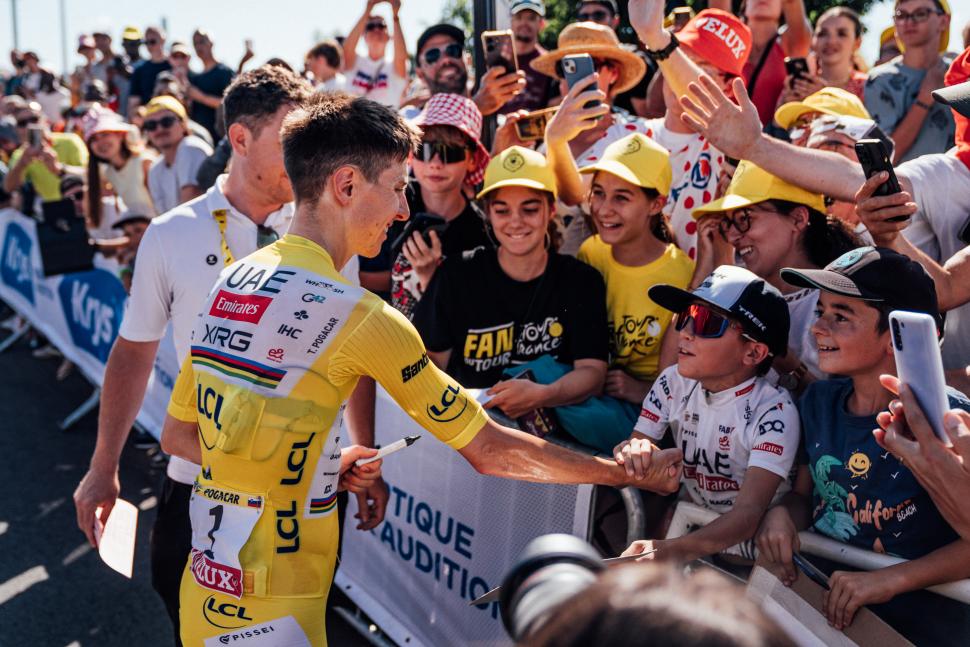 Tadej Pogačar signs autographs, stage nine, 2025 Tour de France (credit: Zac Williams/SWpix.com)
Which is perhaps why KuCoin is so insistent on placing ‘trust’ at the heart of its new partnership with the greatest cyclist in the world.
When asked about the implications of Pogačar’s new ambassadorial role with KuCoin, White linked the deal to the collapse of disgraced “crypto king” Sam Bankman-Fried’s FTX exchange, which was backed by NFL legend Tom Brady and basketball star Steph Curry, as well as comedian Larry David.
“Personally I don’t think it’s appropriate for sports figures to partner with any crypto exchange, regardless of how well run they claim to be,” she told road.cc.
“It’s shades of FTX all over again — at least in the US, Tom Brady and Steph Curry touting FTX as the ‘safe and easy place to buy crypto’ is far from a distant memory. The two of them were later sued by people who believed their advertisements, and lost money as a result.”
road.cc got in touch with Pogačar’s agent Alex Carera to ask him if the world champion knew about KuCoin’s shady past before becoming the brand’s global ambassador and, if he did, why he went ahead with the deal.
“No comment,” came the reply.
We also asked the Slovenian’s UAE Team Emirates squad about the deal and their knowledge of it. We have not yet received a reply.