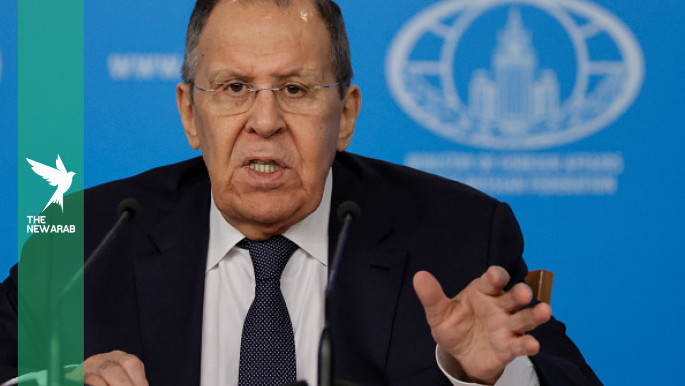
Lavrov’s comments remained vague as to whether Damascus had continued to seek Assad’s prosecution or not [Getty]
Russia’s foreign minister has said the issue of prosecuting Syria’s former president Bashar al-Assad has not been raised for some time, stopping short of confirming reports that Syria’s new authorities have abandoned efforts to put him on trial.
The comments followed reports citing Russian Foreign Minister Sergey Lavrov as saying Damascus had given up on seeking Assad’s prosecution. Saudi-owned broadcaster Al Arabiya quoted Lavrov on Thursday as saying Syria’s authorities had long since dropped the issue.
Speaking to Turkish broadcaster TRT, Lavrov said only that “this issue has not been raised for a long time”, without explicitly stating that Syria’s new leadership had abandoned any attempt to prosecute Assad.
“Our partners are fully aware of the circumstances surrounding al-Assad and his family’s arrival in the Russian Federation in December 2024,” Lavrov added.
Assad, whose family ruled Syria for more than five decades, was ousted in late 2024 after 13 years of war, following a rapid offensive led by Islamist rebels who are now governing the country.
Syrian journalist Rami Jarrah sharply criticised Al Arabiya’s reporting, describing it as inaccurate, but said Lavrov’s remarks still reflected a broader political reality.
Despite the ambiguity in Moscow‘s statements, it remains unclear whether Syria’s new government is actively pursuing Assad’s extradition or whether Russia has rejected any such request.
Syria’s current president Ahmed al-Sharaa and other senior officials have made several visits to Moscow since coming to power, amid reports that Damascus was seeking Assad’s extradition to stand trial in Syria. Sharaa was in Moscow earlier this week, where he met Russian President Vladimir Putin.
Jarrah accused Sharaa’s government of abandoning justice for Assad’s victims and prioritising political rehabilitation instead.
“Sharaa’s government has been taking Syrians for a ride,” Jarrah wrote on X. “The fact that they stopped even raising Assad’s extradition sends a clear message to Russia that they are not concerned with the demands of millions of Syrians, many of them victims of Assad’s killing machine.”
He alleged that Damascus had effectively dropped the extradition issue in exchange for Russian support, including efforts to prevent Moscow from blocking the removal of Syrian leaders from international terrorism lists.
Hayat Tahrir al Sham, the Islamist group that led the offensive which toppled Assad, was formerly affiliated with Al Qaeda and remains designated a terrorist organisation by the United Nations and Russia, despite having that designation lifted by several Western states.
Russia was Assad’s key military backer during the war, helping his forces regain territory lost to rebel groups. Moscow continues to maintain troops at the Hmeimim airbase and the Tartus naval base on Syria’s Mediterranean coast, both of which remain central to negotiations between Damascus and Moscow.
Sharaa, a former jihadist, has sought to pull Syria out of international isolation, restoring ties with several countries and reopening diplomatic missions. However, his first year in power has been marked by ongoing violence and accusations against his government of summary executions and sectarian killings.
In addition to Russia, Turkey, the United States and Israel all maintain a military presence on Syrian territory.