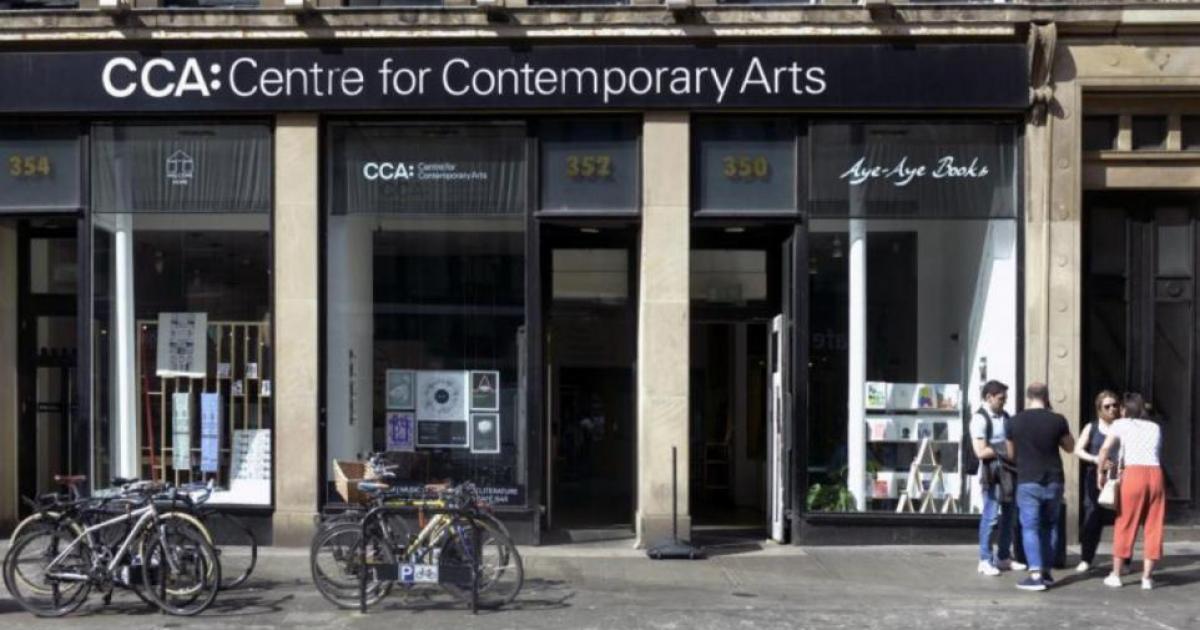
Creative Scotland, which announced £3.4m worth of support a year ago, sold it was no longer able to release funding as the CCA had been unable to demonstrate its “ongoing viability”.
Read more:
An official announcement from the CCA, which was without any senior management and just two board members in recent weeks, blamed “significant financial challenges” for the winding-up decision.
The multi-arts venue has been under prolonged criticism from the Art Workers for Palestine group for refusing to back a cultural boycott of Israel.
Police were called to break up a sit-in protest at the Centre for Contemporary Arts in Glasgow in June 2025.
The CCA has been shut down by its board days after activists were allowed to set up a new “liberated zone” in the venue for a series of weekly protests.
Images which emerged from the demonstration showed a banner calling for Creative Scotland to be abolished had been put on display at the CCA.
Pro-Palestine activists staged a protest outside the CCA in Glasgow last June. (Image: Newsquest)
Creative Scotland, which owns the CCA building, has pledged to explore future options with other partners with the aim of the building re-opening “as soon as is realistically possible”.
Glasgow Life, which runs many of the city’s cultural venues, said it would “work constructively with Creative Scotland to help safeguard the future of this important and historic cultural space”.
A statement issued by the staff of the CCA said they were “deeply concerned” at the way its closure and the winding-up process had been handled.
They also hit out at what they described at “prolonged instability, absent leadership, and repeated governance failures” at the CCA, which has been running since 1992, when it took over the site of the Third Eye Centre.
The statement said also the staff had “worked tirelessly, under sustained pressure” to sustain the CCA, which was previously closed at the end of 2024 over an “increasingly challenging” financial position.
It only reopened last April after securing additional government funding in Creative Scotland’s three-year programme, which increased from £640,000 a year to £832,000 in the current financial year, and was due to go up to £1.28m in 2026-27.
However the CCA closed again less three months later after the police were called in to break up a sit-in protest organised by the Art Workers for Palestine group.
The CCA reopened at the end of August after issuing a statement saying it was “deeply sorry” for the handling of the protest in June and pledged to roll out “meaningful change” across all levels of the organisation.
In October, the CCA pledged to recruit a new board and senior management team, and said it was committed to a “process of reflection, repair and renewal”.
However the venue was plunged into fresh turmoil in recent weeks after the Art Workers for Palestine group announced it would be stepping up pressure for its board and management to commit to a complete cultural boycott of Israel.
The new chair of the CCA’s board, Muse Greenwood resigned earlier this month, just a few weeks after she was appointed, after the pro-Palestine group announced plans to stage weekly protests and set up a “liberated zone” as part of an escalation of their campaign.
Just two board members – Kirsty Ogg and Paola Pasino – had been listed on the CCA’s website in recent weeks, while the organisation has been without any senior management since the departure of interim director Steve Slater, who had also faced calls to resign, in December.
A spokesperson for Creative Scotland said: “We have been informed by the CCA board that they have taken the difficult decision to place their organisation into administration meaning it will, unfortunately, cease to operate.
“As the CCA is unable to demonstrate its ongoing viability and therefore cannot deliver the activity set out in its multi-year funding agreement, Creative Scotland is not able to make further payments. This is in line with our responsibilities as a distributor of public funds.
“We understand how unsettling and upsetting this news will be for everyone working at, and with an interest in, the CCA. As owners of the building at 350 Sauchiehall Street, Creative Scotland will explore future options, alongside other partners, with the shared aim of the centre re-opening as a cultural resource as soon as is realistically possible.”
A Scottish Government spokesperson said: “We understand this decision will be deeply concerning for all those affected.
“The Scottish Government will continue to engage with Creative Scotland on this issue and shares its aim that the centre should re-open as an important cultural asset as possible.”
A spokesperson for Glasgow Life said: “This is deeply saddening news and a real blow for Glasgow’s cultural community.
“Our thoughts are with the staff, tenants, artists, and audiences affected by the CCA’s situation.
“It’s important to be clear that Glasgow Life is not a funder of the CCA and has not, at any point, been involved in formal decision making around the organisation’s governance, financial management, workforce, or day-to-day operations.
“Glasgow Life remains absolutely committed to supporting a thriving, ambitious and inclusive cultural sector across the city.
“As tragic as this development is, it does not diminish Glasgow’s long-term cultural vision or our commitment to delivering the city’s culture strategy and action plan.
“We will continue to work constructively with Creative Scotland to help safeguard the future of this important and historic cultural space.”
The statement from the CCA board said: “Over the past 18 months, CCA has undertaken a structured recovery process to address significant financial challenges.
“Despite the efforts of staff, partners, and the broader community, the organisation was unable to achieve a sustainable financial position.
“The CCA extends its appreciation to its team, audiences, artists, and collaborators for their longstanding commitment, creativity, and support.”
The statement from the CCA staff said: “The acting board has today informed staff of its intention to commence a formal winding-up process.
“They closed the building this morning and informed staff they are no longer employed on a days notice via an online call.
“CCA staff are devastated by this decision. We have worked tirelessly, under sustained pressure, to sustain the organisation in good faith, and we have never wished for the CCA to close.
“Our thoughts are with colleagues, cultural tenants, partners, artists, and communities, locally, nationally, and internationally, who will all feel the loss of this space.
“Throughout a prolonged period of uncertainty, staff have continued to work with restraint and dignity, supporting programmes, tenants, and public activity despite prolonged instability, absent leadership, and repeated governance failures. Many have done so without clarity, security, or meaningful support.
“Staff are deeply concerned about how this decision is being handled. There is currently significant uncertainty around notice, pay, employment protections, and access to HR or pastoral support. For some colleagues, there are also serious implications for immigration status and visas, placing livelihoods and futures at immediate risk.
“While there will be time for scrutiny and accountability, our priority right now is to support one another and all those affected by this decision, with compassion, fairness, and transparency.”
Scottish Green MSP Patrick Harvie said: “Glasgow has an extraordinary cultural scene, but it has faced tough times recently and the loss of the CCA would be a serious blow.
“It has been a hugely important asset for the city, and for the Sauchiehall Street area which has suffered badly in recent years.
“Our first thoughts must be with the staff who face losing their livelihoods, and it’s essential that they are given the support they need. But at a time when Scotland’s public investment in culture is rising, it will be shocking if a solution can’t be found to give this important venue a lifeline.”
The CCA was opened in 1992 at the home of the former Third Eye Centre, which was founded in 1974.
Writers, artists and performers who have shown work or performed there include Allen Ginsberg, Whoopi Goldberg, John Byrne, Billy Connolly, Edwin Morgan, Kathy Acker, Damien Hirst, Sophie Calleite, Nathan Coley, Jacqueline Donachie, Louise Hopkins, Carol Rhodes, Richard Wright, David Shrigley and Ross Sinclair.
The venue has had a number of difficulties over the last decade, including being forced to close for several months due to the impact of the 2018 Glasgow School of Art fire, a long-running dispute over the pay and conditions of workers at its cafe-bar, and “increasingly challenging” financial problems which led to the 2024 closure.