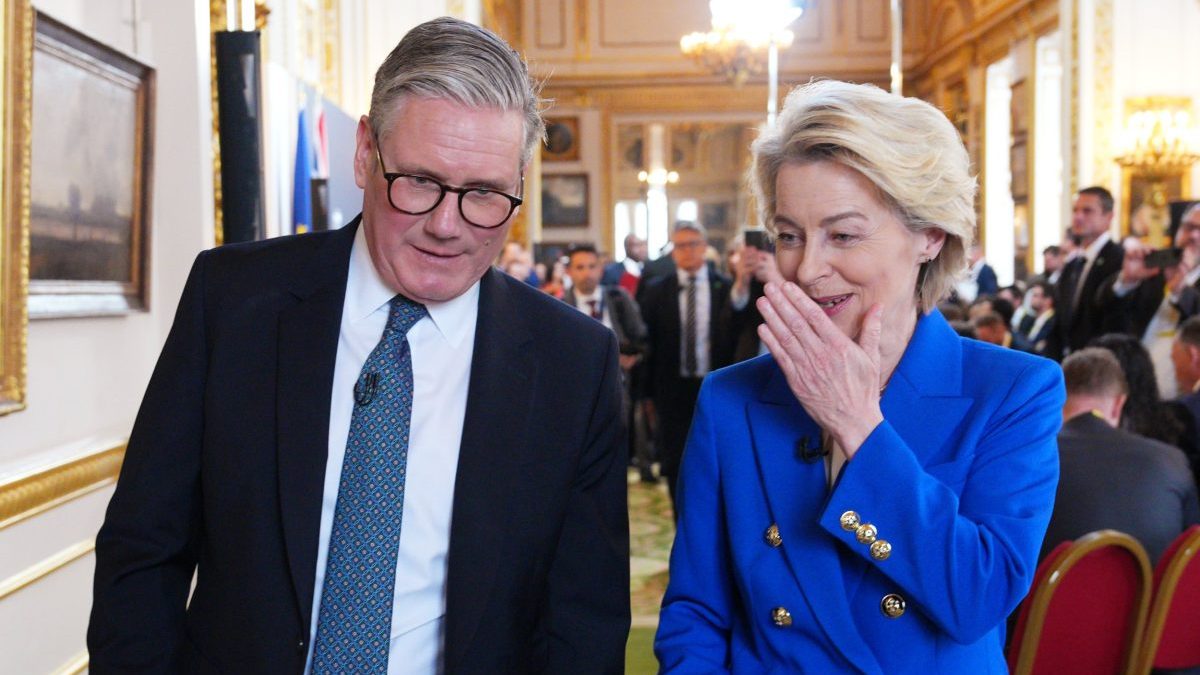
Sir Keir Starmer wants to align UK rules and laws with the EU single market – but risks the wrath of Brexiteers
SHANGHAI – Britain will “go further” in getting close to the EU’s single market, Sir Keir Starmer has promised as he slapped down calls from Cabinet colleagues to rejoin the customs union.
Speaking during his trip to China to drum up trade with the world’s second-largest economy, the Prime Minister said he was committed to doubling down on his “reset” of post-Brexit relations with Brussels.
The UK Government is planning to align its regulations with the EU’s in a handful of areas, including food and drink safety and energy, in order to reduce the scale of checks needed on goods passing between Britain and the continent.
New FeatureIn ShortQuick Stories. Same trusted journalism.
Starmer has made it clear that he wants the next steps to involve further such integration with the single market – rather than going back into the customs union, which would force the UK to abandon the trade deals it has struck with non-EU countries.
Industries seen as the most likely candidates for regulatory alignment include chemicals and cars, which have both been heavily affected by Brexit.
Reducing red tape and trade barriers could lower costs for the UK car industry and improve access for British-made vehicles to the European market, where many are sold. Regulatory certainty could also make the UK car industry more attractive for investment.
But some Brexiteers argue that aligning more with the single market is a mistake because it means giving up the right for the UK to set its own regulations.
A system of “dynamic alignment” would see Britain automatically changing its own rules on certain categories of goods whenever the EU changes its legal regime.
While some businesses are keen to see closer alignment with Brussels, others – including City banks – believe that the UK is better off outside the EU’s legal orbit because it can set regulations that are tailored for the British economy.
The Prime Minister said: “On the customs union, it’s not that it might hamper trade deals, it’s that we’ve already done trade deals, which would then have to be unpicked.
“We’re not starting from a position where we haven’t got deals. We’ve got important deals, and I don’t want to unpick those deals now, and that’s why I don’t think the customs union is the right way forward.”
He added: “I do think that we’ve made progress on the single market – food and agriculture is already in the SPS agreement that we have already agreed and that’s going to be implemented. That’s an agreement which will bring cheaper prices in our supermarkets.
Your next read
“I think we should not just follow through on what we’ve already agreed. I think the relationship with the EU and every summit should be iterative. We should be seeking to go further. And I think there are other areas in the single market where we should look to see whether we can’t make more progress. That will depend on our discussions and what we think is in our national interest. But what I’m indicating here is – I do think we can go further.”
Experts have previously cast doubt on ministers’ claims that they will be able to reach more deals with Brussels in the future. The EU has always indicated that it is unlikely to give the UK special treatment, because of the risks that it would encourage other member states to consider leaving.
Starmer said the UK remained committed to setting up a youth mobility scheme with the EU, which will allow under-30s to travel freely for temporary work, but warned that “there has got to be a cap and there has got to be a duration agreed”.
The Times reported on Friday that British negotiators were proposing a “balancing mechanism” that could see the youth mobility scheme expand above any cap, in a bid to reach a compromise with the EU, which wants no hard limit on the numbers who could be granted visas.
The i Paper has previously reported EU sources indicating a willingness to agree a cap as long as there was a mechanism for regular reviews to see if the scheme could be expanded in future.
And he promised that the “one in, one out” deal to swap asylum seekers with France, which is designed to deter migrants from crossing the Channel in small boats because they know they will be sent back, would “ramp up” over time.