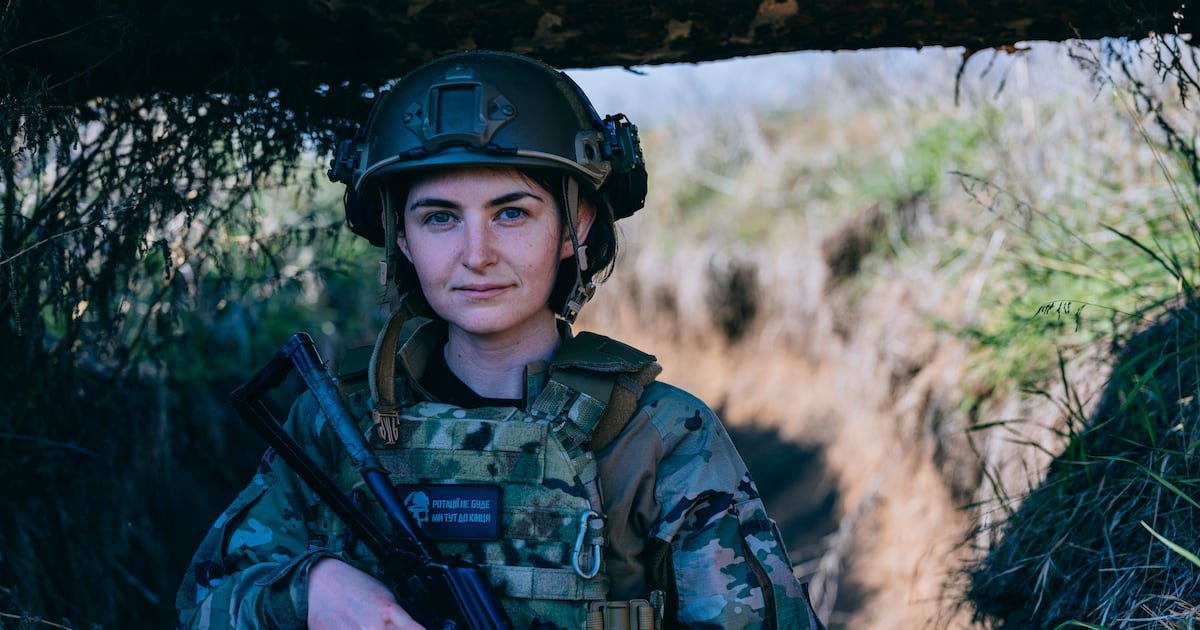
Lieut Yulia Mykytenko’s sad, beautiful face appeared in flickering candlelight on a screen in the Centre Culturel Irlandais. I wrote a book and a column for this newspaper with the Ukrainian army officer. On Tuesday night, she and I participated in an event organised by the CCI as part of France’s official Ukrainian season.
There was no electricity in Kyiv, where Mykytenko was visiting her mother. “I hope you’re warm enough,” she told the audience with a sardonic smile. “It’s -4C here. It was -20C a few days ago.”
The Financial Times had reported that morning that US president Donald Trump is exerting maximum pressure on Ukraine’s president Volodymyr Zelenskiy to withdraw from the approximately 25 per cent of the eastern province of Donetsk which Ukraine still holds.
Zelenskiy is the victim of a double blackmail: Russia will not stop killing civilians, and Trump will not provide security guarantees, unless the Ukrainian leader relinquishes Donetsk.
Russia already occupies virtually the entire neighbouring province of Luhansk, which with Donetsk comprises the Donbas region. Mykytenko has spent six of her 10 years in the Ukrainian army in Donetsk. Her husband, also a soldier, was killed there by Russians in 2018.
Could she accept the loss of Donetsk in exchange for a peace agreement, I asked. “I am not an official. This is my personal point of view. It’s a very complex and painful question,” she stressed.
Russia would use Donetsk as a base for further aggression, Mykytenko predicted. Ukraine needs strong guarantees that Moscow will not attack again, as Russians have done regularly for more than 300 years.
“It’s not a secret that our troops are extremely exhausted,” she explained. “We’ve been on the front line for four years since the full-scale invasion, and some of my brothers-in-arms had already spent six years in combat.”
She stressed yet again that she spoke only for herself. “I know how painful it is for people from the region, but for now, I cannot see any other way.”
Mykytenko commands a 25-strong drone unit amid the “fortress cities” of Donetsk, which Russia has been unable to conquer. “I am thinking about my comrades in the dugouts who are struggling and freezing and dying,” she said.
Yulia Mykytenko is the bravest person I know. She received a medal for courage from Zelenskiy. No one has sacrificed more for Ukraine. But at some point, grief and exhaustion dented her fighting spirit. In December, one of the drone pilots she calls “my boys” took his own life.
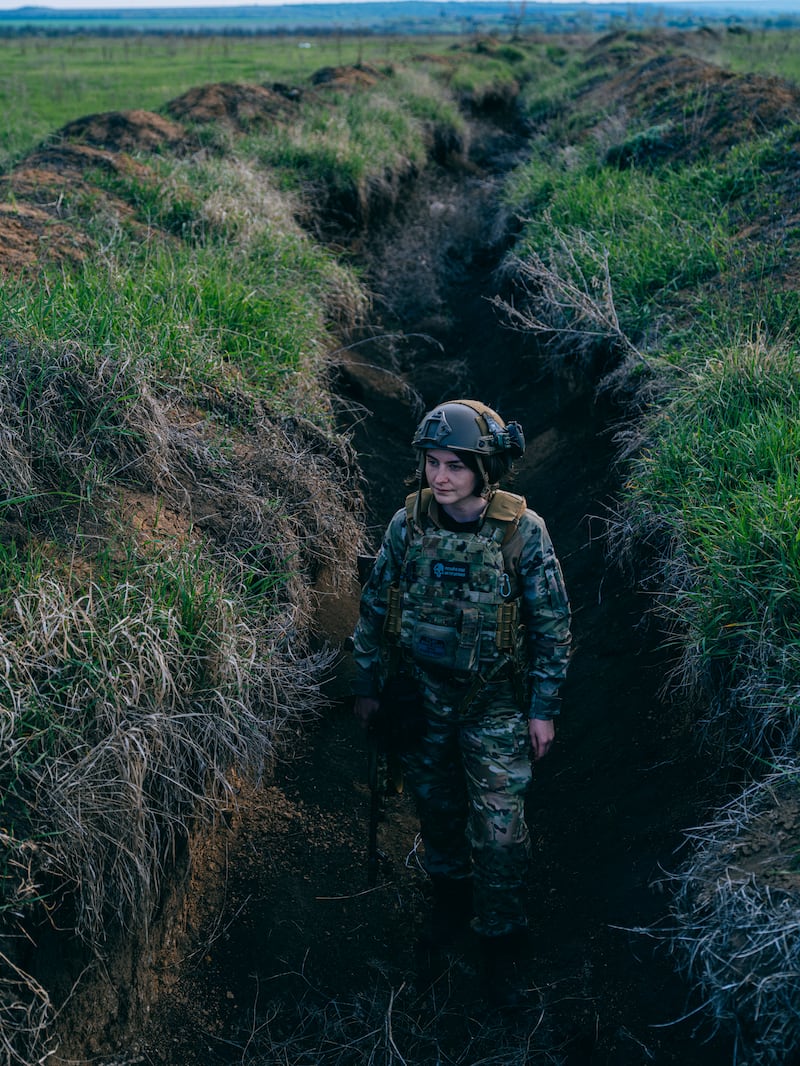 Lieut Yulia Mykytenko: ‘Ukraine is alone, fighting Russia with our blood’
An estimated 250,000 Ukrainians still live in free Donetsk. If the territory is given to Russia, many will flee. Ukraine’s defence minister Mykhailo Fedorov said this month that 200,000 Ukrainian soldiers had deserted, and two million men had evaded conscription. Ukraine killed 35,000 Russian invaders in December. It would have to kill 50,000 monthly to keep up with Russian mobilisation.
The most important security guarantee would be European soldiers on the line between Ukrainians and Russians, Mykytenko said. But France and Britain, the only countries that have expressed willingness to send troops, demand an uncertain US “backstop” and want to deploy their soldiers in safe cities.
In the second World War, Mykytenko continued, the allies triumphed by uniting. “But Ukraine is alone, fighting Russia with our blood. The only way to win this fight is to be together, because we are tired, we are struggling, we are spending our last strength.”
[ Ukraine’s Zelenskiy blames Europeans for air defence gapsOpens in new window ]
A current of shared emotion passed through the audience, who applauded the beleaguered 30-year-old woman speaking to us from frozen Kyiv. We Europeans should hang our heads in shame, said an ageing French industrialist.
Trump’s chief negotiator, Steve Witkoff, said on Thursday that talks between Ukraine and Russia will resume “in about a week”. Zelenskiy and US secretary of state Marco Rubio say Washington and Kyiv have agreed on security guarantees, though Rubio says Russia may not accept them.
Russia violated the Budapest Memorandum and the Minsk accords. In the hope of strengthening whatever security guarantees he obtains, Zelenskiy insists they must be ratified by the Verkhovna Rada – Ukraine’s parliament – and the US Congress.
Last May, US vice-president JD Vance said Ukraine could not be expected to give up territory that Russia had not conquered. That changed with the August 15th Trump-Putin summit in Anchorage. The Kremlin insists Trump promised in an “Anchorage formula” to force Zelenskiy to give up all of the Donbas.
The White House says Trump agrees that Ukraine should give up Donbas, but that he would not strong-arm Zelenskiy. A Trump adviser told The New York Times that “the real estate guys” – for which read Trump, Witkoff and Jared Kushner – “look at it as, ‘OK we’ve agreed on all the other terms of the deal, but we’re fighting over the trim, we’re arguing over the doorknobs’.”
This is the coldest winter in Ukraine for a decade. Russia commits daily war crimes through its relentless attacks on civilians. It fired drones on a passenger train on Tuesday, killing five people. Trump claimed on Thursday evening that Putin had agreed in a telephone call to suspend attacks on Kyiv and other cities for one week, as temperatures are expected to drop below -25C.
Opinion polls show that, although they desperately want peace, a majority of Ukrainians do not want to give up Donetsk. But civilians too are exhausted. Zelenskiy is an able communicator, and he might be able to convince them that the sacrifice is necessary.
If, in the coming days or weeks, Russia and Ukraine conclude an agreement involving the surrender of Donetsk, there will be noxious triumphalism in Washington and Moscow. Trump will renew demands for a Nobel Peace Prize. Putin will claim to have regained historic Russian lands.
The real heroes of this shameful saga will be the millions of Ukrainians who withstood years of death, danger and deprivation, and who must now live with an open wound, the Russian occupation of 20 per cent of their country. But for as long as there is an independent, sovereign state of Ukraine, it will be a victory for Kyiv and a defeat for Russia.