His photographs document a changing Glasgow, warts and all, and some of the best have been collected together for a new book, Glasgow in the 1960s and 1970s, published by Stenlake.
John grew up in a tenement on Clarkston Road and from his window, he could see trams, motor buses and steam trains as well as horse-hauled bread vans and coal lorries.
“I went to Holmlea Primary, from which I could see part of the Holm Foundry and a clothing works building known locally as Dexter’s,” he recalls in his introduction to the book.
Glasgow in the 1960s and 1970s in photographs (Image: ledoo)
His fascination with transport and industry never waned, and as he travelled to high school, firstly by tram and then trolleybus, he marvelled at the sights and sounds of Govan Iron Works and watched the growth of the North British Locomotive Company as he passed by its Queen’s Park works.
During his summer holidays from university, he worked with the North British Locomotive Co, at a ship-breaking yard in Dalmuir, and in the dyeing lab of J and P Coats in Paisley.
John became a much-respected industrial historian and author, and while now retired, remains intrigued by the way Glasgow has grown and developed.
Here are five of the most compelling pictures from his new book.
The White Tower Restaurant c1970 (Image: John Hume)
The White Tower Restaurant sat at the corner of Gallowgate and Spoutmouth in the city’s East End.
This ornate little building has long since been demolished, part of the renovation of the area.
In the 70s, it was already showing signs of wear and tear, but it and its neighbour, the Loch Erne bar, were popular haunts.
Queen Street Station c1967 (Image: John Hume)
Queen Street Station has recently enjoyed a multi-million pound revamp, but here it is pictured in its late 1960s and early 1970s heyday.
The taxi rank stretched all the way up Dundas Street, and you can just see behind it the carriage entrance built by the Edinburgh and Glasgow Railway in 1855.
Bain Street pipe works 1966 (Image: John Hume)
In the 19th century, tobacco was generally smoked in clay pipes.
These clay pipe works on Bain Street,pictured in 1966, made the pipes by hand, fired in kilns sited between the two workshops.
Partick Engine Works (Image: John Hume)
The former Partick Engine Works on Dumbarton Road, pictured here in 1987, specialised in making weighing machines.
Hiding behind the modern entrance block provided for its conversion into a bingo hall, the original engine works is still there, obscured by later street-front buildings.
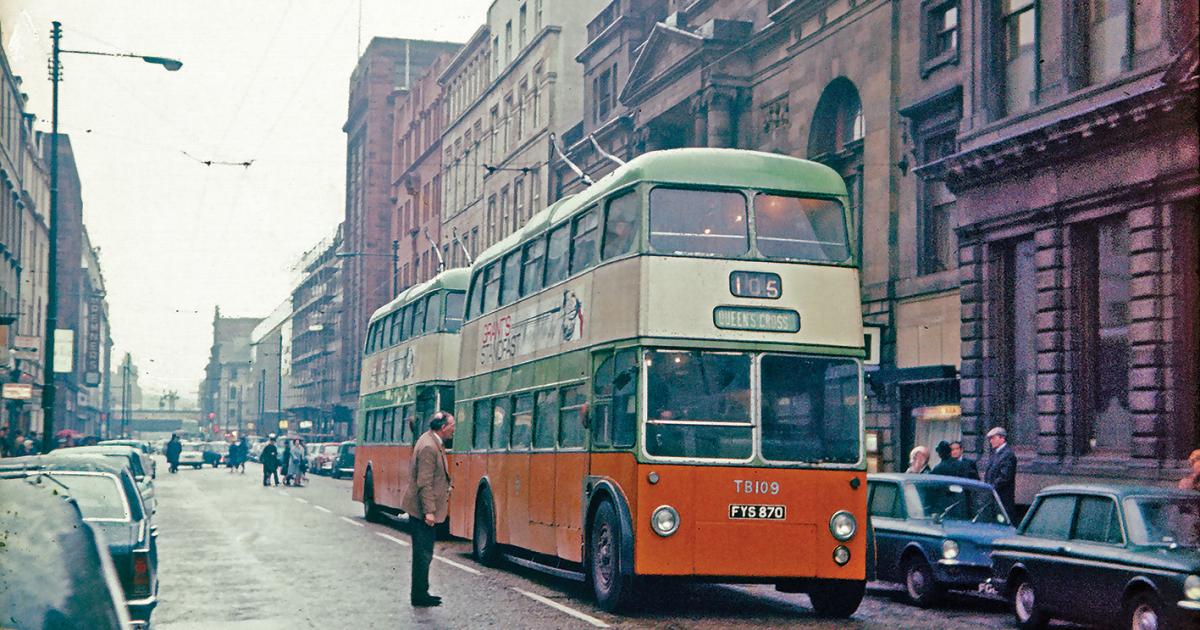
After World War Two, Glasgow began replacing trams with trolleybuses, mainly outside the city centre.
These two, in the distinctive orange, green and cream livery of the city in the main image above, are pictured in the 60s in Glassford Street.
By the late 1960s, the trolleybuses were being replaced with motor buses.