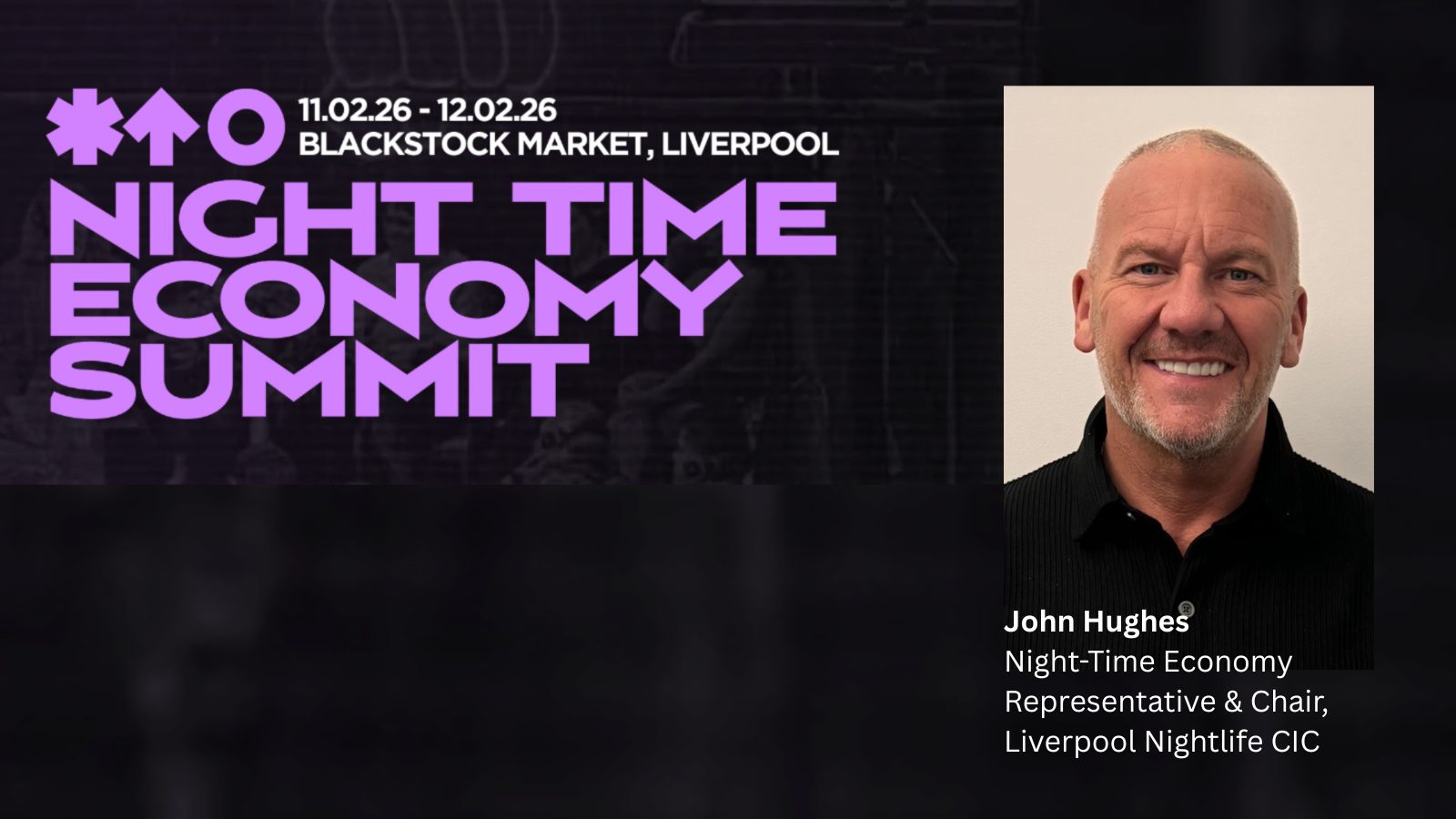
Few people understand Liverpool City Region’s night-time economy as instinctively as John Hughes. A lifelong Scouser and a figure who has worked in the sector for more than four decades, John speaks about nightlife not as an abstract policy area, but as something lived, breathed and felt on the streets of the city every night of the week.
As Liverpool prepares to host the global Night-Time Economy Summit (Wednesday 11 and Thursday 12 February at Blackstock Market), John will be speaking at the event, putting the Liverpool City Region’s approach to nighttime economy safety, partnership and growth firmly in the international spotlight.
We caught up with John to talk about why nightlife matters, what makes Liverpool special after dark, and where the sector goes next.
John, you’ve worked in Liverpool’s night-time economy for decades. What drew you to this role and what keeps you motivated?
“Liverpool’s always lived off the night-time economy. Anyone who knows the city knows that after six o’clock, that’s when it really comes alive. It always has done.
“What keeps me motivated is the people. You speak to visitors on the streets and they tell you straight, they love coming here, they feel safe, they’ve had a brilliant experience and they can’t wait to come back. That matters.
“This sector is also about jobs. Hospitality is the third biggest employer in the country. For a lot of young people, it’s their first step into work. They learn confidence, communication, how to deal with people face to face. In a world where kids grow up on phones, that human interaction is priceless.
“Liverpool city centre is one of the best places in the country to work, visit and live, and the night-time economy is a massive part of that.”
Why is the night-time economy so important to Liverpool City Region’s visitor economy and identity?
“There’s still a perception that holidays and visitor economies are about daytime attractions only. Museums, galleries, family activities. They’re important, of course, but nights are just as important, sometimes even more so.
“Visitors spend money in the evening. Restaurants, bars, clubs, live music, late-night culture, that’s where a huge amount of economic value is generated. It keeps people in the city longer and it shapes how they remember their trip.
“Liverpool’s identity is social. People here love to go out, meet people, dance, talk, have fun. That warmth, that friendliness, that energy, it’s what visitors talk about when they leave. You don’t get that without a strong, well-managed night-time economy.”
Liverpool has retained Purple Flag status again. What does that mean, and why is it so important?
“Purple Flag is about recognising excellence between 5pm and 5am. It looks at safety and transport, the variety of venues on offer and how a city manages its night-time environment.
“Liverpool retaining Purple Flag for the 16th year running says a lot. It tells visitors, investors and residents that this is a city that takes nights seriously and does them well.
“What I’m really passionate about now is extending that thinking across the wider Liverpool City Region. We’re working with partners to make the whole region safer, stronger and better connected at night. My ambition is for Liverpool City Region to be the first region in the UK to achieve Purple Flag status across the board, not just the city centre.”
Safety is often the first thing people ask about nightlife. How is Liverpool addressing that?
“Every major city has crime. The difference is how a city works together to reduce it and respond to it.
“In Liverpool, venues, the council, police, health services, community groups and Liverpool BID Company, in particular, work in partnership. That includes first aid and bleed control training for staff, CPR training, radio networks, pub watch schemes and student safety initiatives.
“None of this is about fear. It’s about preparedness and professionalism. When people feel safe, they relax, they enjoy themselves and they come back. That’s good for everyone, businesses, workers, visitors and residents alike.”
How do venues and operators play their part in creating safer, better nights out?
“Venues here really care. There’s a strong sense of collective responsibility. Operators talk to each other, share information and support one another.
“Liverpool’s night-time businesses understand that safety and enjoyment go hand in hand. A well-run venue isn’t just good for that business, it lifts the whole city. That culture of working together is one of our biggest strengths.”
Transport is often raised as a challenge for late-night visitors. What still needs to change?
“Transport has improved, but I’d love for it to go further. Clubs and venues are open later, but public transport hasn’t fully caught up yet.
“I’d like to see trains running until 2.00am. That would make a huge difference to safety, dispersal and accessibility. London has the Tube. We need solutions that work for Liverpool City Region.
“If we want people to enjoy nights responsibly, we have to give them safe, reliable ways to get home.”
Liverpool is hosting the Night-Time Economy Summit this February. Why is this such an important moment?
“It’s massive for the city region. The summit brings together voices from across the UK and internationally, operators, policymakers, police, performers, government and more.
“Liverpool is the perfect place to host it because nightlife is in our DNA. We don’t just talk about the night-time economy, we live it.
“I’ll be speaking at the summit about Liverpool City Region’s safety initiatives and Purple Flag status, and why partnership working really does deliver results.
“If you’re a visitor economy professional, a venue operator, a policymaker or anyone with a stake in how cities work after dark, this is an event you should be at.”
Finally, what’s your vision for the night-time economy over the next five years?
“I want the sector to be better understood and more valued. When city leaders spend time out at night, meeting operators and seeing the work that goes into keeping the city safe and vibrant, it changes perspectives.
“We’ve already seen that engagement grow, and I want more of it. The night-time economy isn’t an add-on, it’s a core part of Liverpool City Region’s success.
“In Liverpool, we know how to do this properly. The city is welcoming, confident and not only open to new safety initiatives and collaborative working, but also leading nationally in this critically important area of work. We’re determined to deliver fantastic and safe nights out for all and we’re making incredible progress. Now it’s about building on this and showing the rest of the world how it’s done.”
John Hughes will be speaking at the Night-Time Economy Summit, taking place at Blackstock Market, Liverpool, on 11–12 February 2026. The summit will bring together global leaders, businesses and policymakers to shape the future of nightlife. Liverpool City Region visitor economy professionals are encouraged to attend.