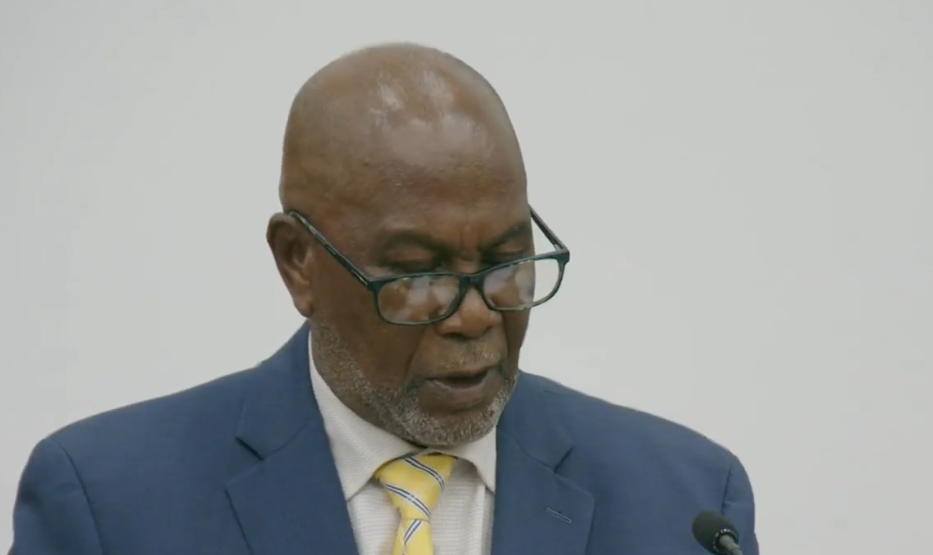
Deputy PM St Clair Leacock, in making his contribution to the 2026 budget estimates, said for years the fiscal health of St. Vincent and the Grenadines has been treated as a manageable concern, but the 2026 estimates have stripped away the veneer.
The national debt now sits at a gargantuan $3.5 billion, resulting in a debt-to-GDP ratio of approximately 103%. In the cold language of economics, that is a crisis; in the language of the street, it is a drowning. Leacock said the shift toward Public-Private Partnerships (PPPs) is no longer a trendy policy choice or a neoliberal preference—it is a desperate necessity for a state that has exhausted its ability to borrow.
The gravity of this situation was laid bare through a chilling analogy of a nation trapped in a water tank. “We are told the water has risen from the ankles, to the shins, to the chest. Today, the reality is that the water is right below our lips. If we only shake the tank, we start to drink it.”
“At 103%, we aren’t just near the limit; the truth be told, we kind of drowning”, Leacock said.
Perhaps the most “shameless” revelation of the debate was the state of the Ministry of National Security—an inheritance described as a wreckage of neglect.
While politicians posture about law and order, the men and women tasked with maintaining it are living in conditions that defy the dignity of their office.
“We aren’t just talking about aging buildings; we are talking about a systemic collapse of basic infrastructure. The Montrose police station was recently shuttered by the Public Health Department because sewage was literally leaking into the kitchen’s food preparation areas”.
The imagery shared from the barracks is nothing short of a national scandal. In a country aspiring to modern development, female officers are forced to sit on toilet bowls that lack seats, while others sleep on mattresses on the floor because their beds were shipped off to training schools years ago and never replaced, Leacock stated.
The Deputy PM recounted the heartbreaking sight of a “female standing with the mattress in their hand,” waiting for a place to lay her head in a room where termite-infested bedposts crumble at a touch.
“This squalor is the “deplorable” legacy of a 25-year regime that, as the new administration points out, seemingly never set foot inside the Ministry to see the human cost of their “bricks and mortar” obsession”.
Leacock told the parliament to navigate this wreckage, the new administration has adopted a specific political narrative: Government as a “baton race.” By framing governance as a relay rather than a sprint, the leadership is acknowledging that they have inherited a “course” already in progress—one filled with the hurdles of high debt and crumbling institutions.
“This “baton race” philosophy serves two purposes. First, it provides a shield against the criticism of slow progress, reminding the public that “Rome wasn’t built in a day” and that they are only two months into a monumental cleanup job”.
The new administration must maintain the momentum of the state while simultaneously steering it away from the “imminent death trap” left by the previous runner.
Leacock said for a generation, Vincentian politics has been dominated by the cult of the capital project.
“If you built a pier, you were a builder of nations. But the 2026 debate signals a sharp, cynical turn away from this “bricks and mortar” obsession. You cannot eat a pier, and you cannot sleep in a spreadsheet. A $1 billion port in Kingstown is a grand achievement on paper, but it serves as a bitter backdrop for the citizens in Paul’s Avenue or Edinburgh who still live with “blocks on the house roof” to keep the galvanized sheets from blowing away”.
The new administration is dismissing the old “sky is the limit” rhetoric as a “long time story.” Instead, they are “peeping beyond the skies” to address the “existing contradictions” of the economy.