Fretwork have been an established presence on the Early Music scene for 40 years now, but as Music in the Round’s guests for this Sheffield concert they demonstrated that niche labels are definitely a misnomer these days. The evening was built around what is absolutely core repertoire for a viol consort, and these five players embraced the distinctive sound world of music for these instruments by Henry Purcell, William Byrd, Orlando Gibbons and more with an ease born of decades of familiarity with its codes and conventions. Yet a concert titled ‘Take Five’ not only promised us five performers but hinted that music associated with the Dave Brubeck Quartet might also feature… as indeed it did, along with modern viol music by Orlando Gough and arrangements for these forces of works by Debussy, Radiohead and Kate Bush.
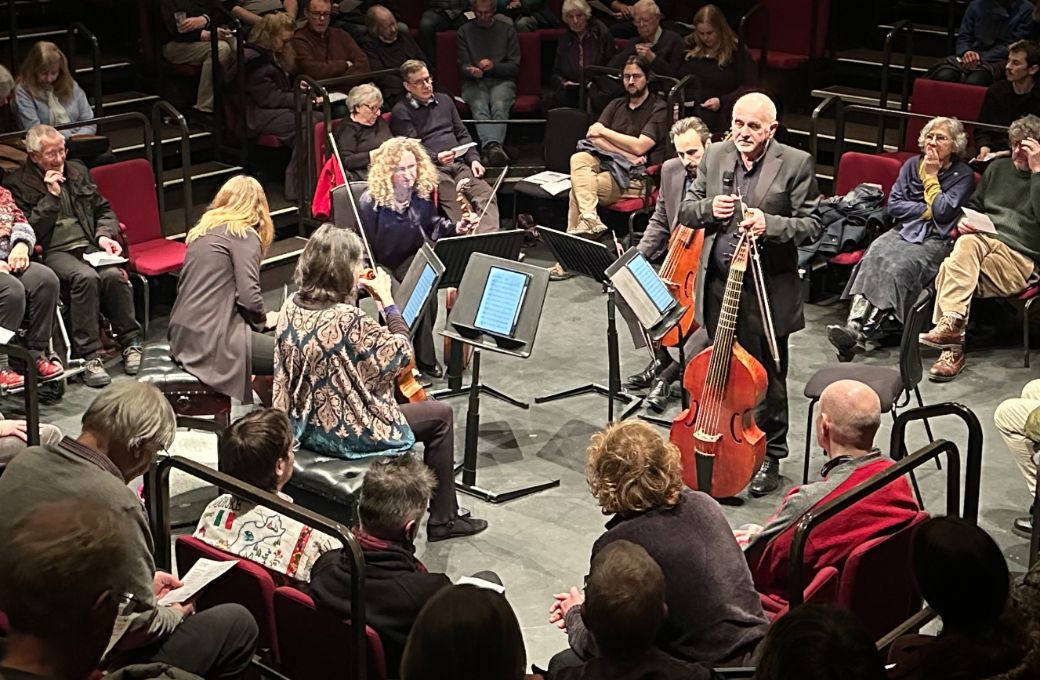
Fretwork
© Music in the Round
To take the genuinely Renaissance material first, the programme featured examples of both In Nomines and Fantasias from the 16th and 17th centuries. Born out of the melodic line in the Benedictus of John Taverner’s Gloria Tibi Trinitas mass setting, the In Nomine was a distinctively English musical genre, all settings sharing Taverner’s melody as a cantus firmus, around which wound lines of often increasingly ornate counterpoint. Fretwork brought us three such pieces, one by Weelkes and two by Gibbons, and the startling contrast between the Gibbons pieces – one stately and sonorous, the other almost ecstatic in its complex interweaving of scurrying lines – revealed much about the diversity of this music. The Fantasy, meanwhile, showed itself as a vehicle for musical games-playing. Byrd’s Fantasia “2 parts in 1 in the 4th above”, in which tenor and bass viol wove patterns in strict imitation, and Purcell’s Fantasy upon One Note, in which the bass viol underpins the music with a single drone throughout, were both intellectual exercises and proof that self-imposed constraint is no barrier to the creation of music of deeply satisfying beauty.
But this was a programme playing games of its own. One substantial segment consisted of pieces which were all written with five beats to the bar. Tye’s Trust (“Trust that everyone can count!” as Fretwork’s founder member Richard Boothby said) was the stepping off point for music by Radiohead (Everything in its Right Place, artfully arranged by Ewan Campbell), John Baldwin’s extraordinarily mathematical Proporcions to the minum: five minums, in which note lengths were halved, then halved again, then halved once more, and finally Paul Desmond’s Take Five – but not as we know it, but in Jonathan Rees’ imaginative arrangement, in which, embedded in the jazz standard, was the In Nomine melody that had featured elsewhere in the programme.
Not all the group’s arrangements worked with equal felicity, even if Fretwork are to be commended for their wit and imagination. Debussy’s La Fille aux cheveux de lin had its internal contrasts ironed out too much, and Sally Beamish’s arrangement of Kate Bush’s Running Up That Hill was similarly rendered overly homogenous. The best of these pieces were those composed with no specific forces in mind: Bach’s Pièce d’Orgue, BWV572 (but then, Bach always sounds perfect whatever the instruments playing it) and Arvo Pärt’s Fratres, in which a tolling bass ostinato perfectly challenged the higher voices’ agitated distractions. And the concert also included one authentic modern viol piece, the first movement of Orlando Gough’s Birds on Fire, written specifically for Fretwork. It sounded precisely what it was: a modern work for musical forces 500 years in the making, and wearing that history lightly but compellingly.
****1