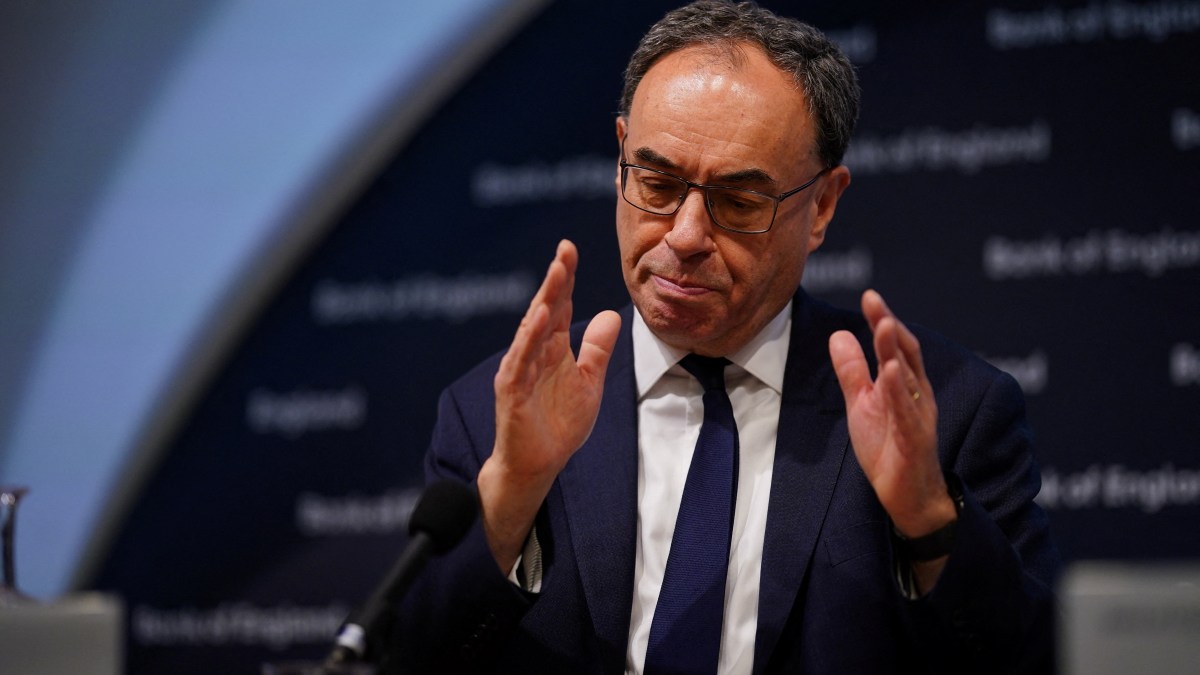
The Bank of England left interest rates unchanged at 3.75 per cent today despite predicting that inflation would be within touching distance of the official target by April amid a “lacklustre” economy and rising unemployment.
The monetary policy committee (MPC), the nine economists who set the base rate in the UK every six weeks, voted 5-4 in favour of keeping borrowing costs at 3.75 per cent. The vote split was much narrower than City analysts expected.
Measures in Rachel Reeves’s budget are anticipated to “weigh” on inflation in the first half of this year and help to drag it down to 2.1 per cent in the spring, from 3.4 per cent. The Bank of England is mandated to keep inflation at 2 per cent.
Andrew Bailey, the governor of the Bank of England, hailed the expected decline in inflation as “good news” but added that the central bank had to leave rates unchanged to “make sure that [it] stays there”.
The governor added: “All going well, there should be scope for some further reduction in Bank rate this year.”
Financial markets think that the Bank will lower rates twice this year, with the first cut likely coming at one of the March or April MPC meetings.
Meanwhile the pound fell sharply and UK government borrowing costs fluctuated as investors digested a renewed risk of Sir Keir Starmer facing a challenge to his premiership.
Sterling dropped by nearly 1 per cent to $1.35 and UK sovereign bond yields rose during morning trading amid fresh speculation that Starmer could be hit by a Labour leadership challenge for appointing Lord Mandelson as Britain’s ambassador to the US despite the peer’s links to Jeffrey Epstein.
During early exchanges, the yield on the benchmark ten-year UK government bond rose by 0.06 percentage points to over 4.6 per cent.
However, the rise in government borrowing costs was arrested in the afternoon after the news that the Bank was leaving interest rates unchanged.
Analysts at Pantheon Macroeconomics, a research outfit, said that they now expected the Bank to bring forward a quarter-point rate cut from April to March.
James Smith, a developed markets economist at ING, the Dutch bank, said that the narrow vote split and downgrade to the inflation forecasts “unquestionably boosts the chance of a March rate cut”.
• From Labour to Reform, bosses have ‘lost trust in all politicians’
The narrow vote split, the third meeting in a row in which the interest rate decision has come down to a single vote, reflects the fact that the Bank of England is closing in on the level of interest rates that it believes is optimal for the UK economy. Rates were lowered four times last year from 4.75 per cent.
New economic forecasts produced by the Bank of England on Thursday claimed that the budget would cut inflation by 0.5 percentage points, mostly via a reduction in household energy bills after Reeves removed some green levies from payments. The chancellor also froze rail fares for the first time in 30 years and delayed an increase in petrol taxes.
The Bank of England said that “the risk of greater inflation persistence is judged to have continued to diminish” after the budget.
The central bank added that the impact of the £25 billion rise in employers’ national insurance contributions on the labour market has now “faded” and that the 4.1 per cent rise in the minimum wage in April will have a “negligible” effect on wage growth.
However, unemployment is set to climb to a peak of 5.3 per cent this year, up from a near five-year high of 5.1 per cent currently. The growth forecast for 2026 was downgraded to 0.9 per cent from 1.2 per cent previously.
London-listed stocks remained subdued, with the FTSE 100 ending the day down 93.12 points, or 0.9 per cent, to 10,309.22.
A survey of the views of businesses up and down the UK compiled by the Bank of England found that they saw the economy as “lacklustre” amid “subdued” consumer and investment spending.
Five MPC members voted to leave rates unchanged at 3.75 per cent, including governor Bailey, who said that he needed to see more data proving that inflation and wage growth would decline further before voting to cut borrowing costs. Bailey has cast the deciding vote at each of the past three MPC meetings.
• Most bosses expect pay growth to stabilise or increase this year
The four members who voted to lower rates by a quarter point this month judged that “the risk from greater inflation persistence had receded materially” and that looser policy was required to stimulate the labour market.
In an update to its long-run expectation for the UK economy, the Bank said that growth could not exceed 1.5 per cent per year without stimulating inflation.
Analysis: More pain to come
The budget has put the impetus on the Bank of England to continue cutting interest rates this year (Jack Barnett writes).
Rachel Reeves’s tax and spending policies are expected to bring inflation sharply down by the spring, according to the central bank’s latest economic forecasts. With unemployment hitting multi-year highs and growth being weaker than previously expected, the foundations are very much there for staggered procession of rate cuts this year.
While bringing down inflation in the short-term, the Bank judged that there was pain to come for households in the not-too-distanct future from the budget. Tax increases, most notably the extension of the income tax threshold freeze, will knock about 0.2 per cent off economic growth by 2030, a function of the chancellor kicking back the bulk of the budget’s fiscal tightening.
Again, though, this sluggish growth outlook should motivate the Bank of England to loosen policy to stimulate household and business spending.
Crucial as to whether the Bank cuts rates at either the March or April MPC meetings will be whether Bailey has seen enough data to convince him that inflation will remain at the 2 per cent target after it falls sharply in the spring, as expected.
At each of the past three MPC meetings, the committee voting pattern has been 5-4, the narrowest of margins, with Bailey casting the deciding ballot every time. “My policy decision is based on accumulating evidence,” he wrote in the paragraph explaining his current view of monetary policy.
Rates have fallen quite some way from their peak of 5.25 per cent. When the MPC kicked off its policy loosening process in 2024, it was united in thinking that rates needed to fall, and the voting record reflected this.
However, as the panel has crept closer to its “neutral interest rate”, which it believes neither pushes up inflation and pushes down growth, the MPC votes have become much, much more tightly contested.
This “neutral interest rate” starts with a 3, economists reckon, meaning that there is probably only scope for two or three more cuts before the Bank of England stops. The timings of these will depend on what the data shows ahead of each MPC meeting. The Bank is very much in data-dependant mode.