
Your support helps us to tell the story
From reproductive rights to climate change to Big Tech, The Independent is on the ground when the story is developing. Whether it’s investigating the financials of Elon Musk’s pro-Trump PAC or producing our latest documentary, ‘The A Word’, which shines a light on the American women fighting for reproductive rights, we know how important it is to parse out the facts from the messaging.
At such a critical moment in US history, we need reporters on the ground. Your donation allows us to keep sending journalists to speak to both sides of the story.
The Independent is trusted by Americans across the entire political spectrum. And unlike many other quality news outlets, we choose not to lock Americans out of our reporting and analysis with paywalls. We believe quality journalism should be available to everyone, paid for by those who can afford it.
Your support makes all the difference.Read more
A new satellite survey has found nearly 30 unusual planets orbiting two stars instead of one, similar to Tatooine, the fictional home of Star Wars protagonist Luke Skywalker.
Such circumbinary planets were the stuff of fantasy for a long time, with only 18 known to exist until now, compared to the more than 6000 planets that we know that orbit single stars.
Now, a new satellite survey has unveiled 27 potential circumbinary planets in one sweep, using a new method.
“Most of our current knowledge on planets is biased, based on how we’ve looked for them. We’ve mostly found the easiest ones to detect,” explained Margo Thorton, a PhD candidate from the University of New South Wales.
“This new method could help us uncover a large population of hidden planets, especially those that don’t line up perfectly from our line of sight. It could help reveal what the true population of planets in our universe is,” said Ms Thorton, author of a new study on the discovery published in the Monthly Notices of the Royal Astronomical Society.
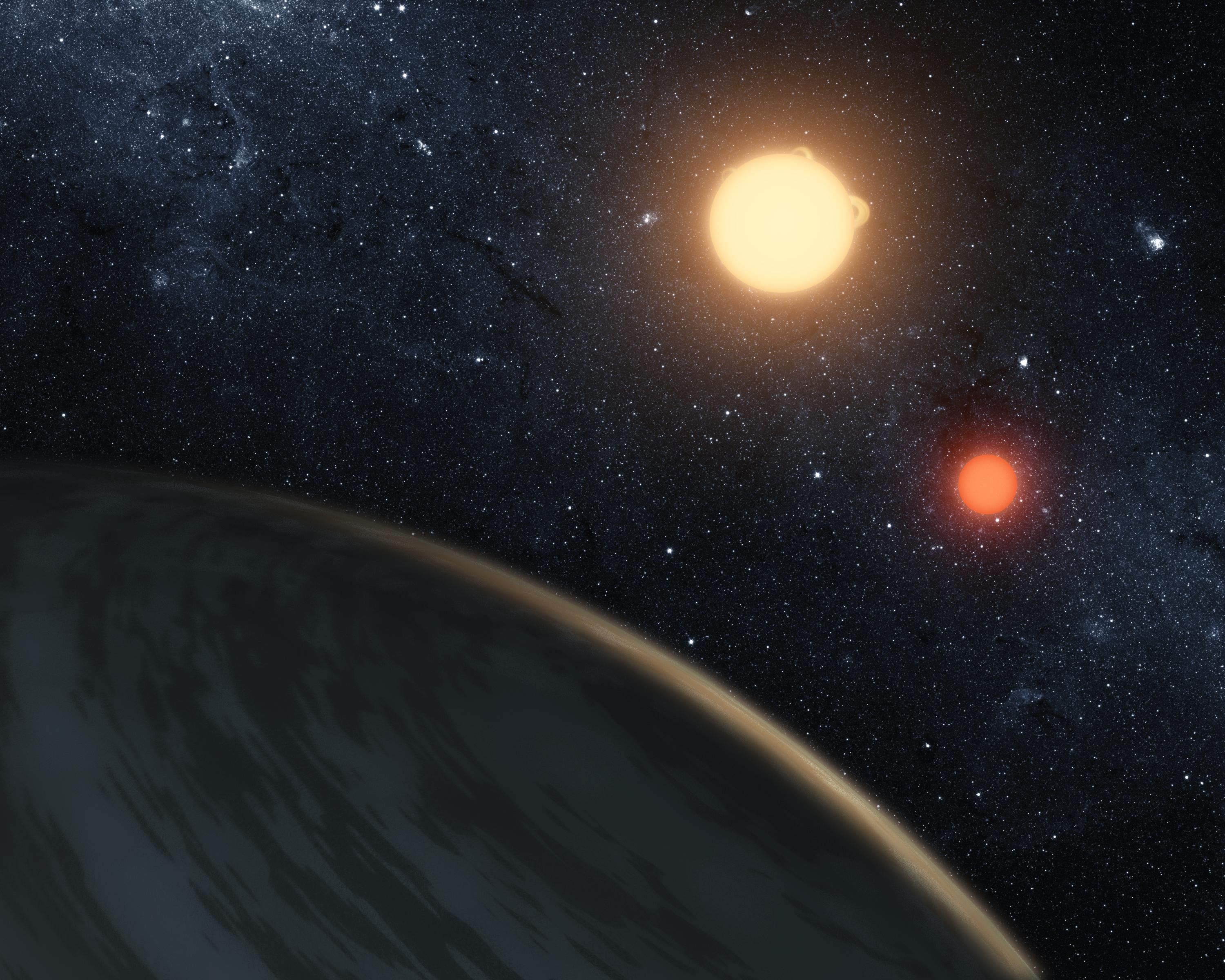 A circumbinary planet (Nasa)
The method used in the latest study had previously been used to characterise systems with two stars circling each other, but not in a large-scale search for planets.
It monitors how binary stars’ orbits change over long periods of time.
Researchers then track the variation in their eclipse schedule, which could reveal if a third body could be influencing the stars’ orbits – one that’s likely a planet.
Such eclipses cause a dip in the starlight signal sent to Earth, suggesting there might be a planet orbiting there.
To track the orbits, scientists used data from Nasa’s Tessspace telescope, launched in 2018, with the mission to search for exoplanets.
“I’m excited about the potential for how many planets we could find with this method,” astronomer Ben Montet from UNSW said.
“With this method so far, we have 27 strong planet candidates in environments completely unlike our own solar system,” Ms Thorton said.
These “candidates” wait to be confirmed as planets in future surveys and could be as small as the mass of Neptune to 10x as large as the mass of Jupiter.
“We found 27 planet candidates out of 1590 binary star systems, which is an almost 2 per cent rate of binary systems that could potentially host planets,” Dr Montet said.
“That implies there could potentially be thousands, or tens of thousands, of possible planets to be found,” he added.