
Ukraine has accused Russia of “nuclear terrorism” after claiming a drone struck a spent nuclear storage facility located approximately 15 km (nine miles) from Chernobyl nuclear power plant.
In a Facebook post on Sunday, Ukraine’s General Staff said an “enemy” uncrewed aerial vehicle (UAV) struck the Container Reception Building of the Centralized Spent Nuclear Fuel Storage Facility near Buriakivka in the Kyiv region.
The allegation comes days after Russia’s state nuclear energy company, Rosatom, said a Ukrainian drone struck a turbine hall at the Russian-occupied Zaporizhzhia nuclear power plant. Kyiv denied targeting the facility, calling the claim “yet another propaganda ploy.”
Newsweek contacted Russian and Ukranian authorities via email for comment.
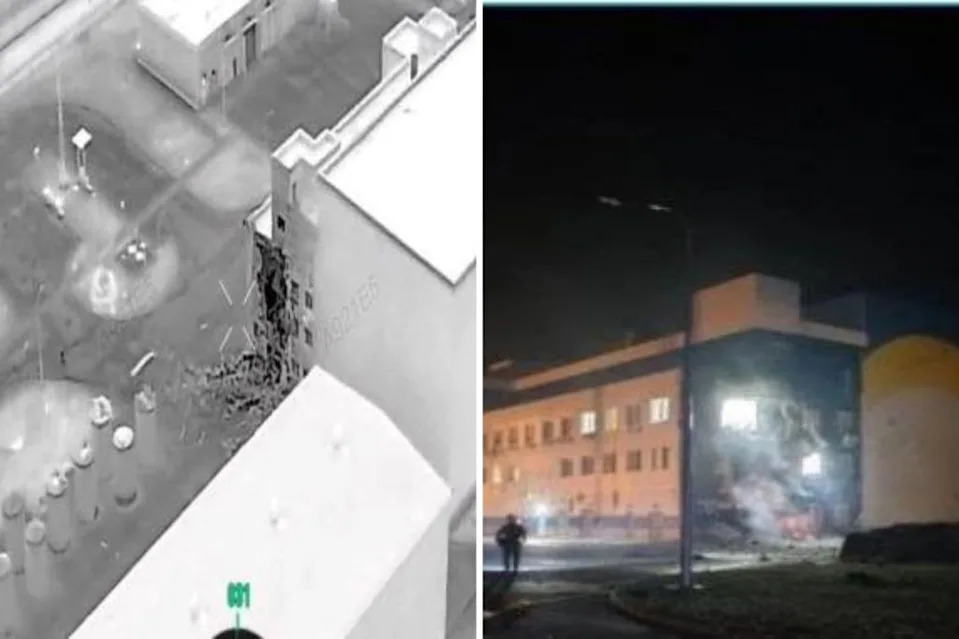
Images released by the General Staff of the Armed Forces of Ukraine after claiming a drone had struck a Centralized Spent Nuclear Fuel Storage Facility
Damage and Immediate Response
Ukrainian authorities said the strike occurred at about 2:10 a.m. local time and damaged part of the facility, which stores spent nuclear fuel from the country’s reactors and is operated by Energoatom.
According to statements from Ukraine’s Ministry of Energy and the Armed Forces, the impact caused partial damage to the building and ignited a fire covering roughly 40 square meters, approximately 430 square feet.
Emergency services reportedly extinguished the fire within an hour, with no casualties reported. Officials also said radiation levels at the site remained within normal limits following the incident.
Ukrainian military officials said fragments of a Shahed-type drone were recovered at the scene.
The Energy Ministry described the incident as a serious threat to nuclear safety.
“Such actions pose risks of damage to critical systems on which the safe storage of nuclear materials depends,” the ministry said, calling on the International Atomic Energy Agency (IAEA) to assess the situation.
Ukraine also described the incident as “an unprecedented threat to nuclear and radiation safety.”
Ukraine Calls for International Response
Ukraine’s General Staff said the strike formed part of what it described as a wider pattern of Russian military activity near nuclear infrastructure.
“Throughout its full-scale aggression, Russian forces have repeatedly routed cruise missiles and attack UAVs directly over Ukraine’s nuclear facilities,” it said, adding that such actions “create unacceptable risks of radiation incidents with consequences that could extend far beyond Ukraine’s borders.”
The military also pointed to previous incidents, including damage to the Chernobyl site. It said a 2025 strike on protective structures over the destroyed reactor at the plant “demonstrated the Russian military-political leadership’s complete disregard for international nuclear safety standards.”
It further cited concerns over the Russian-occupied Zaporizhzhia Nuclear Power Plant, saying it remained “the greatest threat” and alleging that it was being used as a military base.
“The international community must provide a proper assessment of these criminal actions and increase pressure on the aggressor state in order to prevent a nuclear catastrophe in the heart of Europe,” the General Staff said.
Ukraine’s claims have not been independently verified.
Why the Site Matters
The facility lies within the Chernobyl exclusion zone, established after the 1986 nuclear disaster, the worst nuclear accident in history.
The Chernobyl nuclear disaster occurred in April 1986 when reactor number four exploded during a late-night safety test, releasing large quantities of radioactive material into the atmosphere.
Large areas of northern Ukraine and southern Belarus were heavily contaminated, and hundreds of thousands of people were evacuated in the months following the accident. A 30-kilometer exclusion zone was established around the site, including the nearby town of Pripyat, which remains largely uninhabited.
The destroyed reactor was later encased in a steel and concrete structure to prevent further release of radioactive materials and allow for the eventual dismantling of the damaged unit.
Ukraine has maintained monitoring and management of the site since independence, although Russian forces seized control of the Chernobyl exclusion zone in the early stages of the 2022 invasion before withdrawing weeks later.
The site continues to be subject to international monitoring due to the long-term risks associated with spent nuclear fuel, radioactive waste, and the stability of containment structures.
Related Articles