
Every day, the Ukraine Battlefield update newsletter offers a clear look at how the war is unfolding on the ground. Subscribe for free here to get the full text delivered to your inbox.
Russia is trying to cover up problems in Dnipropetrovsk region with AI videos and other tricks.
Flamingo missiles struck a factory in Samara where rockets for Russia’s Starlink were being produced.
The largest Wildberries warehouse near Moscow burned down.
What we know after one week about the Russian incursion towards Orikhiv.
Maps of the day — Dnipropetrovsk region; Orikhiv.
Videos of the day — the largest Wildberries warehouse burned down; the heroic act of the commander of the 475th Regiment’s company; drones against electronic equipment; damaged drones continue towards their target.
The information in this article summarises events from Sunday (16 August). The situation may have changed since then.
Russia is trying to cover up problems in Dnipropetrovsk region with AI videos and other tricks. Last week, Ukraine announced that since the start of the year, it had managed to liberate 26 villages and 745 square kilometres of territory at the junction of the Dnipropetrovsk, Zaporizhzhia, and Donetsk regions. This section of the front is generally referred to as the ‘Oleksandrivka direction’. We have regularly written in Ukraine Battlefield update that something was happening in this area, and independent analysts also reported it, but the operation was accompanied by silence from the Ukrainian side. As this has now changed, it most likely means that no major changes can be expected.
Still, this is unwelcome news for Russia, as it exposes just how unreliable the information its army provides to the Russian public is. An information war therefore followed, aimed at casting doubt on Ukraine’s gains and persuading audiences that the Kremlin version was correct.
Russia deployed various tools in its information operation, including AI videos. Its course and content are sufficiently interesting and instructive to merit a closer look.
The first map lists the settlements that the Ukrainian army considers liberated. Each is marked with a yellow pin.

In the following days, however, Russia began publishing videos intended to prove that its forces were still present in all of these settlements. Using them, the Russian Telegram channel Rybar created its own map, marking 21 of the 26 allegedly liberated villages. A soldier carrying a Russian flag appeared in each of them.
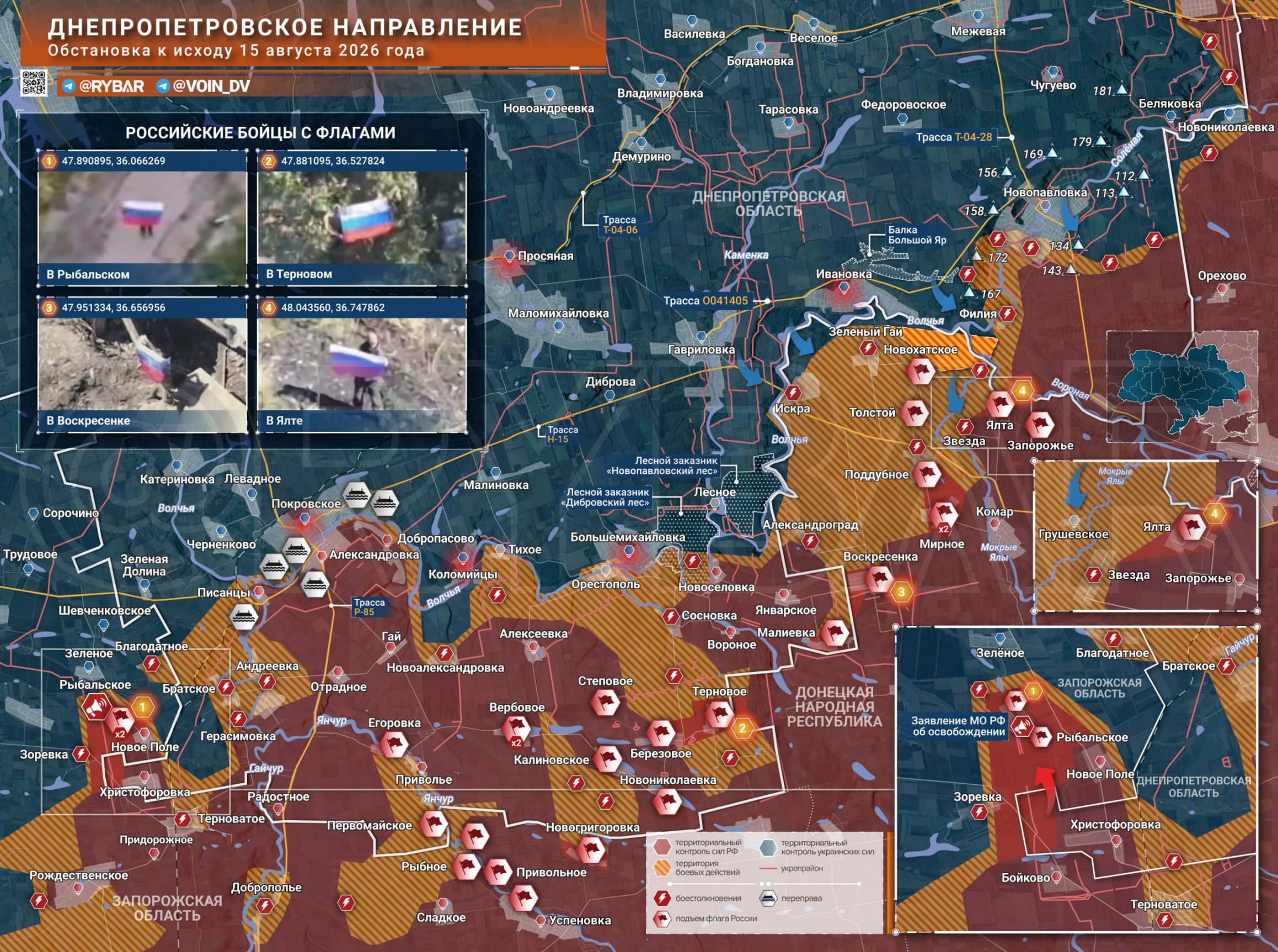
“Media ‘victories’ do not last long. While the enemy was celebrating the ‘clearing’ of Dnipropetrovsk region, the command of the East group of forces presented objective evidence of the stability of the front line in this direction,” Rybar wrote. According to Rybar, it was instead the Ukrainian side that had sent its flag-bearers into the villages in order to create a false impression of Ukrainian successes among the public.
“The Ukrainian army command’s loud statements about a ‘successful counteroffensive’ are not supported by any real advance or change in the situation in this sector,” Rybar added, saying that the soldiers in footage purporting to demonstrate a Ukrainian presence had been sent on a “one-way” mission.
This is therefore a situation in which Russia accuses Ukraine of doing something that Russia itself does far more often.
The source of Rybar’s information is an almost seven-minute compilation of drone footage from another Telegram account, Voin DV — which can only be viewed by those with Telegram. The account said that all the footage had been recorded between 12 and 14 August. Several accounts analysed the Russian images and found that at least some of them were fabrications.
The respected analyst Playfra, for example, said that the second segment of the compilation was already misleading. Russia claimed that it showed Voskresensk on 13 August. In reality, the images were from Velyka Mykhailivka and dated from some time before 14 July. Playfra used Sentinel satellite imagery to verify the authenticity of the footage.
French analyst Clément Molin calculated that eight of the 20 videos in the compilation were fake — containing an incorrect date or location, or being AI-generated; these are marked in white on the map — while five were also in the grey zone on the current DeepStateUA map. Among other things, he found that footage from Oleksandrohrad was from last year. By contrast, he described the view of a soldier in Ternove as genuine, but wondered why Russia had shown it in this way, thereby revealing his position.
As expected, local Russian 🇷🇺 Telegram chanel Voin DV posted a video to show the proofs that the Ukrainians are lying and that the situation is under control
Out of 20 videos they posted, 8 are false (wrong location, wrong date, AI (in white)) and 5 are in the current Deepstate… https://t.co/T2W67dCDZn pic.twitter.com/hXCObezF0s
— Clément Molin (@clement_molin) August 14, 2026
It is almost certainly inaccurate to describe all 26 settlements as liberated, as Russia is able to infiltrate some of them with its soldiers. However, its claims are clearly false and far less accurate than Ukrainian claims and independent analyses.
Ukrainian military analyst Kostiantyn Mashovets said of the situation in this sector that the Ukrainian army command faced a difficult decision over how to proceed. Very limited forces had been attacking in the Oleksandrivsk direction, and their advance had slowed, while Russia continued its attempts to capture the Sloviansk-Kramatorsk agglomeration further east.
Mykhailo Drapatyi therefore faces a choice between continuing the offensive “with limited forces and resources in the Southern Strategic Operational Zone, with rather questionable prospects”, and focusing “on repelling the Russian offensive in the Eastern Strategic Operational Zone”.
Flamingo missiles struck a factory in Samara where rockets for Russia’s Starlink were being produced. The factory is called Progress and is part of the Russian company Roscosmos. Volodymyr Zelensky was among the first to report it in a post on Saturday, indicating the importance Ukraine attached to the event:
Today, there are new significant results from our deep strikes. In Russia’s Samara region, one of the key enterprises within Roscosmos – the Progress Center, which was involved, among other things, in electronics production – was hit. Flamingo missiles were used. A good… pic.twitter.com/1BlZpmvKRN
— Volodymyr Zelenskyy / Володимир Зеленський (@ZelenskyyUa) August 15, 2026
As the Ukrainian analytical account Oko Hora wrote, the factory is located 930 kms from Ukraine and, among other things, produces Soyuz-2 rockets. One of them launched 16 Rassvet-3 system satellites into space on 23 March. Two Flamingo missiles reached their target. According to several sources, including the Russian Telegram channel Veteran’s Notes, they struck a hall where the final phase of rocket assembly was under way. The same author claimed that two of six Flamingos had managed to reach the factory under the cover of a large-scale Ukrainian drone raid.
Veteran’s Notes described the cruise missile, also known as the FP-5, as a “serious challenge” for Russian air defences. This is due to its very low flight altitude and low cost, which enables mass production. Russia estimates its production at 60 to 100 units per month. To reduce the risk posed by the Flamingo, Russia is also attacking sites where it is manufactured. Ukraine itself acknowledged some time ago that one of its factories had been destroyed. According to Veteran’s Notes, Russia targeted another one, directly in Kyiv, in early August.
Rassvet-3 is still difficult to compare with the US Starlink in terms of scale, but its aim is to achieve a similar capability — allowing the Russian army to operate over Ukrainian territory in the same way that Ukraine is able to use drones over occupied parts of Ukraine.
What we know after one week about the Russian incursion towards Orikhiv. Exactly seven days ago, Ukraine Battlefield update examined reports from the Russian side that its soldiers had infiltrated near the highly important town of Orikhiv in the Zaporizhzhia direction. It was the Russian Telegram channel Rybar that tempered the enthusiasm of its compatriots at the time.