
Every day, the Ukraine Battlefield update newsletter offers a clear look at how the war is unfolding on the ground. Subscribe for free here to get the full text delivered to your inbox.
Ukrainian offensive near Lyman: Four years ago, Ukrainians carried out one of their most successful operations in this war. They launched a surprise attack on Russian forces in the Kharkiv region and, within several weeks, managed to liberate 500 villages and towns and around 12,000 square kilometres of territory.
For comparison, this is an area roughly equivalent to a quarter of Slovakia. Russia has been unable to make up for this loss anywhere along the front over the past four years.
Liberation of the Kharkiv region in 2022
Four years ago٫ the world stood in awe as the Armed Forces of Ukraine launched a masterclass in modern warfare. 🇺🇦
In a lightning-fast surge of courage, our defenders shattered the enemy’s lines, reclaiming 8,000 square kilometers of stolen land in a heartbeat. From the… pic.twitter.com/dxTGfHEqmY
— Ukraine News 🇺🇦 (@Ukrainene) September 7, 2026
In the first days after breaking through the defences, they advanced by as much as 20 km per day. Unlike the offensive in the Kherson region, the Kharkiv operation was genuinely unexpected.
Since autumn 2022, Russians have made modest advances in the Kharkiv direction. They attacked Kupiansk and other towns and, according to the DeepState UA account, recaptured around 1,600 square kilometres in total. This remains only a small part of what they lost there in the autumn of the war’s first year.
Here, it is possible to compare the liberated part of the Kharkiv region in November 2022 with the current map. The territory previously liberated by Ukrainians is shown in green.
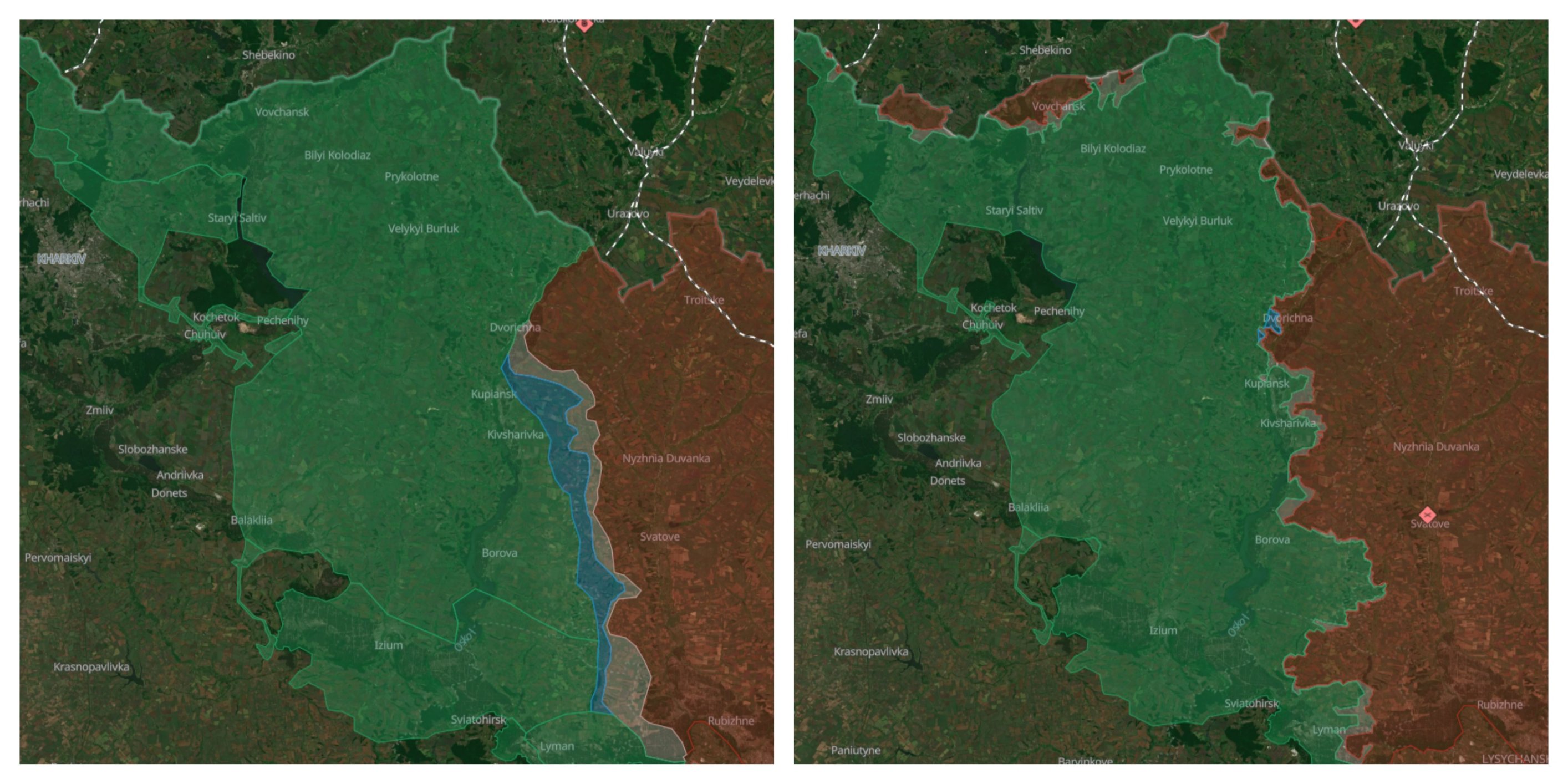
Now, exactly four years after that operation, information is beginning to emerge about another liberation of territory in the Kharkiv region. This is nowhere near an operation of the same scale: it concerns a small area north of Lyman. Nor is it something that happened in recent weeks, but an operation that has been under way for the past four months.
The Ukrainian general staff has remained silent about it, while pro-Ukrainian accounts have also so far maintained what is known as operational security (OPSEC). Russians, too, have written about the area only sporadically.
That is beginning to change. Russian sources and the first pro-Ukrainian analysts are describing the situation. “Russian, and therefore pro-Russian, sources have finally started mentioning it too, which means that local units can now speak without concern about a situation they successfully kept secret for months,” French OSINT analyst Clément Molin wrote on Monday (7 September).
On Tuesday (8 September), he too broke his silence and published a lengthy thread with maps. “This is one of Ukraine’s most important victories in 2026, which will delay the offensive in northern Donbas,” Clément Molin wrote.
What happened: North of Lyman, a Russian salient lay between the Nitrius and Zherebets rivers. According to DeepState UA, Russian soldiers were also present on the western bank of the Nitrius river. These are the two rivers in the centre of Molin’s map.
The results of this offensive are significant since this is a very important area in eastern Ukraine. This saliant, was the base for an offensive on Lyman, which could have allowed further offensives to Izium and Sloviansk, threatened the northern supply road to Donbas.
This… pic.twitter.com/oqkvr7rcb6
— Clément Molin (@clement_molin) September 8, 2026
According to Molin and other sources, Ukrainians drove them from the western bank of the Nitrius river and pushed them back towards the western bank of the Zherebets river.
After 4 months of the Lyman counter-attack, Ukraine 🇺🇦 3rd Army Corps managed to cut Russian 🇷🇺 salient north of Lyman and liberate more than 200 km2
This is one of the most important victory for Ukraine in 2026 which will delay the offensive on northern Donbas
🧵THREAD🧵1/20⬇️ pic.twitter.com/PybB6jO9DO
— Clément Molin (@clement_molin) September 8, 2026
According to him, the attack began on Friday (22 May), when “a mechanised battalion of the 3rd Assault Brigade, supported by at least two other brigades — the 60th and 66th — from the 3rd Army Corps, launched a large-scale mechanised offensive, during which Russian drones were significantly jammed”.
“The attack began in the forests east of Izium and reached the village of Nove. Around five Ukrainian vehicles were hit during the assault, mainly by fibre-optic drones — suggesting that only these could fly — and many returned. That day, Ukrainians managed to dig in within fortified woodland east of Nove and began their counteroffensive towards Lyman,” the respected analyst wrote.

The following week, Ukrainians conducted clearing operations in the village of Nove, where they held a numerical advantage. By Monday (1 June), the village had largely been liberated.
In mid-July, Ukrainians secured the village of Zelena Dolyna, according to Molin, but more importantly, they continued advancing through fortified tree lines in the east.
Overall, Ukrainians liberated 200 square kilometres, according to Molin. The AKM Mapping account wrote that Ukrainians may have liberated 151 square kilometres. Its map is very similar to Molin’s.

By mid-August, Ukrainians had reached the northern edge of the village of Kolodiazi, according to Molin. This means they cleared the salient from north to south and created a pocket in which they could cut off Russian soldiers. Most of them apparently managed to withdraw.
On Monday (24 August), Ukrainians carried out a second mechanised attack. This map by Molin shows the progress of the liberation of the area.
The main offensive axis comes from Nove and goes all the way south. We know there are two main support axes, one east and on west. The one east is recent and there are very few proofs, we just know that they nearly reached the Zherebet river.
The one west is known, but there is… pic.twitter.com/t7LG4BGHzO
— Clément Molin (@clement_molin) September 8, 2026
What Russians are saying: The Russian channel Rybar recently wrote about “problems near Lyman”. It did not acknowledge Ukrainian advances to the extent described by Molin, but claimed that Ukrainians were pressing from both the north and the south.
“From the direction of Ridkodub, Ukrainian units have been systematically attacking southwards for several months and have achieved at least tactical successes. Footage of M113 vehicles being evacuated from the vicinity of Karpivka shows that Russian forces do not even control the airspace immediately near the front line,” it wrote.
Its map does not yet confirm the loss of the entire salient, but it describes the problems Russia faces.
The Russian account Two Majors wrote on Tuesday (8 September) that Ukraine’s armed forces were amassing troops in the village of Stavki and deploying smaller units near Zarichne and Yampolivka to the south. According to it, sabotage groups were operating in the Ternove area.
“If confirmed, this would mean very serious problems for Russian forces operating west of the Zherebets river. It cannot be ruled out that the approach to Lyman from the direction of Zarichne has also been lost,” Rybar wrote.
Why this matters: This area is strategically important, and if Ukrainians have indeed cleared it and forced Russian forces to withdraw, it will help defend major Donbas strongholds such as Sloviansk and Kramatorsk. On a larger-scale map, there was a risk that Russians could use this salient to bypass this urban area from the north. That possibility is now less likely.

“Improving the situation around Lyman is crucial to preventing the bypassing of the belt of fortifications in Donbas. Work on this has been under way for many months. Although it is still officially not discussed, the measures are continuing,” the Woofers account wrote.
How it is being kept secret: The Andrew Perpetua account wrote that the silence around Lyman had been even more rigorously maintained than during other similar Ukrainian liberation operations — whether near Kupiansk or in the Dnipropetrovsk region in the direction of Velyka Novosilka during the summer. Ukrainians then liberated around 600 to 700 square kilometres, the largest area since autumn 2022.
“The operation near Lyman appeared even more secretive, as it was apparently missed even by the best-informed and most honest Russian journalists. Or at least they are keeping quiet about it. It was truly shocking to see how detached from reality Russians were, which I believe was largely linked to the collective OSINT effort to avoid discussing this situation,” Perpetua wrote.
This area is one of the parts of the front where official and unofficial Russian sources have lied and misled most extensively about Russian advances. Nearby is Sviatohirsk, a town which Vladimir Putin recently said Russians had captured, yet where the commander of Ukraine’s 3rd Army Corps, Andriy Biletskyi, was calmly walking around on Monday (7 September).
According to Perpetua, it is no coincidence that Russians lie most where they are forced to retreat.
Map of the day
The areas Russia is focusing on can also be identified by where it most frequently attacks with glide bombs. Clément Molin published a map showing where these bombs landed in Donbas. He analysed the traces of 10,000 FAB bombs over the past six months.
According to the analyst, they are focusing on three areas: Kramatorsk, south of Druzhkivka and north-west of Pokrovsk. It is apparent that Russians are making modest advances, or rather extending the range of their glide bombs.
During the last 6 months, Russia 🇷🇺 dropped more than 10 000 FAB bombs in the Ukrainian 🇺🇦 controled Donbas
Russian offensive continues in the region on 3 main axes, east of Kramatorsk, south of Drujkivka and north-west of Pokrovsk.
🧵THREAD🧵1/10 ⬇️ pic.twitter.com/kPw5vQ7oDR
— Clément Molin (@clement_molin) September 7, 2026
Overall, glide bombs remain an important part of Russia’s arsenal. According to the Vitaliy account, Russia dropped around 50,000 bombs during that period — meaning Molin mapped one-fifth of them. This is significantly more than last year.

The issue was also addressed by the Ukrainian soldier and blogger Officer. According to him, in some directions Russians are dropping such bombs “almost continuously”.
“At present, when we are talking about precision strikes against specific targets — even at distances of 5 to 7 km from the line of contact — the enemy often uses aerial bombs practically as a substitute for artillery,” he wrote. He added that this had an effect and that Ukrainians did not have a comparable weapon in their arsenal.
Former defence ministerial adviser Serhiy Beskrestnov said that they were waiting for Gripen fighter jets equipped with Meteor missiles, which could force Russian bombers to fly farther from the front and reduce the number of bombs dropped.
Chart of the day
The Ukrainian account Oko Hora published changes along the front over the past week. According to it — based on data from the DeepState UA account — Russians occupied 54 square kilometres. This is the highest figure since April, but still significantly lower than last year. Between July and December 2025, only one week was worse than the past week.
The chart also shows the 96 square kilometres liberated by Ukrainians in mid-August. At that time, however, the DeepState UA account merely disclosed earlier Ukrainian advances carried out under operational security, meaning this was not the result of one successful week but progress made over a longer period.
Amount of territory occupied by Russians per week.
 Figures are in square kilometres. Source: datawrapper/Denník N.
Videos of the day
Ukrainians hit a Russian Su-24 military aircraft in Crimea. The video shows the strike from a camera mounted directly on the drone, as well as a wider view from an observation drone.
Russian FPV drones continue to attack Ukrainian military and civilian vehicles in the streets of Sloviansk. The city is currently around 10 km from Russian lines.
It is becoming increasingly important to destroy enemy drones not only in the air, but ideally before they take off. Near Oleksiivka in the Kharkiv region, Russians unfortunately managed to do this on this occasion. A jet-powered Geran-4 drone struck several Ukrainian FP-2 drones that had been prepared for launch.
Footage of a Russian missile which struck Kyiv during an overnight drone and missile attack. After three days of calm, terror returned to Ukraine’s capital.
What are the losses
No update on Tuesday (8 September).
By Monday (7 September), Russia had verifiably lost 24,066 pieces of heavy equipment, compared with 24,041 on Friday (4 September). Of these, Ukrainians destroyed 19,034 pieces (19,009), 1,000 (1,000) were damaged, crews abandoned 1,194 (1,194), and the Ukrainian army captured 2,838 (2,838). The total includes 4,446 tanks (4,441), of which 3,351 (3,346) were destroyed in combat.
Ukraine lost 12,097 pieces of equipment (12,040), of which 9,507 (9,451) were destroyed, 698 (697) damaged, 693 (693) abandoned, and 1,199 (1,199) captured. The total includes 1,462 tanks (1,459), of which 1,120 (1,123) were destroyed in combat.
Note: Neither side regularly reports its own deaths or destroyed equipment. Ukraine publishes daily figures for Russian casualties and destroyed equipment, but these cannot be independently verified. In this overview, we use data from the Oryx project, which has compiled a list of equipment losses documented exclusively by photographs since the beginning of the war.