
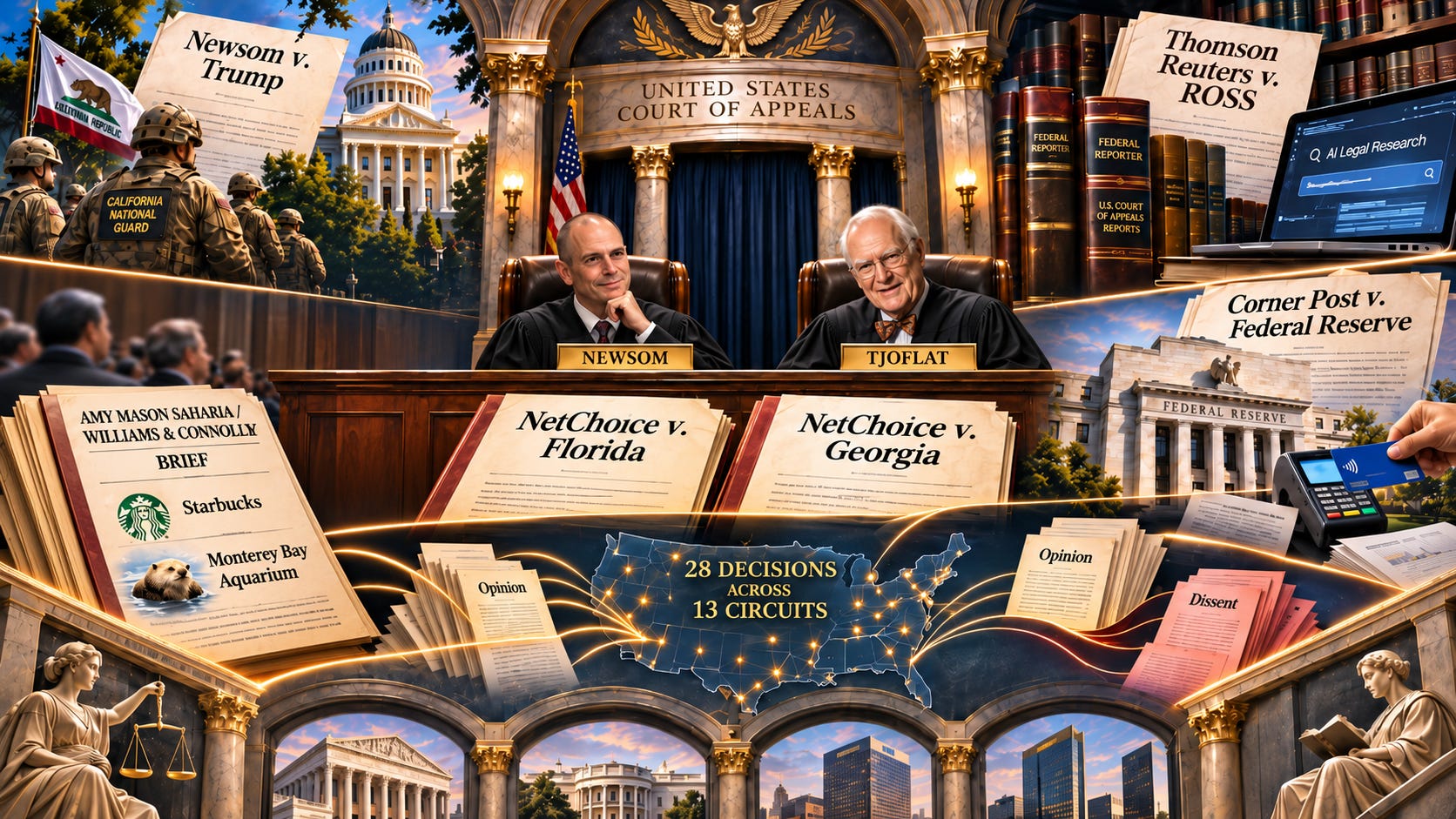
In two months this fall, federal appellate courts confronted disputes involving presidential control of the National Guard, copyright protection for legal-research material used to build artificial intelligence, and federal regulation of debit-card fees. The cases arose in different courts, implicated different industries, and attracted different levels of attention. Yet each had consequences extending well beyond the immediate parties.
The Ninth Circuit’s Newsom v. Trump restricted the federal government’s deployment of California National Guard troops in Los Angeles. The Third Circuit’s Thomson Reuters v. ROSS Intelligence examined the use of copyrighted Westlaw headnotes to develop a competing AI legal-search service. The Eighth Circuit’s Corner Post v. Federal Reserve addressed the legality of a rule governing debit-card interchange fees. These were different kinds of important cases: a contest over governmental authority, a decision about emerging technology and established intellectual-property rules, and a challenge to the reach of financial regulation.
Looking across 28 selected decisions issued in September and October 2026 reveals several patterns. Government entities were parties in 19 cases, or 68%, but the clearest appellate-stage outcomes divided evenly between government and nongovernment advantages. A substantial share of the decisions addressed preliminary relief or procedural questions rather than final liability. Judicial alignments sometimes crossed appointing-president party lines, while recurring appellate practices and institutional litigants appeared more consistently than individual arguing lawyers. Public attention, meanwhile, was concentrated in relatively few disputes.
These cases provide a snapshot of how federal appellate courts exert influence: through legal rules, the distribution of institutional power, and decisions that determine what litigants can do next.
The analysis covers decisions released between September 1 and October 31, 2026. An initial search yielded 540 records, reduced through preliminary consolidation to 514 distinct court–docket–date observations. That search supplied a discovery pool, not a complete census. Thirty-two matters received closer examination; 28 were selected, representing every federal appellate circuit, including the D.C. and Federal Circuits.
The legal-significance index awarded up to ten points: three for doctrinal novelty, two for practical reach, two for en banc consideration, and one each for a substantive merits resolution, dissent, and related Supreme Court activity. A supplementary measure awarded up to 1.5 points for verified reporting during the seven days after a decision, considering article volume and independent publishers; opinion length supplied a maximum additional 0.3. Scores guided the selection, alongside circuit representation and subject-matter diversity. Assessments of novelty and reach necessarily involve judgment, and coverage totals are verified minimums.
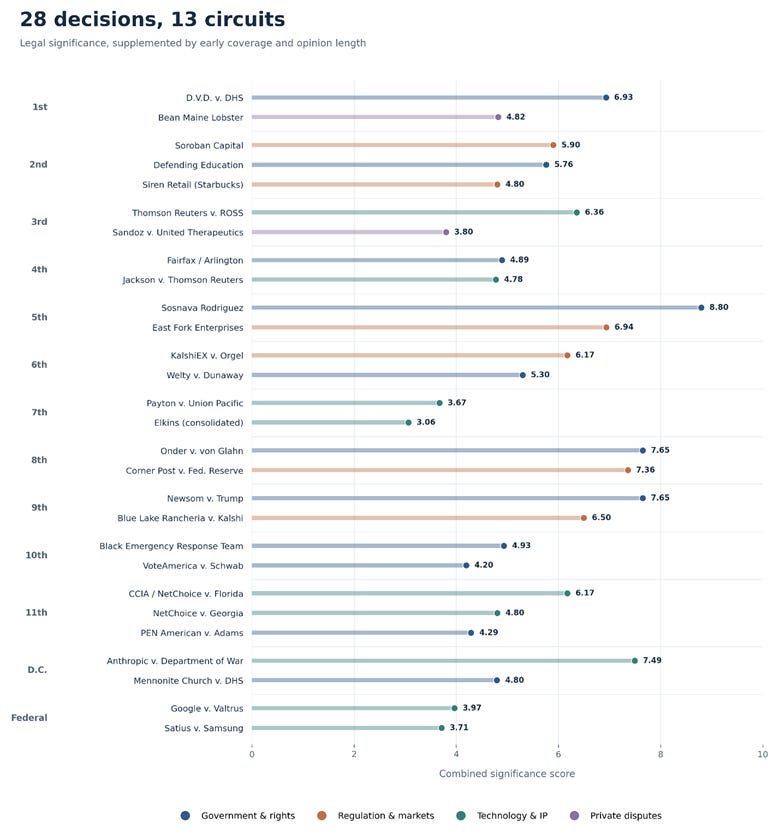
The Fifth Circuit’s en banc decision in Sosnava Rodriguez v. Vergara received the highest combined score, approximately 8.8. By a 10–7 vote, the court held that three noncitizens detained during removal proceedings were not entitled to individualized bond hearings on dangerousness or flight risk. The ruling reversed district-court grants of habeas relief and established a binding rule for similar challenges in the circuit. Its reach, en banc posture, and divided outcome all contributed to its placement.
Other decisions derived their importance from regulatory consequences. In East Fork Enterprises v. EPA, the Fifth Circuit vacated EPA’s methylene-chloride rule, concluding that the agency’s legal and evidentiary analysis was deficient. Corner Post likewise invalidated federal regulation, this time involving the interchange fees paid in debit-card transactions. Although each dispute began with particular regulated entities, the judgments concerned nationwide regulatory arrangements.
The Thomson Reuters decision occupied another category. The Third Circuit upheld copyright protection for editorial headnotes and rejected ROSS’s fair-use defense for copying associated with development of a commercial legal-search platform. The holding concerned the record before the court rather than AI training in all its forms. Still, it addressed a question of evident importance to publishers and technology developers: how conventional copyright rules apply when protected material becomes an input into a new information product.
Some decisions were consequential because of their immediate institutional effects. Newsom restricted federal executive authority over California’s Guard, while the D.C. Circuit’s Anthropic v. Department of War upheld exclusion of an AI developer’s product from military supply chains. Those judgments moved in different directions under different legal authorities. Taken together, they show how the significance of an appellate ruling may dependson the power it defines and the activities it changes, as well as on the doctrine it announces.
Federal, state, or local governmental entities appeared as parties in 19 of the 28 selected decisions. The disputes reached well beyond conventional challenges to agency regulations: they involved immigration detention, election administration, public schools, labor relations, taxation, military procurement, and social-media restrictions. Even nominally private commercial cases often arose against the background of contested governmental regulatory authority.
Yet government participation did not produce a consistent advantage. The coding identifies seven cases in which government obtained the principal appellate-stage benefit and seven in which a nongovernment litigant did. Two placed governmental entities on opposing sides, while three had outcomes that were mixed, issue-dependent, or altered by later stays. Those categories reflect the practical direction of the appellate ruling, rather than whether a judgment was formally affirmed or reversed; reasonable classifications can differ at the margins.
Federal authorities prevailed in Soroban Capital Partners v. Commissioner, where the Second Circuit held that investment-firm principals actively managing their partnership did not qualify for the limited-partner exemption from self-employment taxes. In Anthropic, the D.C. Circuit rejected challenges to the Department of War’s exclusion decision. These cases sustained government action in quite different settings, applying distinct statutory schemes and standards of review.
Private litigants secured important victories elsewhere. East Fork and Corner Post placed limits on federal regulatory authority, with effects extending to businesses beyond the named petitioners. In the Second Circuit’s Siren Retail decision, Starbucks prevailed in substantial part against the National Labor Relations Board over restrictions on employees’ union insignia and attire. None supplies a general measure of how appellate courts treat government: the challenged actions, legal claims, and procedural settings differed.
The Eleventh Circuit’s two social-media cases are particularly revealing. On October 14 and 15, the same Newsom–Luck–Tjoflat panel decided challenges to Florida’s HB 3 and Georgia’s SB 351, both restricting minors’ access to certain online platforms. The states obtained significant relief from district-court injunctions, although the Florida disposition was expressly divided among affirmance, reversal, vacatur, and remand. The rulings involved similar industries and constitutional arguments without resolving every issue raised by the lawsuits.
Two cases also exposed disputes within government itself. In Newsom, California contested federal control over its National Guard. In Fairfax County School Board v. McMahon, local school boards challenged federal education officials. For these decisions, describing the result as a governmental victory or loss would conceal the allocation of power between governmental institutions that the court was actually determining.
Twelve selected decisions, or 43%, centered on preliminary or emergency relief, jurisdiction, discovery, removal, or related procedural questions. This is one reason appellate outcomes require more careful treatment than win–loss tallies permit. A litigant may gain a decisive legal advantage without securing final judgment on the underlying claim.
In Blue Lake Rancheria v. Kalshi, two tribes argued that sports-event contracts offered by Kalshi violated federal Indian gaming law. The Ninth Circuit concluded that the tribes were likely to succeed on their statutory claims, but returned the remaining preliminary-injunction factors to the district court. That ruling changed the parties’ legal positions without finally resolving the dispute or immediately supplying the full relief requested.
Jurisdictional decisions operate similarly. In Fairfax, the Fourth Circuit vacated a dismissal and remanded the school boards’ challenge for further proceedings. In the Seventh Circuit’s Elkins litigation, hospitals facing privacy claims arising from website-tracking technology sought to move related cases from state court into federal court. The appellate court rejected the asserted basis for federal-officer removal. Its judgment decided the forum for continued litigation, leaving the underlying privacy allegations unresolved.
In PEN American Center v. Adams, the Eleventh Circuit addressed whether school board members could claim legislative privilege against questioning about their removal of particular library books. That evidentiary ruling shaped the development of the constitutional case without adjudicating the underlying First Amendment dispute. The Eighth Circuit’s September ruling in Onder v. von Glahn, concerning Missouri’s congressional map, illustrates the additional complication of subsequent judicial action: the Supreme Court stayed the resulting injunctions four days later.
Such decisions can be highly consequential precisely because their effects arrive before the litigation ends. They determine who must defend a case, where it proceeds, what evidence can be gathered, and whether contested conduct may continue. Counting only final merits judgments would miss much of the appellate activity that gives prominent cases their immediate practical force.
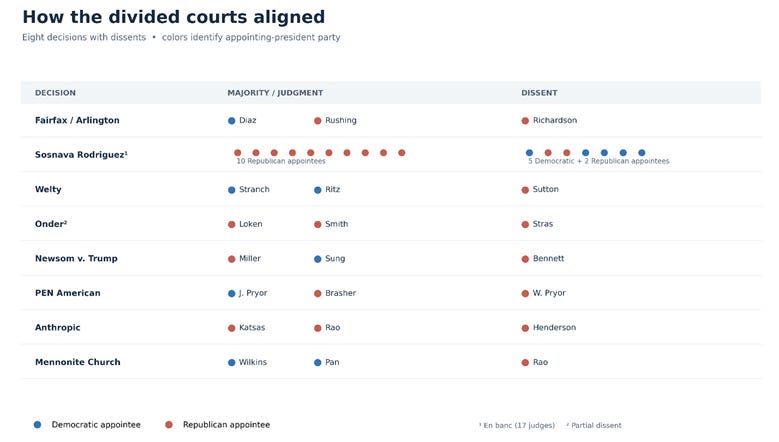
The sample contains 98 judge-case appearances involving 86 distinct judges, including one 17-member en banc court. Among the other 27 panels, 15 included judges appointed by presidents of both parties, while 12 consisted entirely of appointees from one party. Eight decisions included dissents. Five of those divisions occurred on mixed-appointment panels, two on panels composed of appointees from one party, and one in the en banc case.
Several majority coalitions crossed appointing-president party lines. In Newsom, Sung, appointed by Biden, authored the opinion affirming the injunction against federal deployment. Miller, a Trump appointee, concurred, while Bennett, also appointed by Trump, dissented. In Fairfax, Rushing, appointed by Trump, wrote for a majority that included Diaz, an Obama appointee. Richardson, another Trump appointee, dissented. The Eleventh Circuit’s PEN American decision paired Brasher and Jill Pryor in the majority, with William Pryor dissenting.
Shared appointment-party labels did not necessarily produce agreement. In Anthropic, Katsas and Rao upheld the exclusion of the company’s product over Henderson’s dissent, although all three judges were appointed by Republican presidents. The Fifth Circuit’s Sosnava Rodriguez decision divided 10–7 en banc, with two Republican-appointed judges joining five Democratic-appointed judges in dissent.
The two NetChoice appeals offer a complementary illustration of judicial continuity. Newsom wrote both opinions for the same Eleventh Circuit panel, which had heard both arguments on March 10. Rather than infer judicial ideology from the panel’s composition alone, these paired decisions permit direct comparison of how the same judges addressed related statutory schemes under similar constitutional challenges. The broader pattern is one of coalition variation as well as continuity, with the qualification that eight divided decisions are too few to estimate normal voting behavior across the circuits.
The 27 selected decisions involving oral argument generated 60 advocate appearances by 58 distinct lawyers. Only two argued more than one case. Amy Mason Saharia of Williams & Connolly represented Monterey Bay Aquarium in a First Circuit defamation dispute and Starbucks in a Second Circuit labor case. Erin Murphy of Clement & Murphy argued both NetChoice social-media appeals before the same Eleventh Circuit panel on March 10; Newsom subsequently authored both decisions. That overlap involved counsel, client, judges, and related legal questions.
Recurring firms were more numerous. Williams & Connolly appeared in three cases, adding Charles McCloud’s argument for United Therapeutics in Sandoz to Saharia’s two. Latham & Watkins appeared through Samir Deger-Sen for defendants in Jackson v. Thomson Reuters and Gary Feinerman for Union Pacific in Payton. Milbank participated in two Kalshi-related appeals: William Havemann argued KalshiEX in the Sixth Circuit, while Grant Mainland argued for other defendants in the Ninth Circuit’s Blue Lake Rancheria. Clement & Murphy handled both NetChoice arguments. Kirkland & Ellis appeared as counsel for Thomson Reuters against ROSS and for the Managed Funds Association as an amicus in Soroban.
The litigants themselves also recurred. NetChoice challenged Florida and Georgia social-media laws; Kalshi litigated questions concerning sports-event contracts in different circuits. Thomson Reuters appeared as a copyright plaintiff against ROSS and as a defendant in Jackson, represented by different lawyers. These examples distinguish firms serving unrelated clients from businesses confronting litigation on several fronts.
Public-sector participation was substantial. DOJ attorneys argued in eight selected cases, spanning immigration, taxation, education, regulation, and procurement. Tennessee’s attorney general appeared in both KalshiEX and Welty. Oklahoma’s Will Flanagan argued Black Emergency Response Team and joined the multistate amicus briefing supporting Kansas in VoteAmerica.
Amicus organizations provided another recurring set of participants: the Constitutional Accountability Center (Sosnava Rodriguez, Newsom), NAACP Legal Defense Fund (Fairfax/Arlington, Black Emergency), Foundation for American Innovation (Thomson Reuters, Anthropic), Foundation for Individual Rights and Expression (Jackson, Anthropic), Software & Information Industry Association (Jackson, Florida NetChoice), and Federation for American Immigration Reform (D.V.D., Mennonite Church). ACLU organizations also appeared across several cases as counsel or amici. These are documented overlaps, not exhaustive counts.
The sample thus shows overlapping networks of appellate specialists, repeat corporate litigants, government offices, and advocacy organizations. It identifies who participated in consequential cases without supplying a valid measure of comparative advocacy success.
The public profile of the cases was uneven. Six decisions generated 24 of the 45 verified news stories published during the first seven days after each ruling, or 53%. Newsom and Onder received considerable coverage tied to immediate governmental and electoral controversies. Other decisions, although important to regulatory or commercial interests, circulated mainly through specialist publications and institutional networks.
Amicus participation offers a different view. At least 18 of the 28 selected decisions had documented amici, including trade associations, advocacy organizations, and governments seeking to influence legal rules affecting interests beyond the litigants. The available amicus entries are not a complete count of separate briefs or participants. An absence from the reviewed materials therefore does not establish that no amicus brief was filed.
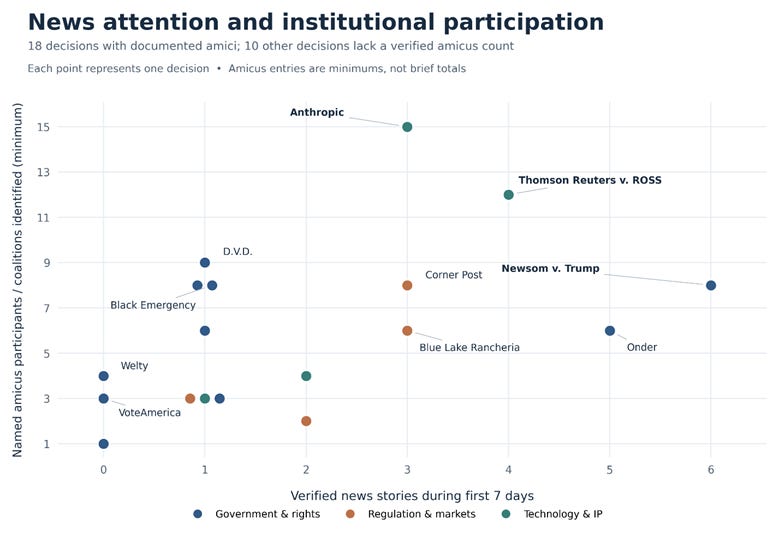
The resulting contrast is illuminating. A high-stakes dispute can command national news coverage because of its immediate political consequences, draw extensive organized participation because of its potential precedential reach, or have both characteristics. The distribution reinforces the rationale for selecting cases on legal significance first and using public attention as a supplementary measure. It also explains why commercially specialized decisions such as Thomson Reuters and Corner Post belong in the same account as more publicly visible constitutional litigation.
Across these two months, consequential appellate judging appeared in several forms: resolving limits on governmental authority, governing important commercial relationships, and controlling the next stage of litigation. The judges did not always divide along appointment-party lines, and the lawyers represented a mixture of recurring institutions and highly varied clients. The 28 cases are a snapshot rather than a national baseline, but considered together they show the many ways appellate decisions shape law well beyond the disputes that bring them to court.