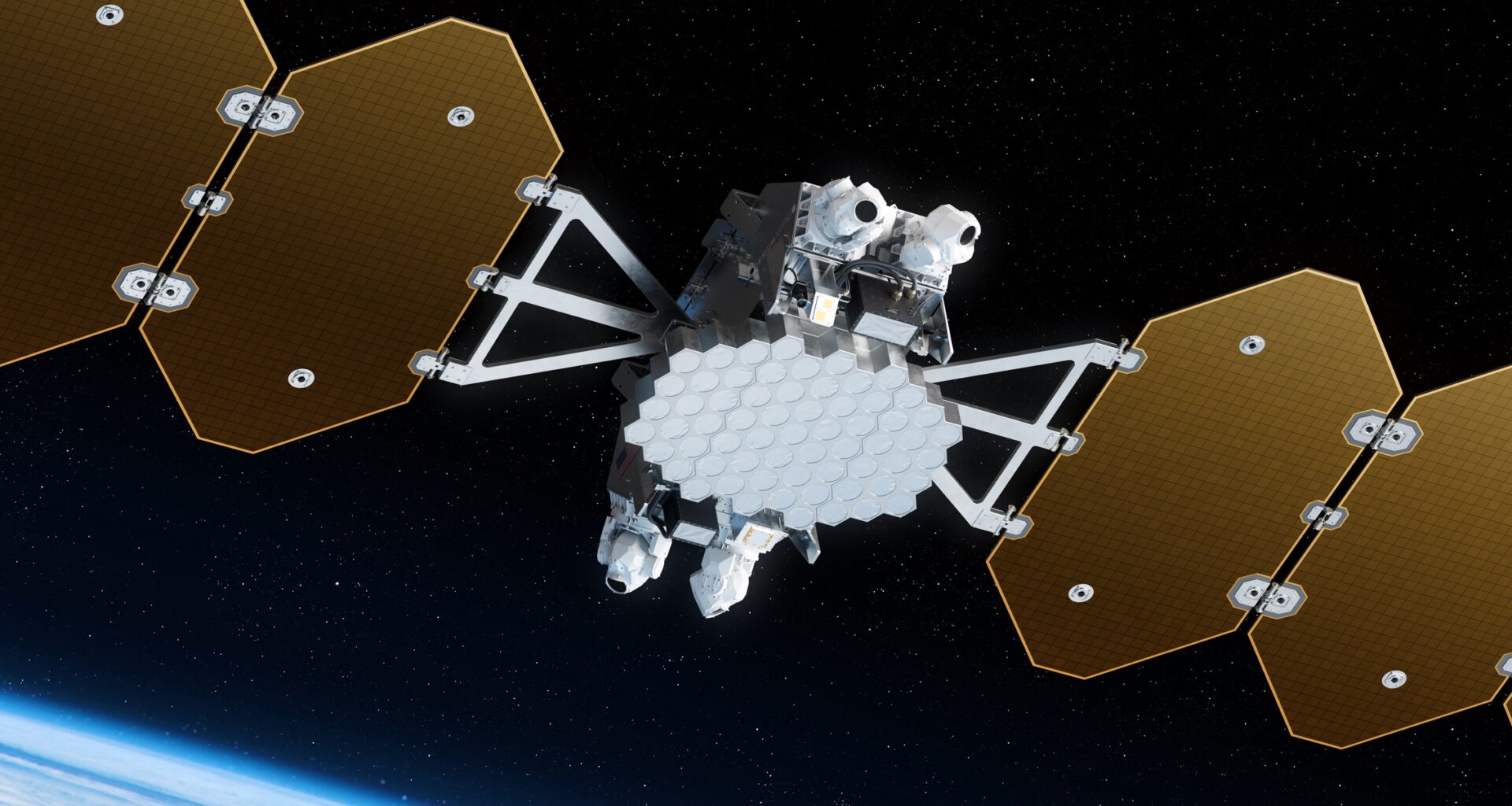
SALT LAKE CITY — CesiumAstro plans to launch a satellite in October that will be a precursor to the company’s planned constellation of more than 700 spacecraft.
In a presentation at the Small Satellite Conference here Aug. 23, Dylan Pfeifer, principal software engineer at CesiumAstro, said the company’s Element-1 satellite will be shipped later this week to Vandenberg Space Force Base for launch on a SpaceX rideshare mission to sun-synchronous orbit in October.
The spacecraft is part of CesiumAstro’s push into satellite systems. The company has been best known for work on phased-array antennas but, in 2024, announced plans for Element, a satellite with a multibeam phased-array antenna.
“This satellite represents two years, day and night, of the dedicated push and effort of more than 70 employees at CesiumAstro,” he said.
The spacecraft is primarily designed to test phased-array antennas, he said. The spacecraft’s Earth-facing deck features a distinctive set of hexagonal tiles that comprise an L-band antenna. The spacecraft also has several Ka-band phased-array antennas.
The spacecraft is 12.5 meters across when its solar arrays are fully extended, providing 2 kilowatts of power to the payload, according to a paper accompanying Pfeifer’s presentation. The spacecraft has a mass of 510 kilograms when fully fueled, using Hall-effect thrusters that provide 450 meters per second of delta-v.
“This is the first satellite of a constellation we’re building,” he said. CesiumAstro has said little about that constellation, called Synchronicity. The company recently filed plans with the Federal Communications Commission for a constellation of 737 satellites operating in Ka-, Ku- and V-bands to provide fixed and mobile connectivity services for enterprise and government users.
CesiumAstro has been acquiring other companies to support that effort. The company announced Aug. 13 that it acquired Jariet Technologies, a semiconductor manufacturer, saying the firm would play a “big part” in that planned constellation.
It also acquired Vidrovr, a startup developing AI tools for signals analysis, in February. That came just after CesiumAstro raised $470 million in equity and debt to increase manufacturing of satellites and components.
Pfeifer did not discuss plans for the constellation in his presentation but said in-space testing of Element-1 would inform future spacecraft in the constellation. “Every mission is a new journey, a bit of a mountain to climb,” he said.
Related