When are the pitchforks coming?
Wealth inequality is becoming extreme. Political corruption is rampant in the United States.
Billionaires are building fortified bunkers to protect themselves from the inevitable social upheaval that lies in our future (they fear).
“What do I see in our future now? I see pitchforks,” US tech entrepreneur Nick Hanauer famously warned in 2014.
Democracy cannot survive trillionaires
“There is no example in human history where wealth accumulated like this and the pitchforks didn’t eventually come out.
“You show me a highly unequal society, and I will show you a police state. Or an uprising. There are no counter-examples.”
Some tech leaders say it is inevitable that people will revolt against automation.
“This is the real underlying threat posed by automation: tremendous social upheaval, public unrest, and political collapse stemming from widespread unemployment and grotesque inequality,” warned Kai-Fu Lee, a former president of Google China, in 2022.
It’s why 100 millionaires signed an open letter for the Davos Summit in 2025 with a simple message for their wealthy colleagues: “It’s taxes or pitchforks!”
So where is society headed?
Daron Acemoglu, a winner of the Nobel Memorial Prize in Economic Sciences (2024), published a working paper recently, with Mehdi Shadmehr and Arda Gitmez that grappled with these issues.
It was titled Automation and Repression, and its conclusion was disquieting.
Redistribution or repression?
The economists argued in their paper that, when faced with the threat of a popular revolt against greater automation, political leaders would have two choices, and they would choose the option most people wouldn’t like.
“We show that the capitalist state can use redistribution or repression to reduce the threat of a revolt,” they say.
Daron Acemoglu, Simon Johnson and James A Robinson awarded the Nobel memorial prize in economics
“[And] greater automation makes repression more attractive to the capitalist state,” they argue.
Why is that the result?
Because according to their model, more automation will require more redistribution to cushion the disruptive effects of automation, so as a country automates more, the tax burden will keep increasing on “capitalists”.
So, the “capitalist state” will opt for repression, since repression only has a fixed cost (as a proportion of output), whereas the cost of redistribution keeps increasing with the extent of automation.
It’s a strange use of language.
They’re talking about the “cost” of repression like it’s a basic financial cost of running a state, and they write in negative terms about the “cost” of redistribution when that redistribution is being used to keep people alive and democratic society functioning.
But that’s the language these economic models use.
A lot of surveillance, forced compliance
And it’s the language some wealthy individuals and business leaders employ.
The paper references an interview with Mo Gawdat, former chief business officer at Google X, who spoke of the attitudes of many tech leaders as rushing toward full-scale automation and then using other tools to control the population who lose their jobs, in these terms:
“And so you’re going to see a world where unfortunately there’s going to be a lot of control, a lot of surveillance, a lot of forced compliance.”
What influence will the new ‘tech oligarchy’ have on the US?
According to Acemoglu, Shadmehr and Gitmez, these types of debates have become prominent in popular media and the business world.
So they have tried to incorporate revolts, triggered by inequality between capital and labour, into a task-based model of automation.
In essence, they have modelled how workers would try to coordinate in an uprising, and how a capitalist state would try to prevent an uprising occurring, in an environment in which automation and inequality are increasing.
Their paper contributes to growing literature on the historical evidence on political and social reactions to automation.
They say the novel finding of their paper is that automation and repression complement and reinforce each other.
Its full dynamic model shows that if society develops to the point where there is a credible threat of revolt against automation, “the economy will ultimately converge to repression and the ‘pitchforks’ will be met with ‘guns’ from the capitalist state”.
“In a further extension, we show that if society first starts in a democracy, democratic decision-making will become less and less acceptable to capitalists as the level of the capital stock grows, and society will experience an anti-democratic coup, once again transitioning to repression,” the paper notes.

Priscilla Chan, Mark Zuckerberg, Lauren Sanchez, Jeff Bezos, Sundar Pichai, and Elon Musk, among other dignitaries, attend Donald Trump’s second inauguration on January 20 last year. (AP: Shawn Thew)
Data centre and AI boom at risk from backlash
The three economists acknowledge that their paper is only a “first step” in the investigation of the dynamics between political regimes and technology choices, especially automation.
They say it would be great to incorporate richer political interactions into their model, including the reality of lobbying and political donations and other forms of democratic capture.
Police drones over troubled town
And they say it would be interesting to explore how advances in AI can change politics in other ways that interact with automation and repression.
But their paper comes at an interesting time.
In recent months, The Economist magazine has been warning that the data centre and AI boom is at risk from a growing public backlash in countries like the United States, Britain and Australia.
In Australia, there has also been public unease about the increasing use of new surveillance tools used by the state.
The NSW Police Force is currently running an Australian-first trial in Moree (an area with a high Indigenous population) using rooftop drones to “fight crime” in the area, controlled by people hundreds of kilometres away at Bankstown Airport.
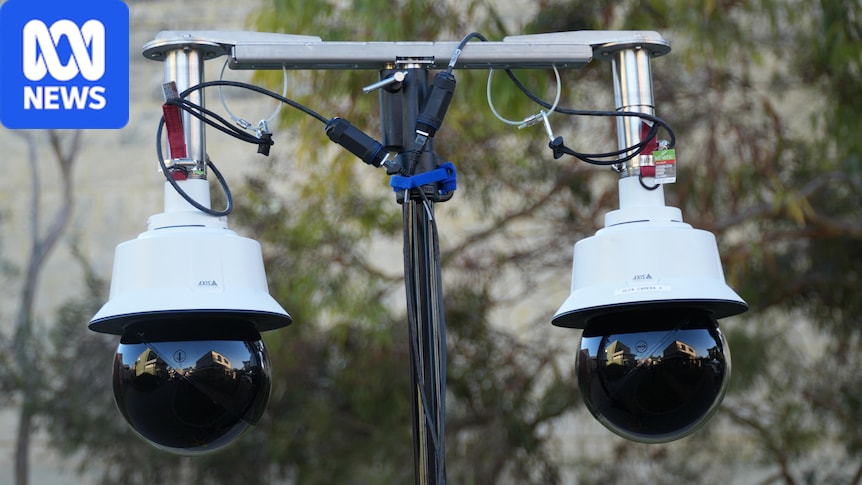
Live facial recognition cameras to be used by WA Police
The same police force has been using software developed by Israeli digital forensics company Cellebrite to download the contents of a suspected criminal’s phone, including deleted messages and images, and new legislation before NSW parliament seeks to extend those powers for police, which is raising concerns that that capability will eventually shift into routine policing.
Back in 2017, the Fairfax Media reported that Centrelink, the Australian Taxation Office, the Australian Securities and Investment Commission, and the Australian Federal Police were already using Cellebrite technology.
In another Australian-first trial, the Western Australian Police have been using live facial recognition software to scan people walking on the streets of Perth and Fremantle, comparing their faces against a police watchlist in real time.
And AFL clubs are now exploring using facial recognition technology instead of digital or paper tickets.
It’s clear we’re heading in a certain direction with this technology. Is the state already rehearsing for a more repressive role?