Would-be writers are always advised to “write what you know.” But when what you know is informed by a lifetime of living life adjacent to a city’s roughest gangs, of promising starts and heartbreaking stops, crushing losses and amazing recoveries, what comes out on the page could be a mess. Or a masterpiece.
On the Shelf
Tear the City Down
By Andre Hardy
Grand Central Publishing: 432 pages, $30
If you buy books linked on our site, The Times may earn a commission from Bookshop.org, whose fees support independent bookstores.
Count “Tear the City Down,” former NFL running back Andre Hardy’s debut, out Sept. 1, in the latter category. It kicks off with an enticing sports-driven setup: Coltrane Davis, an about-to-retire bag man and fixer for a wealthy San Diego macher, is persuaded by Saul Sollman, his boss, and Sollman’s pseudo-son Dylan Banks, a sports agent, to take one last assignment — find Anthony Riddell, a missing L.A. Chargers All-Pro running back being extorted over a scandalous sex photo. But like a play-action sneak, while readers are distracted by Coltrane’s action-packed investigation into the salacious case, Hardy throws into the mix the emotional journey of a hustler trying to balance the karmic scales of his former wrongs. Violence and love, karma and greed square off while exposing San Diego’s underbelly, where gang life, sex clubs and human trafficking are strange bedfellows with the city’s business and political elite.
At the center of the maelstrom is Coltrane — who describes himself as “cast-iron black, six foot three and 235 pounds of mostly muscle.” Moreover, he’s a chess-playing, gourmet cooking, crime fiction aficionado and jazz lover equally comfortable on the mean streets of East Daygo and in the lush life of La Jolla Farms estates. Like other great crime fighting heroes — think Raymond Chandler’s Philip Marlowe or Walter Mosley’s Easy Rawlins — Coltrane has a personal creed, derived from the Rev. Martin Luther King Jr.’s famous speech about how long it will take to achieve justice. In Coltrane’s streetwise translation, it becomes, “Somebody’s got to bend the arc of the moral universe. It don’t bend on its own.”
George Pelecanos, author, screenwriter on “The Wire” and “Treme” and co-creator of “The Deuce,” can relate. His Derek Strange detective novels, including the just-published “The Blue Flame,” also features a highly principled protagonist driven by values Chandler would recognize. Pelecanos became aware of the former NFL running back’s debut from a social media post and requested an advance copy. “I just had a feeling about him. … After reading [his novel], I was surprised to know it was a debut!” Pelecanos says.
Which raises a number of questions: What was Hardy’s journey to becoming a debut author at 64? How did his relatively brief stint in the NFL and longer life experiences shape a book that is as affecting as the debut novels of Mosley, Michael Connelly or S.A. Cosby? And how did Buddhist teachings find their way into this adrenaline-fueled novel? My questions led me to a drive south — to the city people of color often dub “Daygo” — where I met up with Hardy at Las Cuatro Milpas, a family-owned Mexican restaurant in Chicano Park, one of several Barrio Logan settings in the book.
As I approached Hardy, waiting outside the restaurant, his eyeglasses, casual khaki-colored cropped pants, sneakers and a San Diego Padres hat suggest a much younger man, while his slightly gimpy knee hinted at an untold story.
Over tacos and burritos, and during a later tour of San Diego’s under-resourced neighborhoods, we talked about football, the 1970 resistance that inspired Chicano Park and its notable murals, the history of downtown San Diego development, the Black neighborhood in East Daygo where Hardy grew up, and how his life there inspired many aspects of “Tear the City Down.”

(Grand Central Publishing)
Surprisingly, the journey started with tennis. “I wanted to be Arthur Ashe,” he says, his brown eyes intense behind his thick-lensed glasses. Born in 1962, Hardy was an impressionable youngster when Ashe made history as the 1968 winner of the men’s singles title in the U.S. Open, followed by the Australian Open in 1970 and Wimbledon in 1975. Inspired, “I knocked all of the paint off of our garage door, hitting balls.”
Hardy gifted his lifelong love of the game to Naima, Coltrane’s 13-year-old daughter in the novel.
In the ’60s and ’70s, Hardy couldn’t find a path to becoming a tennis pro, but at over 6 feet and 230 pounds, becoming a running back was his ticket out of San Diego, into college, and eventually into the NFL. Drafted in the fifth round by the Philadelphia Eagles, Hardy sustained a debilitating knee injury soon after joining the team. While the team’s doctors cleared him to play, Hardy went to an outside orthopedic surgeon who advised him not to play on the injury and to get immediate surgery. “The Eagles had no choice but to do it then.”
How did Hardy endure the knee injuries he suffered throughout most of the almost four years he played for the Eagles, Seattle Seahawks and San Francisco 49ers? “You just sucked it up.” But being so casually used and abused left a bitter taste in Hardy’s mouth. “Therein lies the root of my love/hate relationship with the NFL,” he says. That ambivalence about football surfaces in the novel, starting with agent Banks’ early assessment of the NFL’s possible involvement in an extortion plot.
Ace Atkins, the bestselling author of the Quinn Colson and Nick Travers series who is also a former college football player whose father played in the NFL, appreciated Hardy’s portrayal of the sport in “Tear the City Down.” “He takes us inside the football factory and shows us the underbelly that sports writers never know, from the locker room to the high-end living,” Atkins notes.
Probed on his feelings about the NFL, Hardy acknowledges the dark side of the sport but is primarily grateful for the scholarship provided by the Trust, established by the NFL Players Assn., that he used to obtain his MFA from Antioch University’s creative writing program in 2018. At that point, Hardy had been working on the novel for seven years, including with instructor Mark Sarvas of the UCLA Extension Writers Program. Between his departure from the NFL and getting his MFA in 2018, Hardy had a long career in business and with nonprofits, most recently assisting small businesses along the Crenshaw Corridor to access Metro’s Business Interruption Fund. However, it was during his stint as a fundraiser for a nonprofit soliciting donations from Silicon Valley businesses to close the digital divide for people of color that Hardy saw how white Silicon Valley executives, arrogant with the power that wealth brings, couldn’t be bothered to hear the advice of a community-based organization on how to reach out to underserved consumers. “That’s when I first had the idea I would one day write about how whites don’t see us, and how we see them.”
Those scenes are among the more intense in the book, as Coltrane’s “invisibility” gives him a front-row seat to observe the ways of white folks, including a special kind of financial arm-twisting he dubs “whitemail,” Anthony Riddell its latest target.
Hardy’s prose brims with assurance and wry details that come from lived experiences and conversations. “One pimp told me a long time ago that Daygo was one of the biggest markets for prostitution and human trafficking in the country,” he confides. “Between San Diego’s weather, the 24/7 convention business, the nearby military bases and proximity of a ready supply of women trafficked across the border from Mexico and elsewhere, he was reaping the benefits of that booming market.”
A recent sting by the California Department of Justice’s San Diego Human Trafficking Task Force bears out the veracity of that claim and lends an eerie verisimilitude to Coltrane. He’s on a quest to find Erykah, a missing Black teen who was best friends with Naima. As Coltrane exposes sex trafficking crimes, he dishes out a fair amount of street justice along the way, but with a purpose.

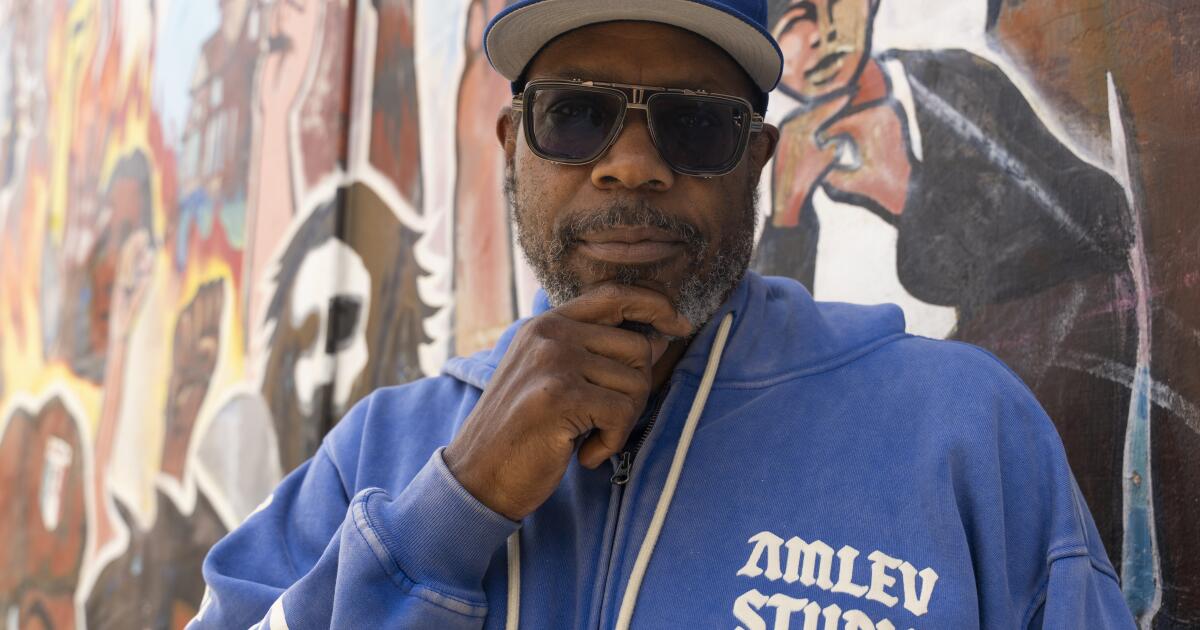
Author Andre Hardy in San Diego near Chicano Park’s iconic murals, which show up in his debut mystery novel.
(Aspen Cierra Evans / For The Times)
“I want people to understand the ways in which Black girls and women are being used and abused,” Hardy says. “Whether it’s a missing teen, presumably lost to trafficking, the women who surround abusive gang members or teenaged Naima, whose talent the sports agent is practically salivating to exploit … Coltrane is the one man in the novel who will stand up for women in the novel, who’s trying to make a difference.”
Coltrane is also deeply interested in the Buddhist principles of karma and dharma, or the moral duties and obligations to a right way of life, which are sprinkled throughout the novel. This mirrors Hardy’s own relationship with the dharma is in his personal life in many ways, along with the relationship with his wife, JoAnna Hardy, a noted Buddhist meditation teacher. “Finding the dharma was like the longest sigh,” he says. “The world suddenly made sense. My mind is my instrument. Meditation is how I keep it fine-tuned.”
As our time together comes to an end, I ask Hardy what it feels like to be an “overnight success” at 64. Already at work on the second Coltrane Davis thriller, he laughs. “Honestly, I’m so invigorated by and get a sense of joy from writing, I feel more like I’m 24 than 64!”
The rewards of fulfilling one’s dharma, to be sure.
A regular contributor to The Times, Woods is a member of the National Book Critics Circle and the editor of several anthologies and four novels in the “Charlotte Justice” mystery series.