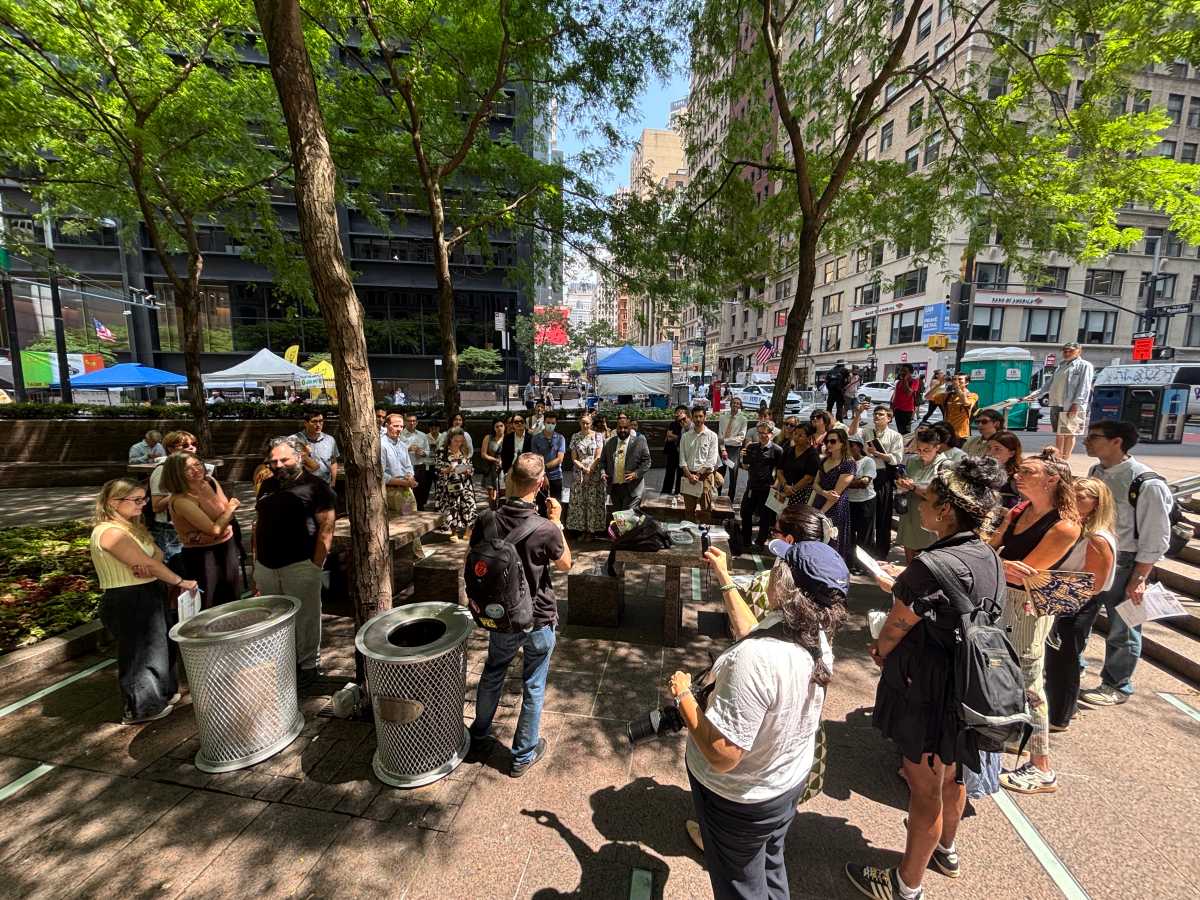
A group of advocates and elected officials is calling on the Mamdani administration to ensure private businesses that own public spaces in the city follow legal regulations and give all New Yorkers proper access to them.
A letter addressed to Department of Buildings (DOB) Commissioner Ahmed Tigani and sent to other Mamdani administration officials asks the city to take several steps to ensure the more than 590 privately owned public spaces (POPS) encompassing 3.8 million square feet of the city are truly public, including implementing clearer signage, training the private businesses that own them on public access rights and improving enforcement processes.
“These spaces should function as a meaningful part of the city’s open space network and ensuring that this bargain is honored consistently should be a citywide priority,” says the letter, spearheaded by advocacy group New Yorkers for Parks. “While building owners are responsible for maintaining their POPS and providing the access and amenities required by the City, DOB and other agencies play an essential role in making this public agreement real.”
POPS are created when private businesses make agreements with the city to purchase or maintain a piece of indoor or outdoor property that they allow the public to access frequently; often on a 24/7 basis. The POPS agreements act as a way to offset certain developments the private businesses are making, or provide the business with a tax break.
The letter, shared with amNewYork, comes as New Yorkers are increasingly reporting on social media POPS that are closed to the public when they’re not supposed to be. The advocacy also comes at a time when POPS are having a bit of a renaissance as organizers take advantage of the public nature of the spaces to hold creative events that offer opportunities for friends and strangers to meet.
Advocates and electeds say the city needs to take steps to make POPS “genuinely public,” visible and accessible via clear signage in all POPS locations and by taking steps to demarcate POPS on common wayfinding apps, such as Google Maps. This, they say, will allow New Yorkers to understand where the POPS are much in the same way that they can see public park locations.
The group also wants the city to incentivize the private businesses that own the POPS to carry out certain improvements in the spaces, such as adding more seating, water fountains, greenery, lighting, shade, trash cans, bike racks, extreme weather protection, climate resiliency measures and bathrooms. It also asks for local communities to have a more meaningful role in POPS oversight.
Right now, people have to go through multiple steps to report when a business is out of compliance with POPS regulations, and advocates say a more streamlined and clear reporting process is needed. To address this, the letter asks the city to implement more training for business owners and security guards to better inform them of the legal regulations governing the public spaces so visitors aren’t improperly removed. It also pushes for the establishment of a clearer citywide compliance and accountability program for POPS.
Spokespeople for Mayor Zohran Mamdani did not immediately respond to requests for comment. The Department of Buildings told amNewYork that it is committed to enforcing POPS public access regulations and looked forward to working with those who sent them the letter and members of the public on ways to improve access to the “treasured public spaces.”
“We are committed to the strong enforcement of the city’s POPS regulations, which provides hundreds of high-quality public spaces for the enjoyment of all New Yorkers,” the department said in a statement. “Thanks to DOB’s proactive enforcement strategy, we have seen a major 42% increase citywide in compliance with POPS regulations in recent years.”
A 2017 audit by Levine’s office found that POPS are skirting their legal public access requirements 55% of the time.
Earlier this week, amNewYork Law reported on a similar situation involving a private business improperly restricting access to a public space on 59th Street near the Ed Koch-Queensboro Bridge. Though that space is not a POPS, the case generated comparable backlash and calls from elected officials, including City Council Speaker Julie Menin, for public space to stay public and the potential need for heightened enforcement against private businesses taking advantage of public space.
New Yorkers for Parks Director for Policy Kathy Park Price says she feels the advocates pushing for changes in POPS have a positive relationship with the DOB commissioner and City Hall, describing the process as a “dialogue.” She said issuing recommendations in the form of letters like this helps give officials an extra push and holds them accountable.
The recommendations were developed over the past few months during group walks through POPS organized by Price, one of which DOB Commissioner Tigani attended. The groups predominantly included public space professionals and representatives from elected officials’ offices, including Menin’s, and involved the professionals assessing issues with public access to POPS and proposing solutions.
The letter sent to the Mamdani administration by New Yorkers for Parks is also signed by Council Member Christopher Marte, Assembly Member Grace Lee, Manhattan Borough President Brad Hoylman-Sigal, New York City Comptroller Mark Levine and park and public space advocacy groups like Open Plans, Transportation Alternatives and The Battery Conservancy.