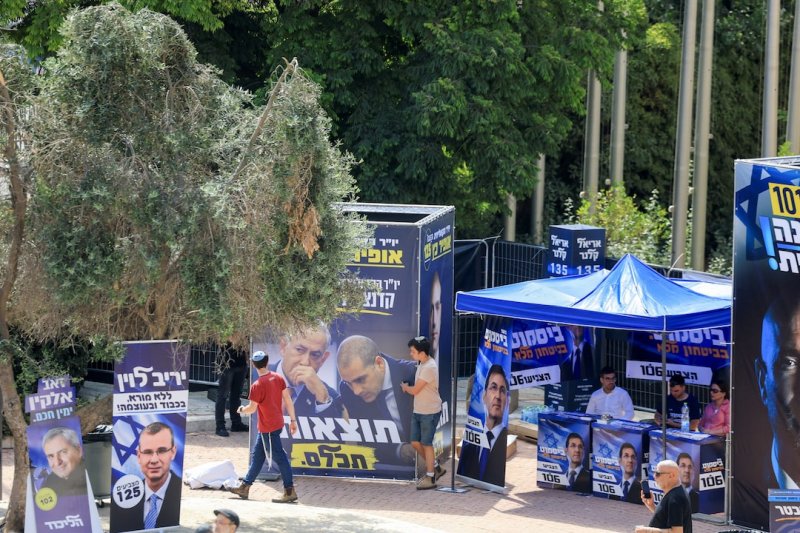
Editor’s note: Moses Becker is a special political commentator for News.Az. He holds a PhD in political science and specialises in inter-ethnic and inter-religious relations. The views expressed in this article are those of the author and do not necessarily reflect the position of News.Az.
On 27 October, Israel will hold parliamentary elections, three years after Hamas’s deadly attack of 7 October 2023. During that period, the country has waged military campaigns against militant groups in the Gaza Strip and Lebanon, as well as their principal backer, Iran. As a result, Israel has further consolidated its position as one of the Middle East’s leading military and economic powers.
Despite its small territory and relatively modest population, the Jewish state has repeatedly demonstrated its ability to withstand and prevail under the most challenging conditions. While prolonged conflicts often place severe strain on national economies, Israel’s experience has been markedly different.
According to estimates by the Bank of Israel’s Research Department, the country’s GDP grew by approximately 2.8% in 2025, despite the continuing hostilities, and under the baseline forecast could accelerate to 5.2% in 2026. In its December 2025 Economic Outlook, the OECD projected GDP growth of around 3.3% in 2025 and 4.9% in 2026.
Another important indicator of economic resilience is monetary policy. Israel’s inflation target remains within an annual range of 1–3%. According to official Bank of Israel data, the benchmark interest rate stood at 4.5% between July and September 2025. It was subsequently reduced by 0.25 percentage points in both November 2025 and January 2026, reaching 4.0% on 5 January 2026.
During 2025, the shekel strengthened by 12.5% against the US dollar and by 1.3% against the euro. The budget deficit for the 12 months of 2025 amounted to approximately 4.7% of GDP. Despite the backdrop of a seemingly endless war, government revenues increased by 13.8%, while tax receipts rose by 14.1%. The IMF estimates Israel’s population at approximately 10.37 million.
At the same time, the Israeli economy remains among the most technologically advanced in the developed world. In 2025, Israel demonstrated a combination rarely seen in advanced economies: unemployment remained low, while businesses simultaneously faced labour shortages in a range of professions. This suggests that the main constraint on growth is not a lack of jobs but a shortage of suitably qualified workers.

Source: Reuters
In 2025–2026, Israel appears to be an economy in which high technology is not merely an advantage but a fundamental pillar of growth. The structure of exports is also evolving, with services, ]including software, cloud technologies, cybersecurity and research-and-development centres, accounting for an increasingly large share alongside industrial products.
In recent years, Israel has firmly established itself as one of the world’s leading high-tech centres. The ability of its economy to remain resilient under extreme conditions has been one of the country’s most notable achievements.
Another significant development has been the government’s decision to expand domestic military production with the aim of achieving greater self-sufficiency in defence manufacturing. Despite ongoing military operations, Israel’s defence exports reached $19.2 billion in 2025, representing a 30% increase compared with 2024.
One achievement of the outgoing coalition is that the current Knesset completed its full four-year term. The last time this occurred was during the 1984–1988 parliamentary term. Since then, every Israeli election had been called before the legislature completed its full mandate.
A distinctive feature of the upcoming election is the emergence of a new opposition party, Yashar, established in 2025 by former Israel Defense Forces Chief of Staff Gadi Eisenkot. Its rapid rise has drawn comparisons with the emergence of Benny Gantz’s Blue and White alliance. Opinion polls suggest that the new party has gained considerable momentum in recent months.
Observers note that after three years of war, Israeli society has shifted noticeably to the right.
Among the most right-wing parties are Otzma Yehudit (Jewish Power), led by Itamar Ben-Gvir, who served as national security minister in Benjamin Netanyahu’s most recent government, and Religious Zionism, headed by Finance Minister Bezalel Smotrich.
The strongest position continues to be held by the centre-right Likud party, led by Netanyahu. A former special forces officer who was wounded during military service, Netanyahu remains one of Israel’s longest-serving political leaders and retains considerable influence both at home and abroad.
The religious parties Shas, led by Aryeh Deri, and United Torah Judaism, whose leading figures include Moshe Gafni and Yitzhak Goldknopf, also remain important players.
On the centre-left, alongside Eisenkot’s Yashar party, voters will also be presented with other opposition forces, including the Beyahad party associated with former prime ministers Naftali Bennett and Yair Lapid.
Standing somewhat apart from these blocs is Yisrael Beiteinu, a party whose support base is concentrated among Russian-speaking Israelis. Led by Avigdor Lieberman, it positions itself on the political right.
On the left is the Democrats party, which unites former members of the Meretz and Labour parties. It is headed by retired general Yair Golan.

Source: Reuters
The field is completed by the Arab parties Ra’am and the joint bloc comprising Hadash, Ta’al and Balad.
As preparations for the election continue, a number of smaller parties have also begun to emerge, although most are unlikely to cross the electoral threshold.
At present, predicting the outcome remains extremely difficult. Neither the governing coalition nor the opposition appears capable of securing the 61 seats required to form a majority government.
Under these circumstances, it is unsurprising that Israel’s neighbours are closely following developments, as the election result could affect the regional balance of power.
In this regard, Iran is widely viewed as one of the external actors with the greatest interest in the outcome. Given the particularly close relationship between US President Donald Trump and Prime Minister Benjamin Netanyahu, Tehran would clearly prefer to see the opposition come to power.
For now, the ayatollah regime appears reluctant to provoke another confrontation with Israel, as such a development could strengthen the political standing of the Israeli right. The Israeli government, meanwhile, does not currently appear inclined to resume military operations against the Islamic Republic.
Nevertheless, Israeli officials believe that Tehran is actively attempting to influence the Israeli electorate.
In his latest report, State Comptroller Matanyahu Englman stated that “foreign actors” were conducting a “series of covert activities” on social media aimed at harming the interests of the state and potentially even its sovereignty.
According to Englman, the primary objective of such efforts is to undermine public trust in Israel’s democratic institutions.
Ultimately, Israel’s elections illustrate how significantly the country’s regional standing has grown in an increasingly unstable Middle East. They also raise an important question: how will the outcome shape both Israel’s future and the wider balance of power across the region?
(If you possess specialized knowledge and wish to contribute, please reach out to us at [email protected]).