
Editor’s note: This story includes discussion of suicide. If you or someone you know needs help, the national suicide and crisis lifeline is available by calling or texting 988. The National Sexual Assault Hotline is 1-800-656-HOPE (4673).
Ducks, four-leaf clovers and cats meowing all make Olga Schultz think of her son Gabriel.
She thinks of him when the Bette Midler version of “Baby Mine” plays on the radio.
He’s on her mind when she eats at Whataburger. He loved all things Texas.
It’s been four years since he died by suicide, days before his 25th birthday. He left behind his wife, Alexandria, and his 8-month-old baby girl, Bernadette. He was serving in the U.S. Navy, following in the footsteps of his dad.
She still thinks of him all the time.
“For me, grief is Veterans Day, Memorial Day, Fourth of July. Who grieves on Fourth of July? I do. Because he wore a uniform,” she said. “It’s not just Mother’s Day, and it’s not just Thanksgiving and Christmas and my birthday and my husband’s birthday. It’s Memorial Day. It’s Valentine’s Day, when I don’t get my call.”
Her loss was, and sometimes still is, incredibly lonely. Someone at the Tragedy Assistance Program for Survivors (TAPS), a national nonprofit for support after a death in the military community, called her after Gabriel died. She didn’t answer. They called again, and she declined. When they called a third time, she finally picked up.
They spoke for two hours, it was the first time Schultz talked to someone who had been in her position. Soon after, she drove from Houston to attend a TAPS regional summit for survivors in San Antonio. She said it was life-changing.
Immediately she signed up to be a peer mentor with the organization, mentoring Spanish speakers, many of whom only speak Spanish. She has made it her mission to help them navigate their loss, and oftentimes the cultural or religious stigma that comes with losing a loved one to suicide.
“This is what I need to do. I need to help other people, not feel alone,” Schultz said. “…If you’re going to be alone and not understand what’s going on, I will translate everything for you.”
Tragedy Assistance Program for Survivors
The organization coordinates events around the country, and this month in San Antonio it held its 18th annual National Military Suicide Loss Survivor Seminar and Good Grief Camp at a hotel on the River Walk.
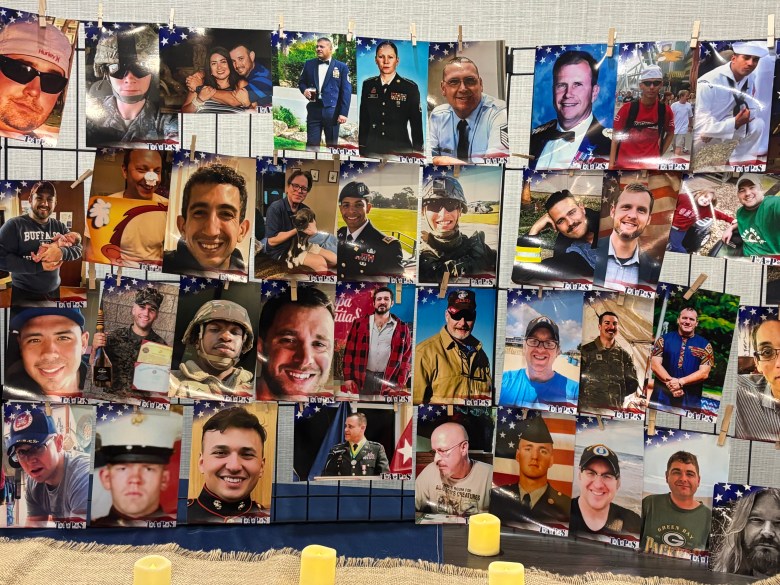 Military families in attendance at the National Military Suicide Loss Survivor Seminar and Good Grief Camp all saw photos of their loved ones on the “Honor Wall.” Credit: Eleanor Fitzgerald/ San Antonio Report
The camp portion is for children, and the seminar is for adults. All of the more than 400 military families in attendance had lost a loved one to suicide.
A 2021 study estimated that four times as many active duty service members and veterans have died by suicide than have died in combat operations post-9/11. VA data indicates that more than 140,000 veterans have died by suicide since 2001.
Research shows that those in close proximity to a death by suicide are 65% more likely to contemplate suicide themselves. TAPS is aiming to stop this cycle using a “prevention through postvention” approach.
Lisa Wright is one of the TAPS mentors making initial calls to survivors. The calls don’t stop once a connection is made, she continues to check in frequently in the year following the death. She has a list of 500 people that she is making calls to this year.
“Many times I’m the first fellow suicide spouse they talk to, and you hear an audible sigh of relief,” Wright said. “There’s just something about being with other people who are walking this journey that causes our shoulders to drop a little bit and relax, and think it’s going to be okay. My life is not over.”
She said 29 of her 500 spouse mentees were in attendance at the August seminar. She carried around a 3×5 index card with all of their names written. Having never met in person, she said they recognized each other’s voices in the food line and around the conference.
“You’re my lifeline. I don’t know how I could have made it without you,” she recalls hearing.
Seven years ago, Wright and her family moved to northeast Texas, finally ready for her husband’s post-Marine retirement stage of life to begin. She teaches high school theater, and her husband was volunteering as her tech.
When he died by suicide later that year, she felt completely unmoored. Still new to town, she drove to the nearest military base for help. But it wasn’t until she connected with TAPS that she felt supported.
Eight months after his death she stood outside of the door of a regional seminar and cried, not wanting to enter and have this part of her life become her “story.” But she went in.
“It takes a lot of courage and bravery to come… because it’s almost like now I have to acknowledge this. This is my life. This is my future,” she said. “…Here, I kind of found I could be whole again and find my personality again. I could laugh, and I didn’t feel like I was betraying my husband.”
She described an immense comfort at being among a community of people where she didn’t have to explain or defend her husband, everyone already understood.
It was a theme commonly evoked over the course of the seminar: the general public’s stigma around suicide, and the profound relief of gathering with a group of survivors where memories of loved ones could be shared without judgment, and suicide could be spoken about openly.
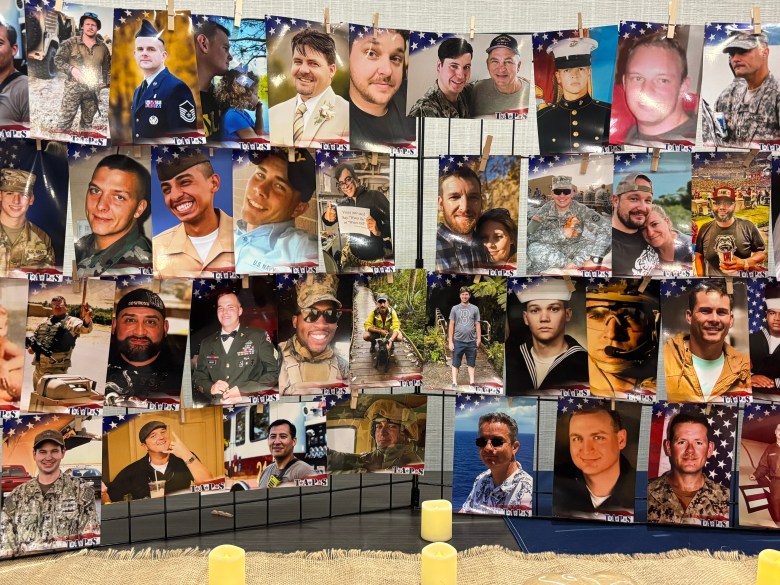 At least 400 military families in San Antonio gathered earlier this month for the 18th annual TAPS seminar and camp. Credit: Eleanor Fitzgerald / San Antonio Report
Good Grief Camp
Donald Current is a retired San Antonio Marine who has been volunteering as a peer mentor with the Good Grief Camp since last year. He said when he got out of the military he was looking for purpose, and he found it working with kids at TAPS. This time he was with the 12- to 14- year-old group, helping them make sense of the death of a parent.
“We had a kid say ‘I wish society would normalize the word of “suicide”…because if I say my father was murdered or my mother was murdered, no one bats an eye. But if I say my father committed suicide, everything stops, and everybody looks at me like I did something wrong,’” Current said.
He shows up for the kids beyond the weekend-long camp, he went to the San Antonio high school graduation of one of his mentees last year. Current said he knew her father had been her person, and he wanted to help make up for that absence.
Even while currently being on active duty at Lackland Air Force Base, Abby Daniels has been volunteering with TAPS. Since 2016 she has served as a peer mentor, but she said it’s still emotional to think about her own close proximity to these children’s loss.
“We’re supporting the kids, but their parents and brothers and sisters were us,” Daniels said.
She said many of the kids she mentors have had to grow up faster and help support their surviving parent through this loss, and her job is to give them a space where they can be seen and heard, and be young still.
Lynn Paljarvi’s children were 5 and 7 years old when her husband died by suicide in 2017. Five years later they traveled from Houston to attend their first TAPS regional seminar. She said the organization has given her children the chance to be kids again.
At Good Grief Camp they can talk about their dad and not feel embarrassed by their loss; they can remember and honor him with kids who get it.
“In our normal lives, we’re not really around other people who’ve experienced something similar, and if we are, we don’t always know because people don’t talk about it,” Paljarvi said. “So I think for them, it’s also a place for them to just take their mask off and be around other people, and for them to feel normal.”
It’s not just her kids who feel this way – she said TAPS has also become a space for her to speak openly about her grief, no matter how many years have passed.
“I just remember feeling like a human again and normal because it’s a place where I didn’t have to pretend I was okay,” she said about her first seminar.
‘God Winks’
Over the course of the seminar weekend attendees chose from a variety of workshops, from nature walks and art classes to a newly added Spanish-only workshop. One of the most popular workshops is one called “God Winks,” where participants share stories of signs that made them feel a connection to their loved one.
Schultz said she has many of these stories. She “hoards” them for this event, eager to share the ways she thinks Gabriel is watching over her. His name on a street sign, a rubber duck with a four-leaf clover stamped on it and “Texas” written across its belly, a cat with a red bow showing up on her husband’s 50th birthday.
Schultz has been trying to bring her daughter, Jeanne, out to one of these seminars, and she almost got her to attend this one.
“She was questioning some things…she was like, ‘I don’t know if it’s the right thing for me. I just wish I had a sign to know that this is what I need to do,’” Schultz said.
On the first day of the seminar she got a text from Jeanne, who works at the Houston VA hospital. She sent a picture and the message said, “Mom, this guy just walked in. He’s an EMT.”
The picture was of a tall, brown-haired, mustached EMT. He was the spitting image of the photo of Gabriel on Schultz’s nametag.
She says Jeanne is coming with her to the next seminar.
The San Antonio Report’s military and veterans coverage is supported by Report for America.