
Dieri/Kauna man Spike has a distinctive beard, long and wrapped into a thin ponytail in string, the ends bleached white.
Warning: This story contains references to suicide and self-harm.
He calls it a reminder of his time in hospital, when he received care for depression and anxiety.
If you or anyone you know needs help:
- Suicide Call Back Service on 1300 659 467
- Lifeline on 13 11 14
- Aboriginal & Torres Strait Islander crisis support line 13YARN on 13 92 76
- Kids Helpline on 1800 551 800
- Beyond Blue on 1300 224 636
- Headspace on 1800 650 890
- ReachOut at au.reachout.com
- MensLine Australia on 1300 789 978
- QLife 1800 184 527
Spike has been around suicide from a young age.
“From primary school to high school, I had friends’ parents and friends commit suicide,” he said.
“I thought I was drawn to this magnet of suicide.”
The tipping point came while he was living in Adelaide in 2018.
A close friend of his died by suicide, with Spike being the one to find his body.
He said the death hit him hard, and his mental health slowly deteriorated.
“I wasn’t coping well and a lot of people didn’t see that either,” he said.
“I came up to Darwin thinking I could leave that behind — but I couldn’t, and it didn’t work.”

Spike moved to Darwin after a close friend of his died by suicide, but says he still felt lost until he started healing in hospital. (ABC News: Marcus Kennedy)
In Darwin, Spike said he felt lost.
He struggled with depression and anxiety, and tried to find help.
“I went to a couple of [doctor’s] surgeries and basically they were like, ‘We can’t help you right now, come back in a couple of weeks’,”
he said.
He went home after being waitlisted but without access to care, his condition rapidly worsened.
“I was basically found unconscious,” Spike said.
Following the advice of a supportive friend, he then went to “stay in hospital for a while”.
Services stretched to capacity
Spike’s struggles finding mental health support in the NT is not an isolated experience.
The Northern Territory has the highest rates of suicide, self-harm hospitalisation, and acute mental illness in the country, according to Australian Bureau of Statistics (ABS) data.
The NT lost 52 people to suicide in 2024 — the most recent year covered by the ABS data — putting its suicide rate at 19.3 per cent, far above the 11.9 per cent national average.
It also has 1.7 times the national rate of self-harm hospitalisations, while 51.7 per cent of Territorians aged 16-85 have a lifetime mental disorder.
But mental health sector workers say the NT’s limited services designed for early intervention and prevention are struggling to resource the high demand.
Rina Bruinsma, chief executive of Territory-wide mental health care service TeamHEALTH, calls it the “missing middle” — the group of people, like Spike, who often miss out on mental health services because their needs aren’t considered acute enough for emergency care.
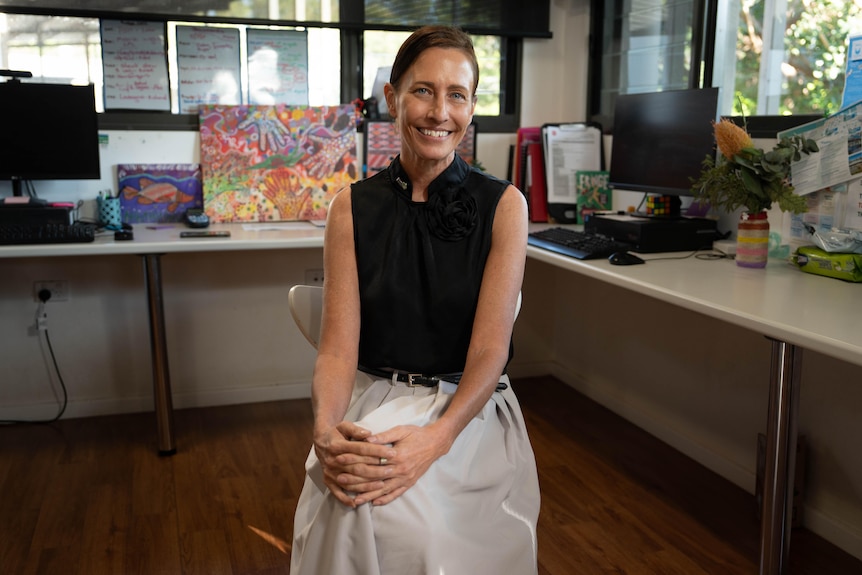
Rina Bruinsma says services in the NT are designed for early intervention and prevention, creating a support gap that means many miss out. (ABC News: Marcus Kennedy)
She said the organisation’s residential service — which accommodates people before and after hospital stays — is at 97 per cent occupancy all the time.
Ms Bruinsma said the gap in care was felt in urban areas, but the divide was even wider in remote communities, which often had to rely on visiting physicians or telehealth appointments.
“Whilst we have good services, there is a group of people that often receive support too late and get [airlifted] into the emergency department,” she said.
“[It’s] because of a lack of early intervention and prevention that might have otherwise been available.”
NT Chief Psychiatrist Dr David Mitchell said mental health services outside of hospital settings needed to be better funded in the Territory.

There are calls to invest more funding in mental health services for the Northern Territory. (ABC News: Marcus Kennedy)
“It’s not rocket science — we know if people get care early then it doesn’t fester, it doesn’t become more severe,” he said.
“An investment in early intervention and prevention is not just the right thing to do, it’s the sensible and pragmatic thing.”
He called on the federal government to increase the level of investment for those services.
“I do think that there is a moral imperative for the Commonwealth to be investing,” Dr Mitchell said.
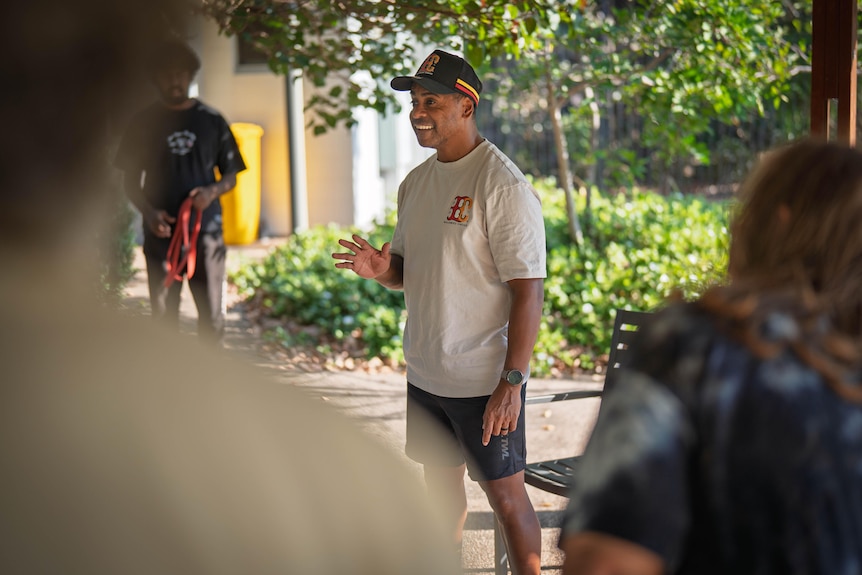
TeamHEALTH offers a variety of community supports, including a weekly collaboration with Balanced Choice to deliver court-side cook outs for local youth. (ABC News: Marcus Kennedy)
Federal Mental Health and Suicide Prevention Assistant Minister Emma McBride said the Australian government was investing in mental health services across the Territory, as part of a $1.1 billion spend on the sector nation-wide.
New Darwin service provides parents with mental health support
She said the recent opening of the NT’s first perinatal mental health centre, with a second centre to come, and a free walk-in mental health clinic in Alice Springs added to “a growing network of mental health supports across Darwin, Katherine and Alice Springs, including headspace centres, Kids Hubs and Medicare Mental Health Centres”.
“We know many Territorians face additional challenges accessing mental health support, particularly in rural and remote communities, which is why we are investing in services across the Territory,” Ms McBride said.
Recovery support essential
Spike’s story didn’t end in hospital.
He completed two stints in one of Royal Darwin Hospital’s mental health wards, commonly known as the Cowdy Ward.
It was there that he dyed his beard white.
Geographic isolation, paired with an overwhelmed mental health sector, are presenting access barriers for Territorians in need of support. (ABC News: Marcus Kennedy)
“That was two years ago,” Spike said, motioning to the bleached end of his beard.
“Everyone keeps saying to me, ‘Why don’t you dye it the same colour as your natural hair?'”
“Now, that’s a memory that I’m not going back,” he said, triumphantly tugging on his beard.
After leaving hospital, Spike also accessed TeamHEALTH for mental health care and the service also helped him gain employment.
He now works in aged care and at TeamHEALTH, where he uses his lived experience to help others manage their mental wellbeing.
Like Spike, Darwin resident Maria also spent time in Cowdy Ward after she was diagnosed with postpartum psychosis a few years ago, following the birth of her first child.

Maria says doctors and TeamHEALTH support workers have helped her achieve a more regular medication routine after she was diagnosed. (ABC News: Marcus Kennedy)
She described having to complete multiple stays at the ward, and struggling to stay on her medication at the time.
“I remember I went to a party with my friends, I said farewell — they thought I was going to Melbourne, but they don’t know that night I was really planning to end my life,” she said.
“I’m glad my friend picked it up, so she never left my side.”
Maria has since been diagnosed with bipolar disorder and anxiety.
She said doctors and community services like TeamHEALTH, who she now works for, had helped her stay regular with medication ever since.
“My studies [are] now slowly getting on track and my boy is in my care now,” she said.

Maria says her studies and home life are back on track, now that she’s in a better place mentally. (ABC News: Marcus Kennedy)
Community-based groups key to saving lives
Executive director of sector advocacy with Suicide Prevention Australia, Chris Stone, said community-based services and settings saved lives.
“What we hear over and over again from people who have been in suicidal distress, when they’re in that situation, is an emergency department is not the best place for them,” he said.
He called for a greater focus on prevention prior to crisis — but also said that when people reach a crisis point, the system should immediately be helping.
“When people are in suicidal crisis, an appointment tomorrow is not good enough,”
he said.
“Many of our member [organisations] in the Northern Territory are in this position where they’re sometimes overwhelmed.”

Chris Stone says community-based mental health services can save lives, but many of them are overwhelmed by demand in the NT. (Supplied: Suicide Prevention Australia)
He said growing the workforce to a size that can adequately respond to the crisis “sits at the heart of it”.
Ms Bruinsma agreed, and said one of the solutions, alongside funding, was to train people with lived experience to work in the sector — like Spike and Maria.
She said those workers were often able to apply their own knowledge to speak from experiences and help others.
Workers with lived experience ‘give hope’ to others
Astrid, a terror attack survivor, also uses her experiences to guide her work as a TeamHEALTH peer support worker, helping others to navigate a system that she once struggled to get help in herself.
She said navigating the healthcare system as an immigrant was difficult — figuring out what services were available on different visas, communicating with thick accents, and even overcoming cultural stigma about reaching out for help.
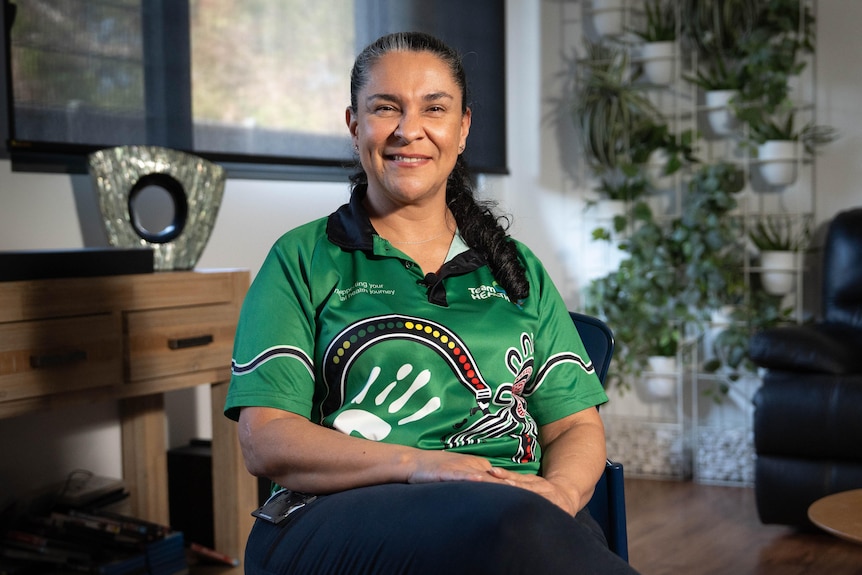
Astrid remembers having difficulty navigating the healthcare system herself. (ABC News: Marcus Kennedy)
“To go to different doctors to get a mental healthcare plan, and tell the story and assessments — one time, two times, three times — it’s triggering,” she said.
“It has a name — it’s re-traumatisation. That’s very, very hard for us.”
She said the TeamHEALTH role gave her the opportunity to use her own experience “to give hope” to the people she cares for.
“That’s our job, to stay there and support and advocate and to sustain hope,”
she said.