
Many movies are made to be seen on big silver screens; all movies are made to be seen sitting alongside others. Chicago has long been the midwestern movie mecca for audiences and filmmakers alike, and while there is no shortage of multiplex and independent theaters for folks to visit, many of which have lounges to linger in, there is still a collective longing for spaces dedicated to connecting before and after screenings. Additionally, local filmmakers are in need of stronger systems of support to exhibit their work on large formats in front of audiences. Although some theaters offer rental services, the cost can be inaccessible for small productions or early career artists. A solution? Microcinemas.
In true underground fashion, microcinemas have an enigmatic origin. There is little evidence documenting their prevalence, but their histories exist across the world and most clearly appear to date back to the 1950s–1970s in cities such as Tokyo, San Francisco, and Paris. Microcinemas as a category include various iterations of DIY theaters fueled by their local communities, often involving secondhand projectors, speakers, and screens with mismatched furniture arranged for a laidback viewing experience—storefronts, back rooms, and backyards transformed into miniature cinemas. Despite their technical imperfections, these self-made spaces are a crucial component of the cinematic ecosystem.
During the lockdown years of the pandemic, plenty of people found or rediscovered a deep love for the cinematic arts. Social media platforms like Letterboxd and TikTok especially allowed folks to connect over their love of movies, and this translated into a desire to connect in real life. In Chicago, the resurgence of microcinemas has evolved to meet the current moment; there is a clear consensus on the power of movies as a way of bringing people together. Across the city, there are more than 20 microcinemas located in at least 12 different communities.
 An outdoor Sandy Film Festival screening
Credit: Danielle DeGrasse-Levi
Interestingly, across more than a dozen alternative theaters I surveyed, there are no owners or operators whose sole responsibility is running their microcinema; a great majority are also juggling full-time roles, other creative practices, and personal responsibilities. Logistically and fiscally, most microcinemas and film clubs are in it for the love of movies. To keep operating costs at a minimum, some venues forego proper licensing. And in lieu of ticket sales, almost all spaces have a strongly suggested donation to help cover the costs of snacks, drinks, and rent; oftentimes, organizations subsidize the maintenance and programming with their full-time work and simply hope to break even. However, it is rare for guests to be denied entry for lack of payment, making microcinemas one of the most accessible and affordable forms of nightlife and entertainment.
Records of Chicago’s microcinema landscape show a strong presence in the 2010s but date back to 1986. Cinema Borealis (1986–2020) was a Wicker Park institution run by projection expert James Bond. The Nightingale Cinema—previously stewarded by the Siskel Film Center’s current associate director of programming, Christy LeMaster—ran strong from 2008 through 2022 in a dedicated West Town space. Like much of the theatrical and film industry, Nightingale evolved toward hosting pop-up programming in partnership with other exhibition spaces, allowing them to maintain their collaborative approach. Jake S. Weisman, an indie filmmaker who got his start in Chicago during the 2010s, operated a unique microcinema until 2020 above the New 400 Theater while also working downstairs in the main cinema. Weisman embodied a hunger to be around movie-minded people as much as possible. “Everything is in service to the [film] community,” he said of his vocation as a filmmaker and steward of exhibition spaces. Inspiringly, Weisman’s whatever-it-takes mindset doubles as a blueprint: “Any room that has a projector, a screen, and preferably seats can be a movie theater.”
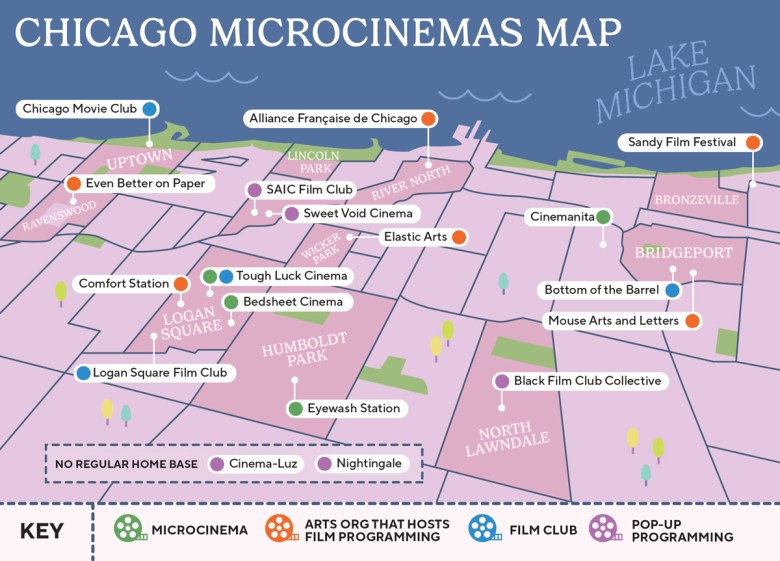 Because many DIY film projects are multifaceted and often shift in scope and location, this map of Chicago’s underground cinemas and movie clubs is likely noncomprehensive.
Credit: Amber Huff
Each organizer I spoke with for this story has a unique approach to selecting films, but ultimately, all are looking to fill a programmatic void while simultaneously creating casual spaces for connection. Sandy Film Festival founders, producers, and sisters Danielle DeGrasse-Levi and Nicole DeGrasse-Mitchell are thoughtfully expanding what an independent film festival offers to its community and filmmakers. In addition to hosting a two-day shorts festival, Sandy organizes a summer outdoor screening series, Feature Fridays, in partnership with Parkway Social in Bronzeville, making it one of the few places for local residents to accessibly see a movie with others. Both sisters attested to a strong belief that “film is a form of art therapy,” and although they consider themselves to run more of an “outdoor pop-up cinema,” they feel a great sense of responsibility in showcasing stories that reflect the neighborhood and underrepresented audiences.
“I would love to be a part of someone’s beginning,” DeGrasse-Mitchell said. “We are coming from such a grassroots place ourselves that we want to extend that same grace and understanding to filmmakers and audiences.”
In the neighborhood next door, Bridgeport’s Cinemanita, founded by Eli Ramirez and Reader editor-in-chief Sarah Conway, is equally determined to bring more awareness to arthouse films and DIY cinema. Drawing inspiration from their annual cinematic escapades to Amsterdam, the pair behind Cinemanita offers complimentary mint tea (fresh mint leaves steeped in hot water) and popcorn to attendees. “The one key thing that Sarah and I share is the notion that movies are a total opportunity to be transported,” Ramirez shared with a passionate tone that underscores the energy of Weisman. The microcinema is currently housed in the Chicago Art Department, but the duo dream of expanding their bimonthly screenings into a permanent physical space. When I attended a showing of Wong Kar-Wai’s Happy Together (1997) on a beautiful summertime Saturday, the audience turnout was so abundant that extra chairs were added to accommodate. Cinemanita seeks to create community with intentionality, building a safe and welcoming experience for solo moviegoers and groups alike.
Similarly, at a Friday night summer screening of The Spook Who Sat by the Door (1973) at Mouse Arts and Letters, also located in Bridgeport, there was an eager full house. Although Mouse Arts and Letters hosts a wide variety of other programs in their space, which is a former bank with a funky vault in the back, their partnerships with other organizations strategically bolster their reach and turnout. Because of their expansive offerings as a membership club, they do not particularly claim the “microcinema” label. Notably, their programming remains free and open to the public to ensure accessibility, and they do not charge any rental fees to organizations looking to use the space. This is a rare but significant offering for local filmmakers who need a low-cost, turnkey venue to show their movies.
 A Black Film Club Collective screening of the 2024 short Take 290
Credit: M. Lamourt Studios
Eyewash Station, founded in April 2026, is one of the most prominent names in this new era of Chicago microcinemas. Taylor Dye, Eyewash Station’s founder and creator of Eyewash Video Magazine, hosts screenings in a converted Humboldt Park storefront as frequently as possible and recently scaled up to four showings per week. Like Mouse Arts and Letters, Dye welcomes community collaboration; in August, Eyewash hosted a Cuba Past & Present night that was a teach-in and screening. Dye expressed missing minitheaters like Sweet Void Cinema, which closed its Humboldt Park operation at the end of 2024 and hosted more than ten screenings a week at its peak. Jack McCoy, the founder of Sweet Void, now hosts a handful of programs annually at Facets, and he spoke highly of Eyewash as a continuation of his mission in filling a geographic void and “trying to help make part of an infrastructure to truly help sustain Chicago filmmakers.”
One of the more ingenious formats of microcinemas are film clubs. “Troy Martin and Chinyere Achebe, who founded Black Film Club Collective in 2020, claim the classification “mobile cinema house.” Their programming is hosted at various venues, prominently Monday Coffee in North Lawndale and Three Cities Social in River North. What began as close-knit movie nights at Martin’s apartment have grown exponentially; Martin and Achebe are also tapped by studios and festivals, such as Chicago Critics Film Festival and Black Harvest Film Festival, to support audience attendance. As they wrap up a residency on Chicago’s west side, where they focused on capturing oral histories, they have their eyes set on expanding their practice as cinematic gatherers.
On the city’s northwest side, Logan Square Film Club has only burgeoned since its inception in May 2025. The original founder of the club was inspired by a Reddit thread, and more than 30 people attended their first meeting. In addition to their strong digital presence on Instagram and Discord, the current organizers, Sue Cardenas-Soto and Aurora Belloso, expanded the club’s convenings through monthly double features at Podlasie Club. “It’s a dream come true,” Cardenas-Soto said about the opportunity to program movies in a public space, which also led to a guest program at Eyewash Station in June 2026. “This has fulfilled something I’ve longed to do for a long time,” they added. Belloso, who runs the club’s social media accounts, shared that “the community aspect is front and center for me,” and that it simultaneously deepens the duo’s personal relationship to film.
Logan Square is also home to Tough Luck Cinema, founded and produced by Jackie Baker, with support from venue owner Brit Piller. “It gets real weird,” Piller said with a smile. “I always acknowledge in my introductions how much it means that these people left their house to come see a movie.”
Baker added, “A big part of my coming of age in Chicago was living in a DIY venue [the Dollhouse], so when I think of community, that type of space means everything.” Tough Luck began as a horror niche but has since expanded its programmatic lens to creatively consider how that genre manifests. Like her peers in the microcinema scene, Baker is keen on evolving the space and screenings to respond to the community while weaving in cultural relevancy.
“Any room that has a projector, a screen, and preferably seats can be a movie theater.”
As a regular patron of all forms of Chicago’s cinematic venues, from AMCs to drive-ins to indie arthouses, I have never experienced audiences as respectful and engaged as those surrounding me at microcinemas. Even without the standard prescreening disclaimer one might see at a larger cinema, there is no phone usage and no unnecessary mid-movie chatter.
Another common thread among DIY theaters is their emphasis on letting folks linger after the credits roll. “We really understand our audience and the importance of speaking to the lifestyle and community, and they are able to trust us to provide a diverse experience that allows them to engage in storytelling and the conversations it creates,” said Achebe of Black Film Club Collective.
The best way to find a majority of Chicagoland’s microcinemas is via Instagram, meaning there is an ephemerality to their nature driven by the digital age—we’re all at the mercy of the algorithm. However, online platforms permit operating flexibility, quick communication, and limitless reach; both Sandy Film Festival and Black Film Club Collective noted to me their national and international followings. Social media also presents opportunities for mutual education and collaboration between venues in Chicago and around the world.
For some organizations, including Tough Luck Cinema, Mouse Arts and Letters, and Cinemanita, a weekly or monthly newsletter is another means of communication to reach those who may not have a strong presence on social media. Cinemanita’s Ramirez shared how the microcinema’s newsletter is simply another extension of his and Sarah’s passion for the DIY cinema scene; it aggregates upcoming screenings across the city at spaces such as Bedsheet Cinema, an outdoor microcinema. Regardless of their means of outreach, it is inspiring to know that—in a post–pandemic lockdown era—each microcinema’s digital presence transmutes into in-person connection.
As more organizations wield the wonder of cinema, the classification of microcinema, or DIY theater, or film club, evolves and expands. Any limitations in a space’s technical ability are outshone by the courage they exhibit in curating and hosting folks to collectively enjoy a movie.
Correction (9/2/26, 9 AM): The print version of this story includes both mention and mapping of DIY venue Big Foggy. However, on Monday, August 31, three days after the issue went to press, Big Foggy announced its immediate closure via Instagram.
Reader Recommends: FILM & TV
Our critics review the best on the big and small screens and in the media.

Late Fame is a surprisingly warm satire, held down by all-timer performances.
August 18, 2026August 18, 2026
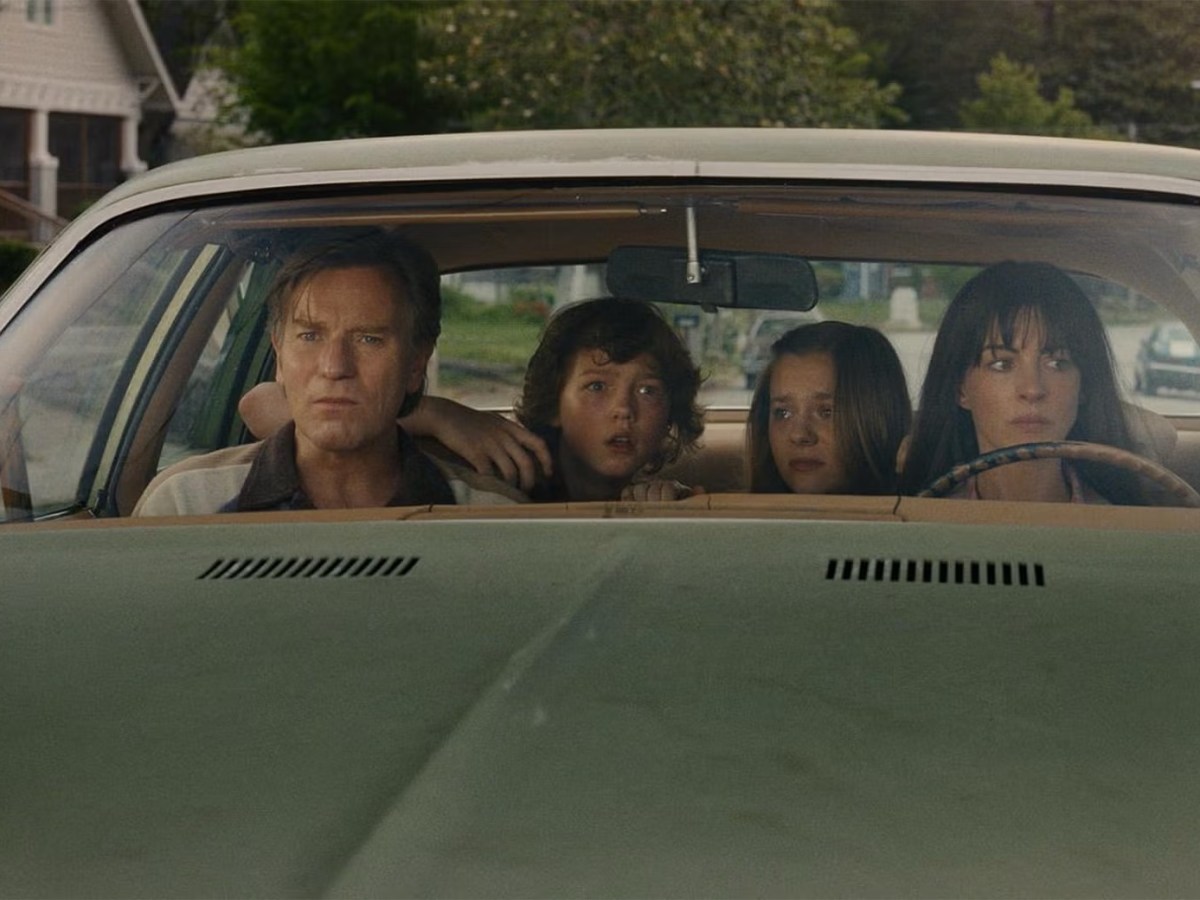
The End of Oak Street is a referential, personal, and balanced adventure film from David Robert Mitchell.
August 14, 2026August 14, 2026

In Tony, director Matt Johnson smartly depicts a snapshot of the life of Anthony Bourdain.
August 13, 2026August 13, 2026

Jane Schoenbrun’s latest is a surprisingly hopeful metacommentary.
August 13, 2026August 13, 2026

Elliot Tuttle’s Blue Film is explicitly about seeing and being seen.
August 6, 2026

Ian Bell’s WTO/99 speaks to our nebulous future.
August 5, 2026August 5, 2026