
The Rent Guidelines Board’s June decision to freeze the rent for nearly 1 million apartments on Oct. 1 now rests in the hands of a Manhattan Supreme Court judge set to rule in the coming days.
Supreme Court Judge Brendan Lantry heard arguments Wednesday in a lawsuit filed by a group of seven landlords suing to halt the rent freeze over allegations of foul play by Mayor Zohran Mamdani and a lack of independent analysis data in the Board’s decision-making process. The nearly six-hour hearing on Sept. 2 saw lawyers for the city and the landlords bringing the suit quarrel over the 7-1 June vote from the Rent Guidelines Board (RGB) to freeze the rent on both one- and two-year rent-stabilized leases — the first time the board’s made such a decision in the city’s history — and something Mamdani promised on the campaign trail.
The landlords bringing the case — represented by Randy Mastro, former first deputy mayor under ex-Mayor Eric Adams — argue that the RGB only voted to freeze the rent this summer because Mamdani, who campaigned on doing so, “put his thumb on the scale.”
They contend Mamdani “packed” the RGB with political allies who manipulated and didn’t properly consider data on the impact a freeze would have on landlords, accusing the board of doing “funny math” and violating its legal requirement to make an independent data-based decision.
“This RGB … ignored, manipulated, denied [data] and was inconsistent with its statutory mandate,” Mastro said during the Wednesday hearing. “There is no rational explanation. The fact of the matter is that a candidate promised a rent freeze, gets elected mayor [and] packs the board with accolades.”
But New York City Corporation Counsel Steven Banks, who argued the case in court alongside Rachel Moston, assistant corporation counsel for the RGB, told the judge that’s simply not what happened.
Mamdani did not interfere with the RGB’s independent process and the board thoroughly considered all of the data in front of it, Banks said, pointing to thousands of pages of studies and data in the public record that board members testified to taking into account when making their decision.
“There is no basis in the record to show there is anything other than proper and lawful proceedings that took place,” Moston said. “It cannot be said looking at the record … that the board did not consider all of the factors.”
Mastro pointed to landlords who said they couldn’t afford their properties now that the city had frozen their rent, saying their costs across the board had gone up 5.3% and that, just to maintain their current financial position, they’d need to increase rents at least 3.4% on one-year leases and 4.8% on 2-year leases.
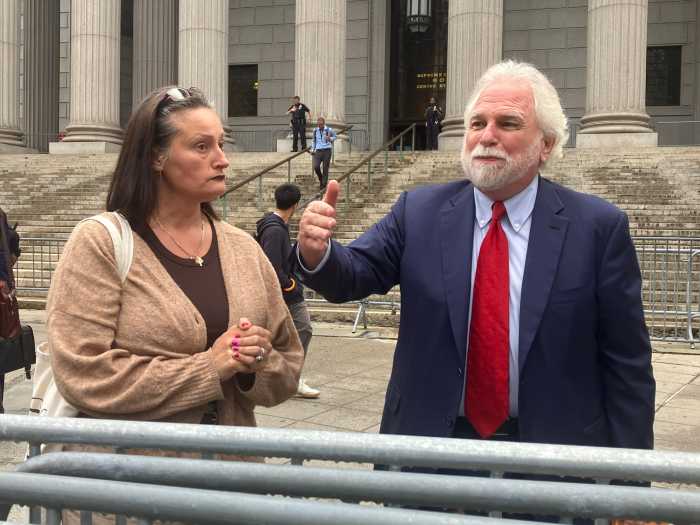 Mastro speaks with a landlord outside Manhattan Supreme Court.Photo by Isabella Gallo
The city said the board did take rising costs for landlords into account, but that it was only one of the many factors the board must consider. 50% of the city’s tenants in rent-stabilized units were rent-burdened and 30% were severely rent-burdened – meaning they spend more than 30% or 50% of their income on rent, respectively – and 40% of the lowest-income tenants had seen a decrease in their wages, all data the RGB took into account.
That means some of the city’s lowest-income renters would likely struggle to continue to pay rent and face more evictions if the freeze were reversed, something that would also harm landlords as they wouldn’t be getting that rental income, the city said. And, there had been years of increases landlords had benefited from and tenants had struggled to keep up with, something the board also balanced.
“It’s not easy enough to just say, ‘Owners’ costs are up and therefore rents have to go up too,’” Moston said. “The board has to consider all factors.”
While Mastro drew attention to the fact that Mamdani appointed six members to the nine-member Rent Guidelines Board prior to its June vote, Banks said that was an entirely legal and typical process, as the mayor needed to fill vacancies that had naturally occurred.
Mamdani’s statements promising a rent freeze on the campaign trail and appointing board members once in office shouldn’t be taken as him unduly influencing or predetermining the board’s decision, Banks said – not only because he said the mayor did not ask the members to vote one way or the other, but because it’s common for candidates to express their feelings on policy matters.
After taking office, Mamdani had shied away from making more declaratory statements about what the RGB should do. However, Banks noted that when Bill de Blasio actually held the mayoral seat, he said the RGB “should” freeze the rent – demonstrating precedent for opining on the board.
Banks also pointed to board member Arpit Gupta, an Adams appointee who voted against freezing the rent, publicly saying that Mamdani did not interfere with the board’s decision-making process – unlike other mayors had in the past – to emphasize that the board’s decision was independent. The fact that he said so after voting – when he had no reason to defend the board’s decision – should speak volumes, Banks said.
Mastro countered by pointing to one of the two RGB members representing landlords, Christina Smyth, resigning “in protest” hours before the June rent freeze vote. Smyth alleged the rent freeze had been predetermined and that the board had traded its status as a “fact-finding body” for one that “starts with an answer and vibe codes its way backward to justify it.”
The other landlord representative on the board, Maksim Wynn, voted in support of the freeze, saying that higher legal rents could reduce collections if more tenants stopped paying, hurting landlords anyway.
Lantry, the former head of Staten Island’s Republican party who was assigned the case just days ago after Mastro lost a fight with the city to bring the case in a Staten Island court, said he would be issuing his decision quickly, as he was well aware of its time-sensitive nature.
No one appeared to have clarity on what would happen to the rent-stabilized tenants who have already signed renewal leases with 0% rent increases. Whether those leases would be voided, would be subject to the increase scheme from last year, would be subject to any increase that landlords may wish to impose or would simply remain valid as signed regardless of the ruling did not seem to be known by anyone and would likely require an additional future court ruling to clarify the situation.
Whichever way Lantry rules, his decision is all but guaranteed to be appealed to the Appellate Division, First Department, further elongating the period of uncertainty for people who have re-signed rent-stabilized leases.