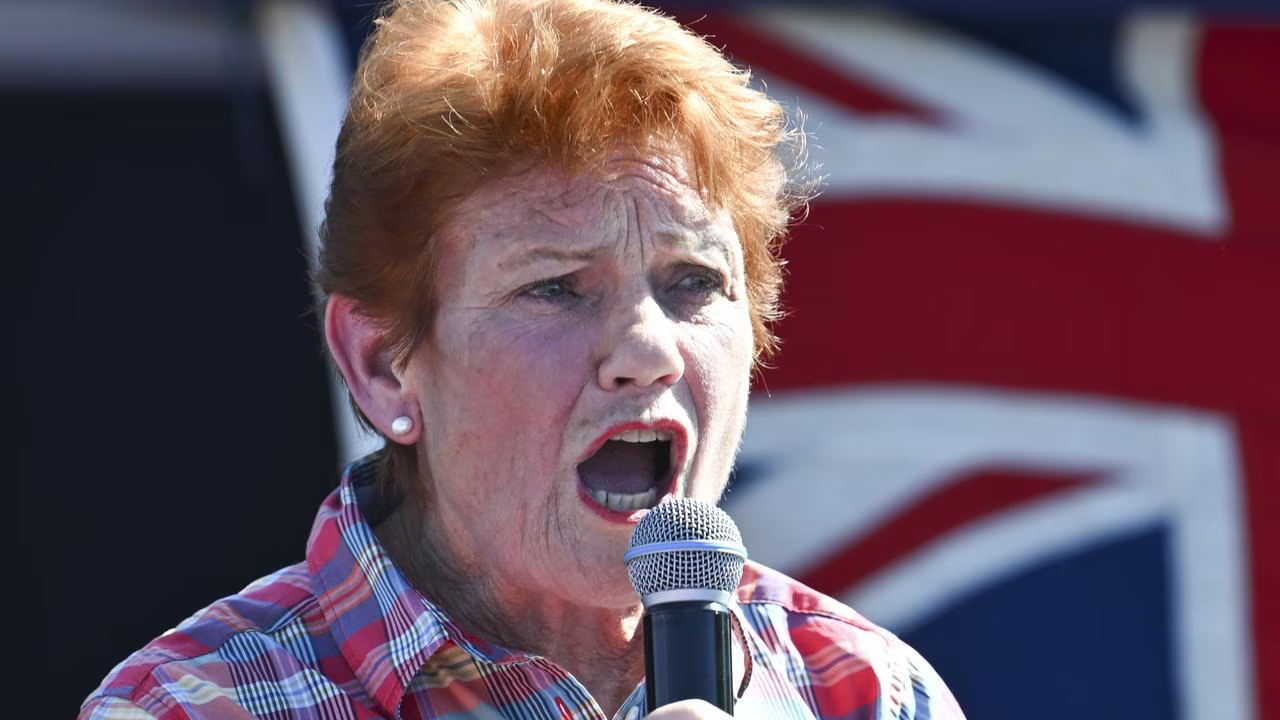
Migration has emerged as a major political flashpoint, as the now three major parties attempt to convince Aussies that their migration policy is superior to that of their rivals.
According to the recently released One Nation Voter Study, authored by Labor strategist Bruce Hawker and pollster John Utting, migration is a significant factor behind One Nation’s rise.
“Migration is the real thing motivating One Nation supporters,” the study states.

“Cost-of-living rhetoric is everywhere these days and people are a bit deadened to it.
“Migration is the real hotspot. Everyone has a cost of living plan and it is hard to get cut-through.”
With opposition to the current size of Australia’s migration intake growing, it’s worth exploring how Australia’s intake stacks up against the rest of the developed world – and where the levels proposed by the major parties would sit if realised.
Our place in the world
On examining a chart of net overseas migration into developed world nations as a proportion of the population each year (with populations over 5 million people), Australia swiftly stands out from its peers.
With an intake equivalent to 1.07 per cent of its population, Australia is among only three nations at this end of the chart, along with Portugal and Ireland.
At a population weighted level, the average rate of net overseas migration into the developed world (countries with a population more than 5 million people) is 0.26 per cent of the population per year. In terms of a simple average across the aforementioned developed world nations, but excluding Australia, the average is 0.34 per cent of the population.
Australia’s current per capita intake is running at more than 2.5 times the per capita pace of global public policy darling Norway, and 13.4 times the pace of the major Anglosphere national average (Canada, New Zealand, UK and US).
This is due to the fact that the rest of the Anglosphere outside of Australia has slashed migration by at least 80 per cent from the peak and as much as 100 per cent in Canada.
How the major parties stack up
Before we get into the numbers, it’s worth clarifying what exactly net overseas migration is, as measured by the Australian Bureau of Statistics (ABS).
For someone to be counted as part of the net overseas migration intake, they need to come to Australia on a permanent or long-term basis, and be present in Australia for 12 months out of a 16 month period.
This naturally does not capture a wide assortment of temporary migrants, such as a sizeable proportion of backpackers whose standard visa is for a maximum of 12 months, but who still require housing and services.
While there is significant variation in the current proposed net overseas migration intakes of the Coalition, Labor and One Nation, the gap between the three is not as wide as it once was.
The current intake based on the latest data from the ABS sits at 301,000 per year.
Meanwhile, One Nation is proposing a net overseas migration intake of 130,000 per year.
According to Opposition Leader Angus Taylor, the Coalition would pursue an intake with a target level “well below 200,000”. In the absence of a hard target from the Coalition, we will be using a placeholder of 175,000 per year.
Meanwhile, Labor is proposing a target of 225,000 per year for 2027-28, but this remains in significant doubt as Cabinet and the Prime Minister continue to debate the changes seen as
necessary to reduce the intake to this level from the current total.
If we translate this into a proportion of the population, it is as follows:
If we were to put this into terms with developed world norms, all of the major parties possess migration targets significantly in excess of both of the developed world averages.
The takeaway
While the Coalition’s migration cuts and One Nation’s migration target are considered by some to be restrictive, when put into context with the per capita intakes of the rest of the developed world, they are both far above the average.
If we take the simple average which is skewed significantly higher by the likes of relatively small countries such as Ireland and Portugal, the Coalition’s place holder figure is 83.6 per cent higher in relative terms, with One Nation’s 36.6 per cent higher.
In terms of the current intake, it is 215.7 per cent higher than the developed world average and Labor’s proposed intake of 225,000 is 116.9 per cent higher.
On the path ahead, debate over the right level of immigration into Australia is likely to continue to persist, but the data from statistics agencies around the globe is clear.
Whichever of the three major parties is the one holding the lever that controls migration into Australia, migration will be significantly higher than the developed world average.
Tarric Brooker is a freelance writer
Read related topics:Pauline Hanson