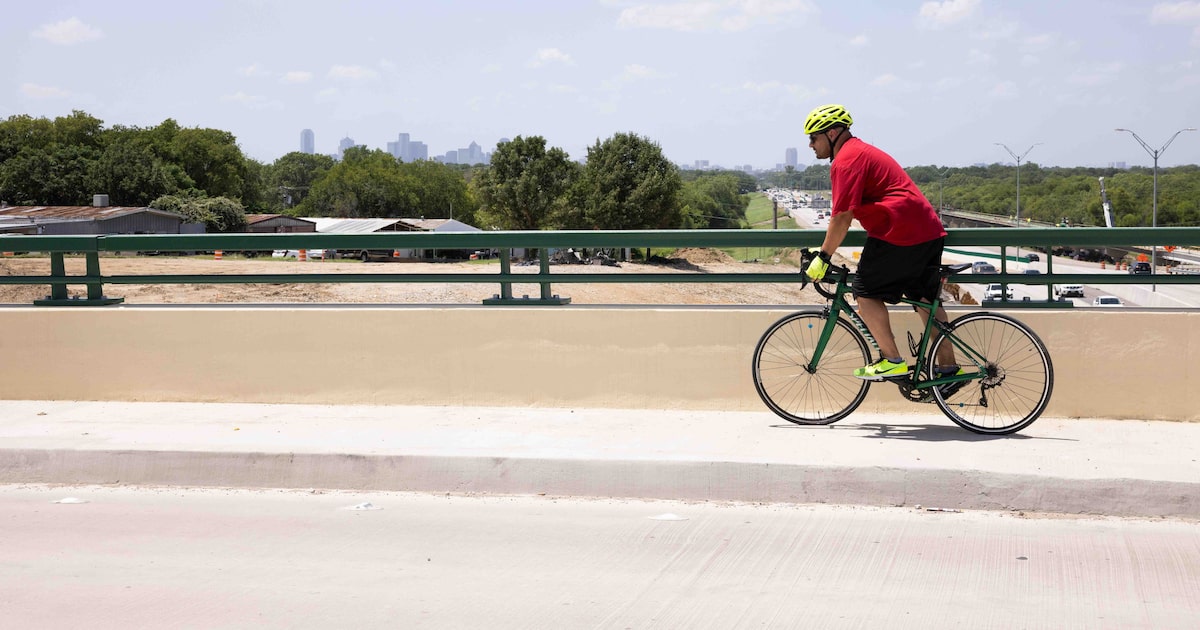
The two-way bridge on Lake June Road once had crumbling edges and no sidewalks. It is often the only way for residents from the Pemberton Hill neighborhood to get to the nearest full grocery store after Texas extended the U.S. Route 175 and cut the neighborhood from the larger Pleasant Grove community.
Juanita Arevalo has used the bridge for years to go grocery shopping. She’s seen wheelchairs and cyclists brave the bumpy, aging terrain. Pedestrians within a hair’s breadth of speeding cars.
Major projects such as the 50-mile Loop trail in Dallas are having positive impacts across the city. The effect is being felt in particular in southern Dallas where residents are eagerly waiting for better infrastructure and the development that often comes with it.
Jaime Resendez, the council member overseeing District 5 in southeast Dallas, has more than a dozen pictures and videos of the close calls. There’s a man wrapped in his rain jacket walking next to a hulking Dallas Independent School District bus. Another photo shows a man next to trucks on a sunny day.
One of Resendez’s pictures ended up in an application for a federal grant to refurbish the eyesore and make roads safer for pedestrians and drivers alike.
Political Points
Now, change is afoot in Arevalo’s corner of Dallas.
A whiff of optimism has spilled into the community with improvements led by The Loop, a nonprofit that’s steering a mammoth 50-mile trail around the city. The project will bring the city’s largest trail network to the doorsteps of residents, and with it, the hope of mixed-income homeowners and a grocery store.
“Good, safe infrastructure has such an opportunity to change a community,” said Philip Hiatt Haigh, executive director of the Loop.
Traffic cones, workers in safety vests and construction hats dot the intersection. The new bridge will have bike lanes and pedestrian walkways that connect to an elevated bridge along U.S. Route 175. It’s part of the 9-mile Trinity Spine Trail, which will connect White Rock Lake, run through the Great Trinity Forest and connect with the AT&T trail to the south.
Haigh said the trail is the most ambitious project the group has embarked on. The first segment of the trail, which improved accessibility for underserved neighborhoods in Far East Dallas, opened off Ferguson Road toward Samuell Boulevard in 2023 and connects to the Santa Fe Trail.
The portion at the Lake June Road bridge was estimated to cost $12 million, but project costs ballooned to approximately $34 million after officials realized they needed to demolish the existing structure and build the bridge from scratch.
Put together, the nonprofit will be investing over $90 million south of Interstate 30 through the trail, Haigh said.
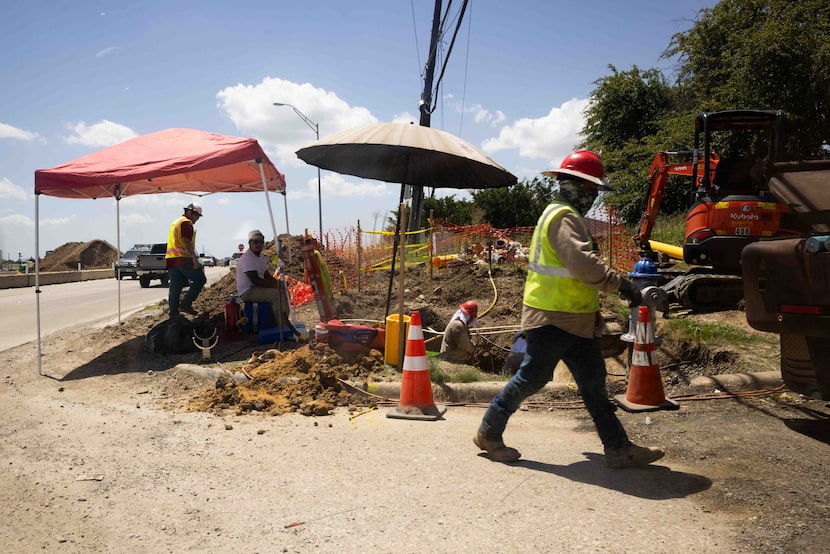 Workers as construction continues on the Lake June Road bridge in Dallas on Friday, July 18, 2025. (Juan Figueroa / Staff Photographer)
Resendez, who grew up in Pleasant Grove, said community members have long battled “a stepchild kind of feeling.” The longing to see the type of resources other parts of the city have attracted has often eclipsed the little progress several communities have made.
“But I kind of want to stop saying that,” he said. “We used to be ignored.”
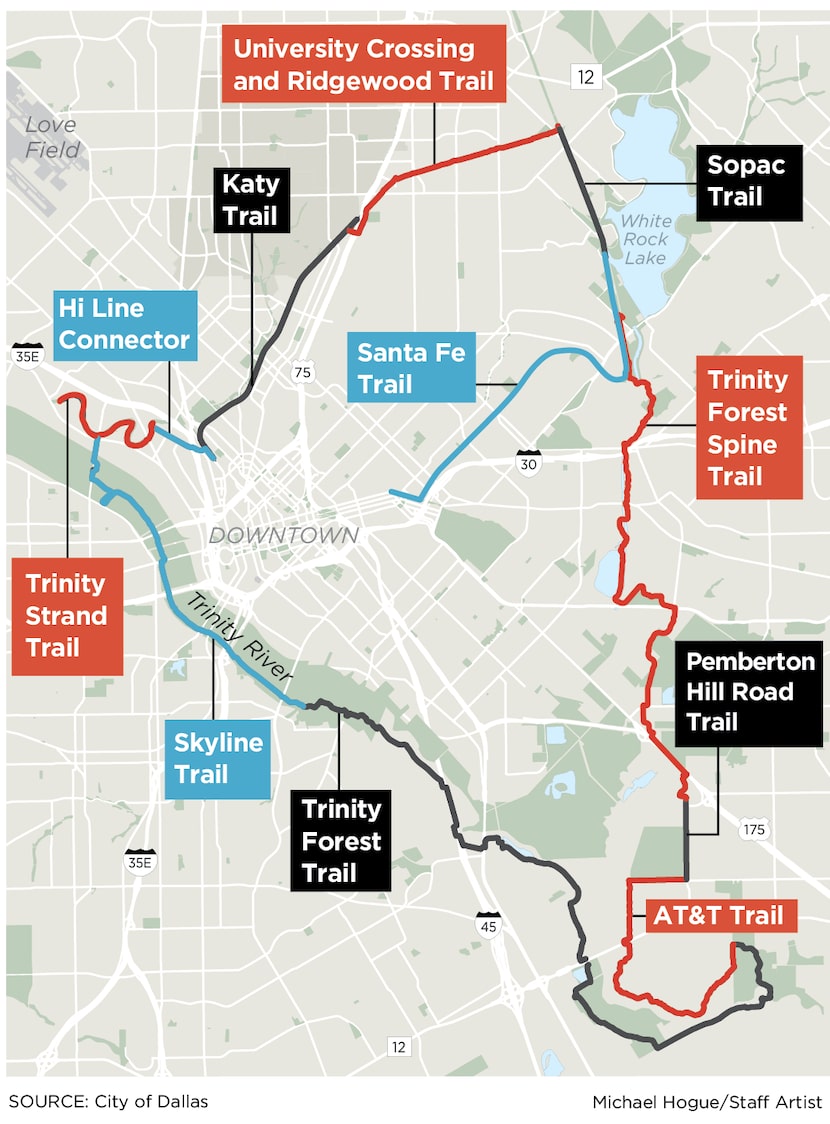 The city of Dallas is working with The Loop to connect 50 miles of trails around the city.(Staff)Dream of seeing more businesses, housing
For people who live here, revamping the Lake June Road bridge itself is half the battle won.
In 2017, in the Pemberton Hill area, which was cut off from the rest of the larger Pleasant Grove community, residents banded with city officials to develop a strategic neighborhood plan.
Much of the area around Pemberton Hill is filled with vacant lots, which present opportunities to attract more residential development and add safer neighborhood streets. Arevalo, who has lived in the area since the ’60s, has had a front-row seat to the changes in her community. These improvements, she said, could help bring more mixed-income homeowners and more police patrols.
“We have the issues everyone else has, you know?” she said. “We’ve got the drugs, we’ve got the gunfire.”
Economic development is closely tied to those dreams. New residential developments have been slow to come. The neighborhood was built nearly 20 years ago, Resendez said, adding that it still remains one of the newer constructions in the area.
“When I first got on the council, I was wondering how possible it would be to just get some development going,” Resendez said, adding that he’s heard from residents about a desire to see more restaurants and houses. “We want some disposable income in our community, so that businesses would want to invest in our area,” he said.
But with that comes the pressures of development and potentially disruptive gentrification.
Haigh said he’s aware new trails can bring with them fears of increased property values and possible displacement as wealthier homeowners swoop in, and skew the cost-burden of living in a neighborhood.
For instance, in the city of Atlanta, officials created a trail on the belt line, a former railroad. “It was so successful that it ended up becoming one of the most expensive areas to live in Atlanta, and that was not what they set out to do,” he said.
Already in the city, there are increased conversations about the tools residents have to stay where they are and age in place. One in five neighborhoods in Dallas is in the early stages of gentrification, according to a report by Builders of Hope, a community housing development organization that seeks to connect local families with tools to counteract displacement.
But Resendez says measured development begins with laying the infrastructure first. “These improvements are more thoughtful. They’re more foundational, and they allow for people who are living here to benefit from those investments,” he said.
Haigh agreed. Safe infrastructure can transform a neighborhood. Roads are no longer the only way to get through a community, he said.
“Pleasant Grove has been left out of a lot of development,” he said. “When you hear from community members, well, this is the first time I’m able to leave my neighborhood, you know, without a car, right? That shows that you’re putting attention on the people who live there.”
A cultural change?
On a sunny July afternoon, Dallas’ skyline gleamed in the backdrop as Resendez, in a T-shirt that said “Cycopath,” biked toward Pemberton Hill Road. Near the Lake June DART station, Resendez can’t help but marvel at the rolling green hills and the understated beauty of the community he grew up in.
“I always thought, man, that corner has a lot of potential,” Resendez said.
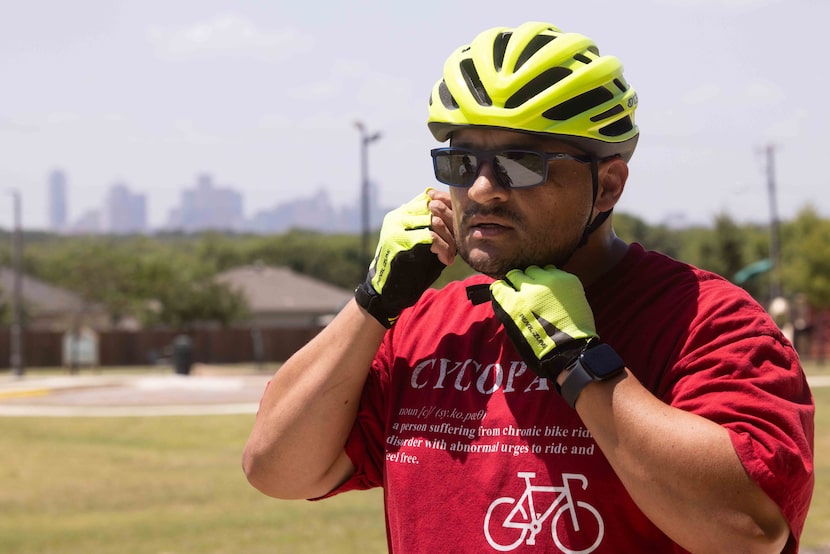 Council member Jaime Resendez puts his helmet on before a bike ride at Guard Park in Dallas on Friday, July 18, 2025. (Juan Figueroa / Staff Photographer)
That’s where Haigh, the leader of the Loop project, came in.
Prior to the nonprofit, Haigh worked at the Dallas Regional Chamber. A common issue he had always heard was figuring out ways to spur investment south of Interstate 30.
Resendez and Haigh found a complementary vision in each other when they first began thinking about how they would develop Pemberton Hill Road. They saw it as part of the 50-mile circuit, and it is lined with historical sites such as Big Spring, one of the only naturally occurring springs in the city, and The Texas Horse Park.
City officials, at first, wanted to calm traffic by adding a sidewalk and off-street parking along the road using bond dollars from the 2017 program.
Several residents, however, resisted the idea of additional parking because they were concerned about traffic from those who don’t live in the community. The idea they eventually settled on was to create a trail instead of a sidewalk. “That gives everybody who lives in this neighborhood direct access to the Loop, instead of it being this natural thing that is elusive to most people,” Haigh said.
Jesus Serrato, a school teacher, lives close by.
An avid cyclist, the community leader said he was ecstatic about the growing trail connections. “I’m kind of limited to my one trail at the moment,” he said. It was either use the trail at the Trinity River Audubon Center or drive to White Rock, “which is not around the corner and kind of out of my way,” he said.
Serrato works with a nonprofit, Los Primos Dallas, to mentor young students. Laying the foundations for more infrastructure can bring cultural change, and it’s possible, he said. One only needs to drive on Elam Road to the Crawford Memorial Park.
 Mayra Servantes walks the Crawford Memorial Park Loop on July 1, 2025, in Dallas. (Angela Piazza / Staff Photographer)
Since 2018, the city has wanted to redevelop the park first established in the 1940s, according to city documents. It has a 2.7-mile trail and is surrounded by soccer and baseball fields and basketball courts, with the Prairie Creek running through it. The redevelopment in the park, with the addition of water fountains, “made people want to go out a little more and do more outdoor activity,” Serrato said.
Resendez, who began biking more frequently during the COVID-19 pandemic, said cutting through strip malls in the absence of sidewalks, cycling past speeding cars on arterial thoroughfares and seeing more families on trails reminded him that growing up he’d never seen cyclists near him. It also gave him the confidence to keep pushing for more development.
“I think it’s important for young folks to see those things,” he said.
The beauty of the Great Trinity Forest could rival White Rock Lake, he said. Access to recreational spaces also has ties to mental health.
“We have so many kids who are athletes — if they pick this habit up, I mean, they would just be super elite, riding 20-something miles close to home. You don’t even have to jump in the car.”