Hall Effect explained through its working principle, applications, sensors, and latest findings showing Hall responses can occur beyond perpendicular magnetic fields.
Hall Effect Latest News
Scientists recently discovered an unexpected form of the Hall effect, overturning the long-held assumption that this electrical response only appears when a magnetic field points perpendicular to a material.
About Hall Effect
- It is named after American physicist Edwin H. Hall, who first introduced the theory to the world in 1879.
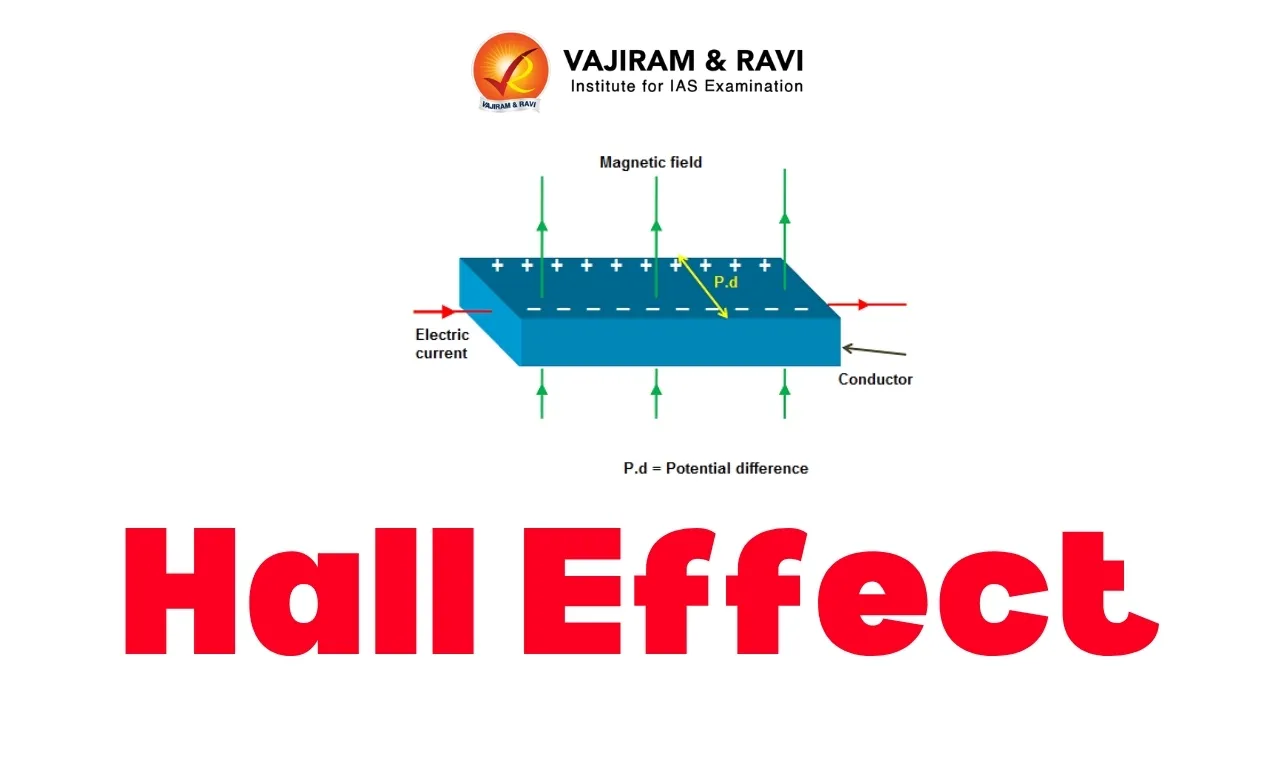
- Hall discovered that when a conductor or semiconductor with current flowing in one direction was introduced to a perpendicular magnetic field, a voltage could be measured at right angles to the current path; this measurable voltage is the Hall Effect.
- How does it work?
- The Hall effect takes place when you set current flowing through a conductor, which is a material such as copper or silver that permits electrons to flow freely across the entire surface area.
- The electrons begin to flow in a straight line from one side of the conductor to the other.
- If you were to introduce a magnetic field near the conductor, it would disturb the flow of the electrons due to the force applied.
- This is called Lorentz force, which is the force on a charged particle due to electric and magnetic fields.
- The magnet’s north pole pulls the negative electrons to one side of the conductor and deflects the positive electrons to the other side of the conductor.
- If you then put a voltage tester between the two sides, you will be given a voltage reading because there is current between the positive and negative electrons; by retrieving this measurable voltage, you are putting the Hall Effect principle into practice.
- In a semiconductor such as silicon or germanium, the drift velocity of electrons is a lot quicker due to the material used.
- This results in a stronger Hall effect which corresponds to a larger voltage reading being detected and therefore a more precise reading being taken.
- The Hall effect is used in several different products, such as sensors, joysticks, and switches.
- A Hall effect sensor is a device to measure the magnitude of a magnetic field.
- Its output voltage is directly proportional to the magnetic field strength through it.
- Hall effect sensors are used for proximity sensing, positioning, speed detection, and current sensing applications.
Recent Findings
- For a long time, people thought the Hall effect only worked when the magnetic field was applied perpendicular to the plane of the film.
- The recent findings show that a Hall response tied to magnetization can occur in more than one direction.
- That gives physicists a new way to investigate multidimensional magnetic and topological structures in condensed matter systems.
News: SD
Hall Effect FAQs
Q1. What is the Hall Effect?+
Q2. Who discovered the Hall Effect?+
Q3. Which force causes the deflection of charged particles in the Hall Effect?+
Q4. Why can semiconductors such as silicon and germanium produce a stronger Hall Effect?+
Q5. What is the Hall effect used for?+
Tags: hall effect prelims pointers upsc prelims current affairs
Previous Article
Eastern Economic Forum (EEF)
At Vajiram & Ravi, our team includes subject experts who have appeared for the UPSC Mains and the Interview stage. With their deep understanding of the exam, they create content that is clear, to the point, reliable, and helpful for aspirants.Their aim is to make even difficult topics easy to understand and directly useful for your UPSC preparation—whether it’s for Current Affairs, General Studies, or Optional subjects. Every note, article, or test is designed to save your time and boost your performance.
Related Posts
Courses

UPSC Sureshot Mains Test Series
₹27000