
WHITE, S.D. — Diesel prices continue to climb as harvest season starts for many farmers across the Midwest, causing concern for producers already facing tough market prices.
“Inputs are the thing that’s kicking the chair out from under us right now,” said Aaron Bowne, a crop and livestock producer from White, South Dakota.
Margins are tight this year for many producers.
“I would say break even, maybe turn a little bit, but I mean, it’s not going to be a runaway,” Aaron said.
This is the first time the national average has ever been over $6 per gallon. The previous record was $5.82 per gallon in June 2022. Sept. 22, 2026, was the highest average so far at $6.52 per gallon. The average on Sept. 30 was $6.41 per gallon.
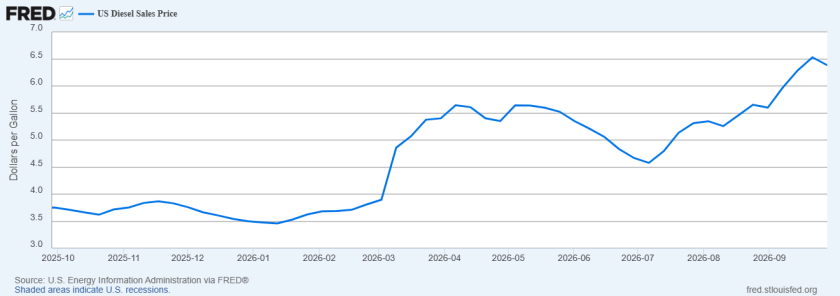
The change in diesel price over the last year.
Courtesy / U.S. Energy Information Administration
“A lot of people around here have semis, I mean they load it on a semi and that’s where it goes to the elevator or the ethanol plant. Well, when you’re 10, 15, 30 miles away, it takes a lot of money to make round trips all day long,” Aaron said. “So, at the end of the day, all of the sudden you, on a typical day, you probably could use 100 gallons of diesel in a truck …depending on your truck and your distance.”
Farm diesel prices are following the same rising trends, but the price is lower due to the removal of taxes, said Sarah Sellars, assistant professor and Extension specialist of sustainable farm and food systems at South Dakota State University.
On Sept. 4, Farm Bureau reported farm diesel prices nationally at $5.45 per gallon, up from $3.02 last year.

Diesel prices are hitting record levels just as farmers are set for one of the busiest times of the year in the field.
Erin Ehnle Brown / Real Ag Stock
Farmers usually store between 500 to 1000 gallons of diesel on their operations, so the individual impact of rising costs will depend on how many acres they farm and how much they have stored up.
Farmers use between 2 to 6 gallons of diesel per acre, depending on farming practices. Sellars said that comes to approximately a $12.55 increase per acre for diesel compared to this time last year. During harvest, the combine uses between .5 to 1.5 gallons of diesel per acre.
The Bownes’ previous diesel contract was $2.70 per gallon. On Sept. 24, it was $5.70.
“We’re looking at what our contract was for this year and what we’re looking at for this fall, contracting into the next year, and it’s a $3 difference,” said Charleen Bowne, who farms with Aaron.
The Bownes use approximately 9,000 to 10,000 gallons of diesel per year.

Gas prices in Brookings, South Dakota, on Sept. 30, 2026.
Ariana Schumacher / Agweek
“I mean, we’re small. I know guys that take two to three tanker loads a year to do their operation. So you take that, I mean, all of the sudden, that’s a huge cost, and it’s huge for everybody,” Aaron said.
Farmers have no alternative for diesel.
The change in diesel price over the last year.
Courtesy / U.S. Energy Information Administration
“Like when we saw high gas prices in the past, we would always tell drivers things like, ‘Oh, well, you can just bike to work or you can use public transportation or make sure your tires are properly inflated or don’t take a summer vacation.’ But when we look at farm diesel and farm fuel use, there’s not a lot we can do. It’s all kind of essential,” Sellars said.
One way farmers can reduce their diesel usage is to skip fall fieldwork, Sellars said.
“We can think about switching to no-till, things like that, but there’s not a lot we can do to move the lever,” she said.
In the 2026 crop budgets, Sellars said fuel and oil were 5% of gross crop revenue for corn. In 2023, that was 3%. The higher fuel prices were not reflected in the 2023 crop budgets because the crop revenue was so much higher, she said.

Sarah Sellars
Ariana Schumacher / Agweek
In 2027, however, that number will climb higher because while some commodity prices have increased, they are still low, especially with input costs higher than previous years.
Several government actions aimed at easing the burden of the high diesel prices have been announced in recent weeks. The Federal Motor Carriers Safety Administration on Sept. 16 waived hours-of-service limitations for motor carriers and drivers transporting gas and diesel. The waiver will be in place through Dec. 16. States can issue similar waivers for in-state travel. Montana Gov. Greg Gianforte issued such a waiver on Sept. 25.
South Dakota Gov. Larry Rhoden signed an executive order on Sept. 28
that allows farmers to haul crops, livestock and other agricultural commodities at 10% above weight restrictions, suspends a $25 overweight trip permit and directs the Department of Revenue to monitor fuel supplies and determine if a tax refund to suppliers is warranted if regular diesel needs to be used in farm machinery because of any future shortage of dyed diesel. It does not allow haulers to exceed the posted weight limit of a bridge or 20,000 pounds per axle.
North Dakota Gov. Kelly Armstrong on Sept. 29 declared a state of emergency
in his state and temporarily expanded the use of dyed diesel fuel, which has a state tax of 4 cents versus 23 cents on regular fuel, to licensed motor vehicles used in connection with ag operations through Nov. 30. Dyed fuel usually can be used only for certain off-highway agricultural, industrial and railroad purposes. Nebraska Gov. Jim Pillen made a similar order for hsi state on Sept. 24.
Fuel is not the input Sellars is most concerned about.
“I think for the total effect, it’s not huge compared to other inputs,” Sellars said.
Last year, Sellars said fertilizer represented 25% of gross crop revenue for corn. In 2025, it was 17%. She said the prices she received from an ag retailer for fertilizer have changed drastically since 2025.
In 2024, urea was $415 per ton, monoammonium phosphate was $775 per ton, potash was $415 per ton, ammonium sulfate was $420 per ton and 28% fertilizer — also known as urea ammonium nitrate — was $315 per ton. In 2026 urea is $570 per ton, MAP is $950 per ton, potash is $455 per ton, AMS is $460 per ton and 28% is $385 per ton.
Sellars said nitrogen, phosphorus and potassium fall prices are $40 to $175 per ton higher in 2026 than in 2024 in South Dakota.
“You look at the fertilizer cost from last year to this year, it’s a $300 to $400 difference, and it has to do with the war that’s carried on as long as it has. We depend on not just the United States to get things, we have to look at a global market to get things,” Charleen said.
Farmers need to optimize profit.
“Make sure you know all your costs, do your balance sheet,
see where you’re at, and then see if there’s any places you can cut costs, whether that’s reducing your fertilizer inputs a bit or trying variable rate fertilizer or maybe planting a different crop. Those are some options to lower fertilizer inputs,” Sellars said.

Gas prices at the pump in Brookings, South Dakota, on Sept. 30, 2026.
Ariana Schumacher / Agweek
“Yes, prices have come up a little bit, but they’re not going to offset that huge jump when you talk about two and three times what we were paying a year ago,” Charleen said. “It’s just hard. It’s very hard, I think, for farmers to look at it and say what crop is the best one to use and everything like that.”
“Price seems to always rise way faster than it’ll ever come down. You know, I mean, fuel and fertilizer … I talked to our seed corn dealer the other day, just asked what seed corn was going to be. Well, he thought 5 to 10% higher,” Aaron said. “Why has it got to be 5 to 10% higher? I mean it isn’t like corn is nine bucks, I mean, then I see it, but I mean we’ve just barely got into the fives on the board.”
Being diversified gives the Bowne family more options.
“If the grain side of it the prices aren’t so well, maybe we have the cattle to help offset some of our grain sales, to help put income from a different side of agriculture. You’re not putting all your eggs in one basket. You’re spreading them out a little bit. A little bit more risk, but maybe more reward,” Aaron said.
“When you diversify like that, or at least for our operation, you know, if one side is down a little bit, then you may have another side that brings you up so you can balance yourself out,” Charleen said.
Sellars offered advice for producers in these difficult times.
“Try to weather these difficult financial times. Make sure you know your break even for all your crops. Evaluate your financials every year, especially on cash rented land — that’s particularly where we see people getting pinched is if they are paying high cash rents and high inputs with low commodity prices. The math doesn’t always work out,” she said.