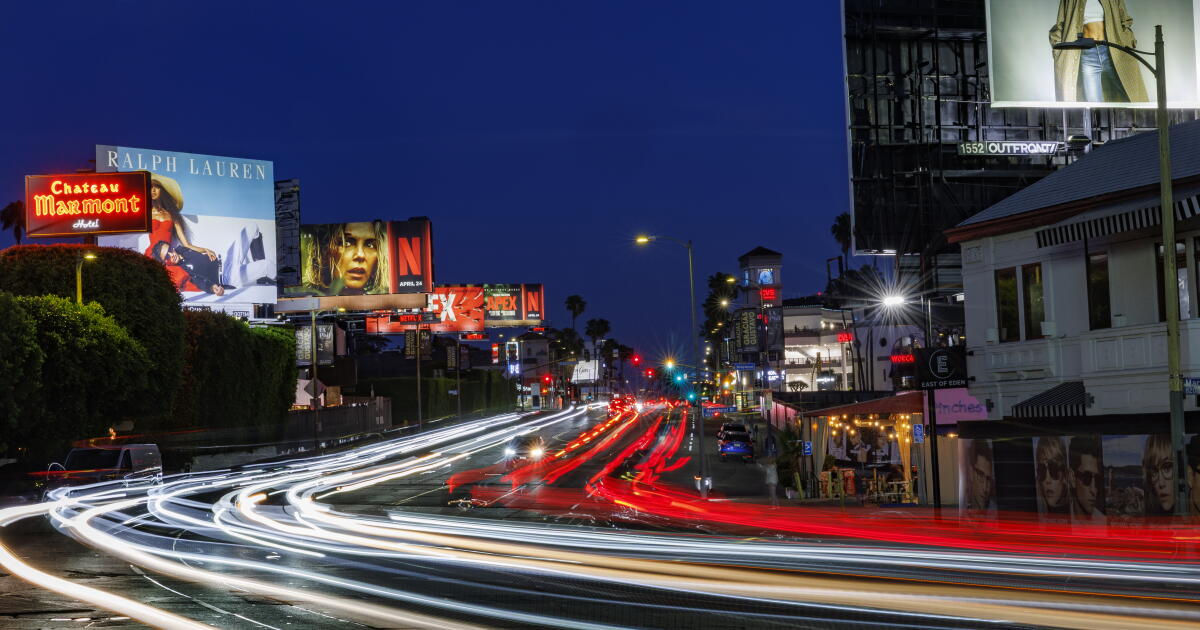
Speeding Angelenos, beware.
The city has rolled out the first 20 or so cameras in L.A.’s Automated Speed Safety System to catch those driving over the speed limit.
A Los Angeles Department of Transportation spokesperson told The Times earlier this month that all 125 cameras in the program would be activated before the end of the year.
You’re reading the Essential California newsletter
L.A. Times reporters guide you through the most important news, features and recommendations of the morning.
By continuing, you agree to our Terms of Service, which include arbitration and a class action waiver. You agree that we and our third-party vendors may collect and use your information, including through cookies, pixels and similar technologies, for the purposes set forth in our Privacy Policy such as personalizing your experience and ads.
L.A.’s Automated Speed Safety System is part of a statewide pilot program that includes San José, Oakland, Glendale, Long Beach and San Francisco.
Speed cameras have been shown to reduce speeding by 31% to 82% and fatal crashes by 53% to 71%, according to the Department of Transportation.
Nearly 300 people are killed every year in traffic crashes in Los Angeles.
Penalties for violating the speed limit
A 60-day warning period will be implemented after the cameras’ activation in which motorists going 11 mph or more above the speed limit will receive a written warning.
After the grace period, violators will be fined.
The cameras will take a photo of the speeding vehicle’s license plate, with the data used to identify the registered vehicle owner on file with the Department of Motor Vehicles, my colleague Summer Lin reported.
The owner will receive a notice of violation in the mail within 15 days.
The violation won’t count as points against the individual’s driver’s license, but the vehicle owner is responsible for paying the fine, even if someone else drove the vehicle.
Depending on how fast the driver is going, the fines are:
- $50 for driving 11 to 15 mph over the speed limit.
- $100 for 16 to 25 mph over the limit.
- $200 for 26 to 99 mph over the limit.
- $500 for 100 mph or more over the limit.
Where the cameras are installed
Under Assembly Bill 645, the cameras will be placed in 15 council districts in high-injury areas, school zones and street-racing hot spots.
From the San Fernando Valley down to the South Bay, at least eight or nine cameras will be in each district, my colleague Karen Garcia reported in March.
See her comprehensive list of affected streets here.
Dramatic findings in Malibu
The 21-mile stretch of Pacific Coast Highway in Malibu has claimed more than 60 lives since 2010, and repeated efforts to improve safety have yielded mixed results.
Similar to L.A.’s Automated Speed Safety System, Malibu’s speed camera program uses advanced camera equipment to detect vehicles traveling at least 11 mph above the posted speed limit.
Although the cameras aren’t yet issuing official tickets — the program must undergo a 60-day warning period in November — preliminary testing data captured 100,000 speeding violations over the course of nine days last month. Officials noted that those included violations in an area with a temporarily lowered 25-mph speed limit in a Palisades fire burn area construction zone.
Nevertheless, the data underscore what residents and city leaders say is a major speeding problem on one of Southern California’s most breathtaking drives. There’s hope the cameras can improve the situation, but also doubt that simply mailing out a slew of tickets will make a difference.
Success in San Francisco
Drivers in San Francisco, however, are slowing down just one year after speed camera installation.
According to a one-year analysis of data collected from San Francisco’s 33 camera locations and other traffic-sensing equipment, excessive speeding — more than 10 mph above the speed limit — dropped nearly 80%. The number of repeat offenders dropped, too.
Roadway and urban engineering experts say San Francisco’s findings are on par with the success of other communities across the nation that have already implemented speed camera technology.
“The results are clear,” San Francisco Mayor Daniel Lurie said in a statement. “Drivers are changing their behavior.”
Top stories 
A beachgoer walks past a trash bin washed up along the Long Beach Peninsula on Sunday.
(Ronaldo Bolanos/Los Angeles Times)
SoCal coast expected to be under siegeThe catch to Prop. 37
- Proposition 37 would allow qualified prospective homebuyers to borrow up to 17% of the sales price of a new home, contributing 3% of the down payment from their own funds.
- The program would not be funded by taxpayers but instead by the interest charged to borrowers on their down-payment loan.
- The caveat? Any home purchased through the program must be new construction, which could limit its potential reach because of the high cost of building, some critics said.
A culture clash inside Netflix
- After laying off 6% of its workforce and abandoning an $82.7-billion Warner Bros. bid, Netflix faces pressure to revive growth as U.S. subscriber gains become harder to find.
- But the biggest challenge confronting the streaming giant is a clash between the firm’s roots as a technology-driven upstart and its ambition to be a force in Hollywood.
More newsCommentary and opinionEditor’s pickMore picksThings to do 
(Myung J. Chun and Ronaldo Bolaños / Los Angeles Times)
Today’s recipe 
(Mariah Tauger/Los Angeles Times)
For Times cooking editor Cody Reiss, preservation was his entry point into cooking, though his first at-home fermentation experiments were hit and miss.
If you’re curious about fermentation, this version of kimchi by Haejung Kim is a great place to start.
Question for you
You’ve told us what your favorite Halloween candy is. Now we want to know: How much have you spent on Halloween candy this year?
Email us at essentialcalifornia@latimes.com, and your response might appear in the newsletter this week.
Photo of the day  Antonio Verduzco smiles behind calavera makeup while staffing the Generaciones en Accion altar at the official opening of the Día De Los Muertos altars in Gloria Molina Grand Park in downtown Los Angeles. More photos here.
(Genaro Molina / Los Angeles Times)
Games 
Here’s today’s mini crossword, plus our other free, daily crossword puzzle, sudoku, word search and jigsaw games.
Have a great day, from the Essential California team
Jack Dolan, investigative reporter
Hugo Martín, assistant editor, Fast Break desk
Kevinisha Walker, multiplatform editor
Andrew Campa, weekend writer
Karim Doumar, head of newsletters
How can we make this newsletter more useful? Send comments to essentialcalifornia@latimes.com. Check our top stories, topics and the latest articles on latimes.com.