Big policy ideas often mean big lawsuits.
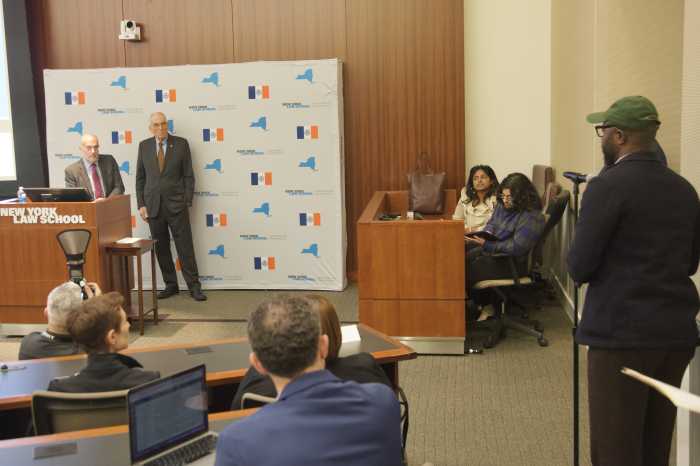
New York City’s top lawyer, Corporation Counsel Steven Banks, explained how an expansion of the city Law Department has played a key role in defending Mayor Zohran Mamdani’s signature policies during a special talk at the New York Law School on Tuesday.
When Mamdani came into office, he set in motion an ambitious plan to expand the city Law Department by 200 lawyers and an additional 100 support professionals.
Banks, who oversees the city’s legal affairs, talked through about half a dozen policy planks at the law school’s CityLaw Breakfast, detailing how new Law Department recruits are putting in the work on vetting and defending Mamdani’s affordability agenda.
“This is a key moment of generational change within the law department,” Banks said. “Any time you have about 785 lawyers, and you bring in 200 more, it is a moment of change. And we are managing through that change by both embracing and respecting and lifting up the norms, the practices, the traditions of the office that have made it the great law firm that it is, but at the same time making way for new views, new perspectives.”
During the talk, Ross Sandler, the founding director of the Center for New York City and State Law, introduced Banks’ unique résumé, having led both the city’s Department of Social Services under Mayor Bill de Blasio and, before that, the New York Legal Aid Society as attorney in chief.
Banks has been both an adversary and a client of the New York City Law Department — a background that, Sandler suggested, helps him to thrive in the multifaceted role of corporation counsel.
Law Department ‘second to none’ as a ‘great law firm’: Banks
Addressing the remarks, Banks said that the skill that might actually be most relevant to his day-to-day comes from his experience managing his own law firm.
“The Law Department is second to none in terms of being a great law firm,” Banks said. “If you look at the elements of what the great law firms do in the world, they have strong litigation. They have strong transactional lawyering, and they have strong legal advising.”
Banks broke down the Law Department’s pursuit of “transformational change” under Mamdani into four actions: settling or resolving lawsuits on favorable terms for the city, re-examining policies that led to those lawsuits, defending new policies “when it’s the right thing to do,” and bringing affirmative cases.
One example of an affirmative case that caused waves recently was a racketeering lawsuit the city brought against a personal injury law firm that alleges it routinely filed false slip-and-fall cases as part of a playbook to pilfer money from incidents that did not actually take place on city property.
The legal tactic of bringing racketeering charges against personal injury firms is controversial within trial law. The New York State Trial Lawyers Association has argued these cases have also been used by insurance companies to chill legitimate personal injury claims and workers’ compensation claims. Banks said the facts of the case justified the strategy.
“The tool being used in that case is to stop that kind of abuse of the taxpayers from paying out to or having to pay out money that was brought by lawyers,” Banks said. “On behalf of New Yorkers, that’s not an issue of principle, that’s an issue of justice.”
Then there are several cases in which the city is defending a lawsuit challenging the legal grounds of part of Mamdani’s platform. In the case of the Rent Guidelines Board’s decision to freeze the rent for stabilized tenants for the next year, the city is defending against a group of landlords seeking to overturn the decision.
In another instance, Banks is overseeing the Law Department’s legal defense of Mamdani’s so-called pied-à-terre tax, the rollout of which was found by a state Supreme Court Judge to be legally deficient. Suffolk County plaintiffs are also challenging the policy in a separate case that challenged the tax on constitutional grounds.
The Law Department is also defending antitrust litigation against the opening of city-run grocery stores.
“The idea that with 1,000 groceries or supermarkets that five grocery stores would be the end of the world — apparently everything’s possible in New York,” Banks said.
In addition to litigation, the agency also handles transactional practices like negotiating real estate contracts on projects involving housing or public development. Banks said that these wings of the law department are fighting for Mamdani’s affordability mandate in the effort to create more housing.
“We’ve done a lot this year, but we’re just getting started. There’s so much more we need to do, and we’ve got the right lawyers in the Law Department now with 200 more to do the job that we’re called upon to do,” Banks said.