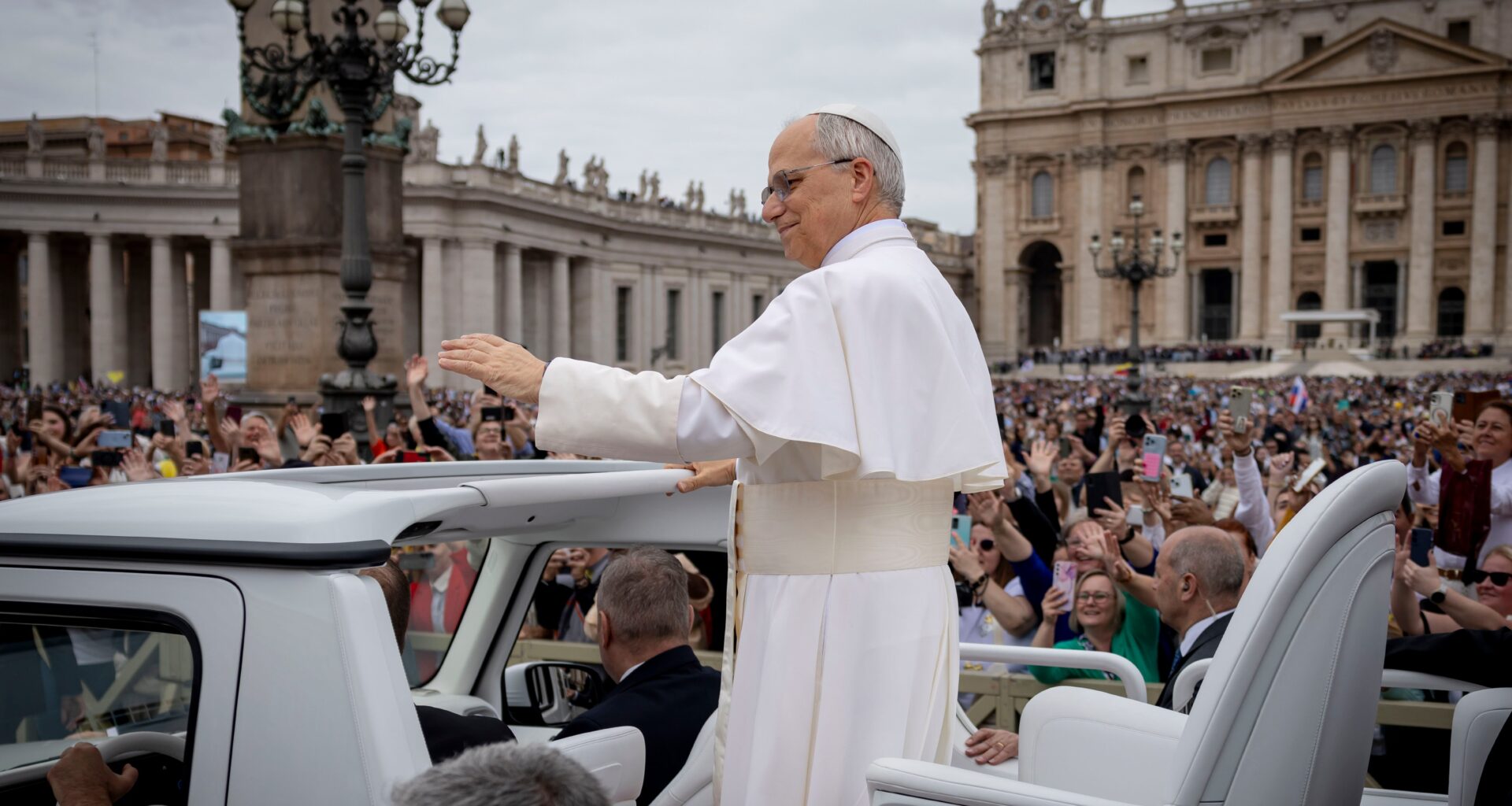
Chicago native Pope Leo XIV has cast a local mail-in ballot ahead of the November midterms, making history as the first pontiff to vote in a U.S. election.
The Vatican announced Friday that Leo, who remains an American citizen, has submitted a mail-in ballot, citing his commitment to civic participation.
“The Holy Father expresses his belief in the right and the duty of citizens to participate in democratic processes,” the Holy See said in a statement.
The pope — formerly Robert Prevost — is registered as a Will County voter in New Lenox, where his brother, John Prevost, lives.
The pope made an online request for a mail-in ballot to be sent to a New Lenox address on Oct. 3, said Kimberly Fladhammer, chief of staff for the Will County clerk’s office.
“It is historic,” Fladhammer added.
The returned ballot was not yet received as of Friday afternoon, she said.
Will County Clerk Annette Parker said she was proud to be the county clerk for the momentous occasion.
“I’m happy he is participating in the voting process just as every eligible person should,” Parker said. “It’s exciting.”
The clerk’s office can track the ballot through its computer software, but Fladhammer and Parker said they may not be able to catch it the moment it is processed. If a staff member recognizes the pope’s name as they go through the mail-in ballots, those in the room might want to touch it to receive a blessing, Parker added.
Chicago Cardinal Blase Cupich said he hopes the pope’s example “encourages everybody to get out and vote.”
“He believes in the power of democracy,” Cupich said, adding that the pontiff’s participation in local elections shows “his affection for the place he grew up in and that formed him.”
By voting, the Holy Father is setting an example for the Catholic faithful on civic responsibility, said Christopher White, associate director at Georgetown University’s Initiative on Catholic Social Thought and Public Life.
Leo has repeatedly “called for ‘a better kind of politics,’” said White, author of the book “Pope Leo XIV: Inside the Conclave and the Dawn of a New Papacy,” published by Loyola Press in Chicago. “In casting his ballot, he’s modeling active civic engagement, something he’s frequently called on U.S. citizens to take up.”
By voting in Illinois, the pontiff is being asked to cast votes in the race for governor between Democratic incumbent Gov. JB Pritzker and Republican challenger Darren Bailey, as well as in the U.S. Senate race to replace Sen. Dick Durbin, featuring Lt. Gov. Juliana Stratton, the Democratic nominee, against GOP nominee Don Tracy.
The Holy Father has met with dozens of Illinois politicians, activists and Catholic faithful in the Vatican since his historic May 8, 2025, election.
This includes Pritzker and first lady MK Pritzker, who presented Leo with a four-pack of “Da Pope” American Mild Ale from a Chicago brewery during a November 2025 trip to the Vatican, where they formally invited the pope to visit Chicago.
 Mayor Brandon Johnson presents Pope Leo XIV with the Key to the City of Chicago, May 28, 2026, at the Vatican. (Simone Risoluti/Vatican Media)
Leo also met with Chicago Mayor Brandon Johnson in May. Other notable local leaders who’ve traveled to the Vatican for a papal meeting include Chicago Teachers Union President Stacy Davis Gates, a delegation of dozens of Illinois mayors, and Illinois Secretary of State Alexi Giannoulias, who is also running for reelection Nov. 3 and for Chicago mayor next year.
Much of the talks focused on immigration and serving vulnerable local communities.
The Holy Father has frequently commented on local politics and current events over his roughly 18-month papacy.
Leo has decried the Trump administration’s severe immigration crackdown that roiled the Chicago area and other major cities.
“With the abuse of vulnerable migrants, we are not witnessing the legitimate exercise of national sovereignty, but rather serious crimes committed or tolerated by the state,” the pope warned in October 2025, during the peak of a particularly brutal Trump administration anti-immigration campaign dubbed Operation Midway Blitz in the Chicago area.
The pontiff also weighed in on a local controversy after Chicago Cardinal Blase Cupich faced backlash among anti-abortion groups for his late 2025 decision to honor Durbin with a lifetime achievement award for his commitment to serving immigrants, despite the lawmaker’s support for abortion rights. Durbin ultimately declined the award. Leo offered a nuanced response to the dispute, stressing that it would be critical to analyze Durbin’s entire record over his four-decade political career rather than a single issue.
“Someone who says ‘I’m against abortion’ but says ‘I am in favor of the death penalty’ is not really pro-life,” Leo said. “Someone who says that ‘I’m against abortion, but I’m in agreement with the inhuman treatment of immigrants in the United States,’ I don’t know if that’s pro-life.”
Leo has also criticized an Illinois law permitting doctors to prescribe medication to allow terminally ill people to end their own lives, calling medical aid in dying a “false compassion.”
After speaking directly to Pritzker about the matter, Leo expressed disappointment in the law’s December 2025 passage.
“Medicine must never become the servant of programmed death,” he once said.
 Pope Leo XIV meets with Gov. JB Pritzker at the Apostolic Palace on Nov. 19, 2025, in Vatican City, Vatican. (Simone Risoluti/Vatican Media)
The pope’s participation in the Illinois election comes on the heels of his Oct. 13 diagnosis of early-stage lung cancer; during a surgery that day, physicians removed the lower lobe of his right lung. The 71-year-old pontiff was released from Agostino Gemelli Hospital in Rome on Oct. 17. The Vatican has reported that no further treatment is expected and the pope has been slowly resuming his daily activities.
While the pope’s ballot is groundbreaking, White said it’s not surprising that the leader of some 1.4 billion global Catholics would take part in a local election.
“His own voting record shows that he’s regularly voted in local elections and is very attuned to what’s happening in his home country,” White added.
The Vatican confirmed that then Prevost — an Augustinian and longtime Peruvian missionary — had also exercised his right to vote in the United States while living in Peru whenever he was eligible.
Since 2000, Robert Prevost has voted in five primary elections, requesting Democratic ballots twice and Republican ballots three times, according to Illinois State Board of Elections records.
They don’t indicate which candidates he favored. In Illinois, voters must declare a party preference for a ballot in a primary election, when parties choose their nominees for the general election.
A party declaration isn’t required in general elections.
Prevost had requested Democratic primary ballots in 2008 and 2010, when he was registered in heavily Democratic Cook County.
After moving to suburban Will County, which leans more conservative, he requested Republican primary ballots in 2012, 2014 and 2016.
He submitted ballots in every general election since 2000, except 2020 and 2022.
It’s unclear how Leo returned his ballot for the Nov. 3 election.
His brother, John Prevost, was in Rome this week accompanying parishioners from St. Jude’s, an Augustinian-run parish in New Lenox.
John Prevost attends Mass at that parish; Leo had also given a talk there in 2024, when he was a cardinal.
The U.S. Conference of Catholic Bishops said in a statement that the Holy Father’s ballot “sets the example that encourages each citizen to exercise their civic responsibility.”
The statement added that church leaders have been encouraging Catholics during this campaign season “to exercise their right to vote and to do so in a way that places our faith before our politics.”
The pontiff has often spoken about the need for greater civic engagement and a change in the tenor of politics.
In September, Leo urged Catholic faithful to “leave behind all passivity and indifference in the face of current events,” during a weekly general audience in St. Peter’s Square.
“We cannot remain as unengaged spectators; rather, we must listen with our hearts, allow ourselves to be challenged, and become involved,” the pontiff said.
In April, Leo called for “a better kind of politics, one truly at the service of a common good,” echoing the message of his predecessor Pope Francis.
“Democracy remains healthy, however, only when rooted in the moral law and a true vision of the human person,” Leo had said. “Lacking this foundation, it risks becoming either a majoritarian tyranny or a mask for the dominance of economic and technological elites.”
The Associated Press contributed.