GRAND FORKS — Communities often have the individual pieces needed for growth, from university research to government support. However, they frequently struggle to connect these isolated sectors, according to Brad Clevenger.
Grand Forks doesn’t have that problem, he said. The research, innovation and leadership in the community — and especially at the University of North Dakota — knit together.
“It’s super exciting,” said Clevenger, president of Rocket Lab USA. “I think (UND President Andy Armacost) and many stakeholders here have brought the right elements here. I see the right things happening up to and including this conference where all those elements — commercial industry, government, academia — are represented. And the more you can foster that ecosystem, the more I think this area, North Dakota, is set to grow.”
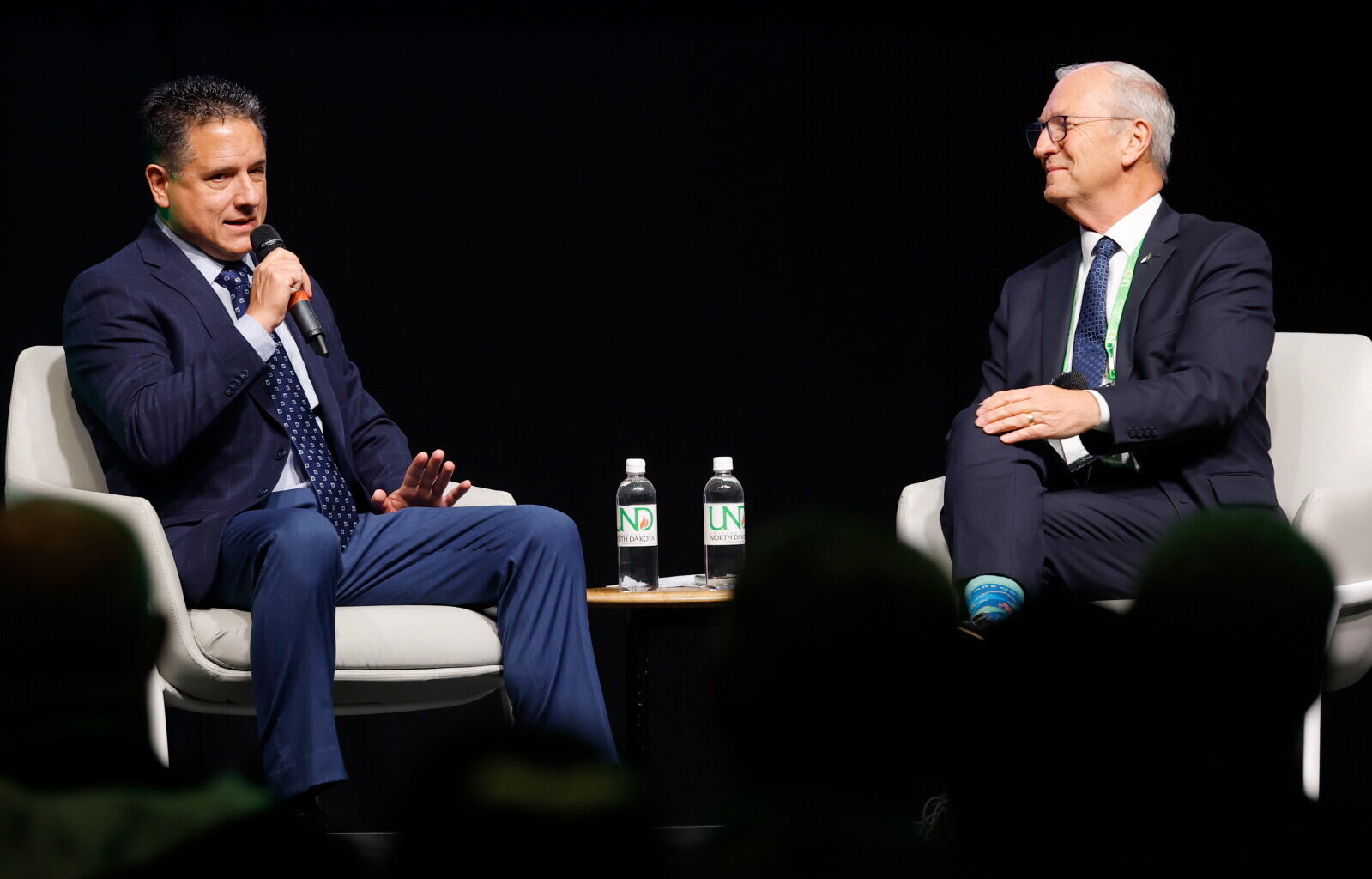
Clevenger attended the UND Space Operations Summit on Wednesday, Nov. 4, alongside other leaders and stakeholders in the realm of space operations. He and U.S. Sen. Kevin Cramer, R-N.D., kicked off the event with a fireside chat.
Rocket Lab, a launch and space systems company, is in the process of acquiring Iridium Communications, a satellite services provider. According to a press release from Cramer’s office, Iridium employs dozens of workers to help conduct operations for the Space Development Agency’s low-earth-orbit mission. The mission is meant to offer communications support for the U.S. military. The SDA has a 25,000-square-foot Satellite Test and Checkout Center at Grand Forks Air Force Base.
During the conversation, Cramer asked Clevenger about the importance of a place like UND in contributing to what Clevenger is looking for.
“How important is it to have, if I might, a president who understands both the importance of the university, but also the importance of national security, and who runs quite a big school here?” Cramer said. “But he runs it like a small company in many respects. They move quickly — it’s remarkable.”
Clevenger said one of the most defining characteristics of the current and next generation of power competition in space is speed.
“How fast can we go from mission capability to deploy solutions on orbit,” he said. “And that’s hard to do if you’re geographically isolated or isolated in a business sense, et cetera. Building that ecosystem is incredibly important.”
He said, with things like commercial companies operating in the area, the local infrastructure, Grand Forks Air Force Base and Space Development Agency, UND is “right on.”
Before the fireside chat, Armacost highlighted UND’s long partnership with NASA, including the recent announcement of UND’s collaboration with NASA on Project ATLAS, which will focus on integrating the capabilities of unmanned aerial systems and unmanned ground vehicles. U.S. Sen. John Hoeven, R-N.D.,
the project at the UAS Summit and in October.
Armacost said his point in sharing UND’s stories is to give attendees a sense of UND as “an epicenter of activity related to space, both unmanned flight and manned flight, and how we play on the national stage.”
“Expect the unexpected,” he said. “Because there’s discovery, there’s a sense of wonder, around every corner.”

Otto is the University of North Dakota reporter for the Grand Forks Herald.