New York state budget officials say it is too early to determine whether tax increases will be necessary in next year’s state budget, even as Gov. Kathy Hochul has signaled a willingness to consider new revenue sources to fund an expansion of childcare.
The state’s annual quick start budget meeting was held Monday, bringing together key players in building the state’s annual budget to review the playing field ahead of negotiations over the next spending plan.
The meeting came after a week of good news for Democrats in the Empire State. The Division of Budget’s mid-year update just before Election Day painted a rosy picture of New York’s financial position and less than a week after an election that strengthened Democrats’ position in Albany, potentially changing the political dynamics surrounding discussions over taxes and spending.
Hochul has long resisted calls from progressive lawmakers to raise taxes on wealthy New Yorkers, but she appeared to leave the cracked to new revenue proposals in speaking with reporters last week as the annual Democratic SOMOS retreat in Puerto Rico as she discussed the long-term costs of expanding access to universal childcare. The program in its current state has been funded for two years but is considered only a step on the pathway toward a truly universal system.
Hochul’s comments made clear that doesn’t necessarily mean a one-way ticket to heeding the progressive campaign chants of ‘tax the rich.’
The governor pointed to this year’s pied-à-terre tax as an example of a creative approach to generating revenue without relying on a broad-based tax increase. That proposal came in last year’s budget as a means of assisting New York City in addressing its fiscal crisis and was not proposed until budget negotiations were well underway and the budget was already days late.
“When it came to helping the city out with the crisis the mayor inherited, I came up with a creative way to do that,” Hochul said. “I’m telling you I want to come up with a creative way to make sure we have the resources necessary.”
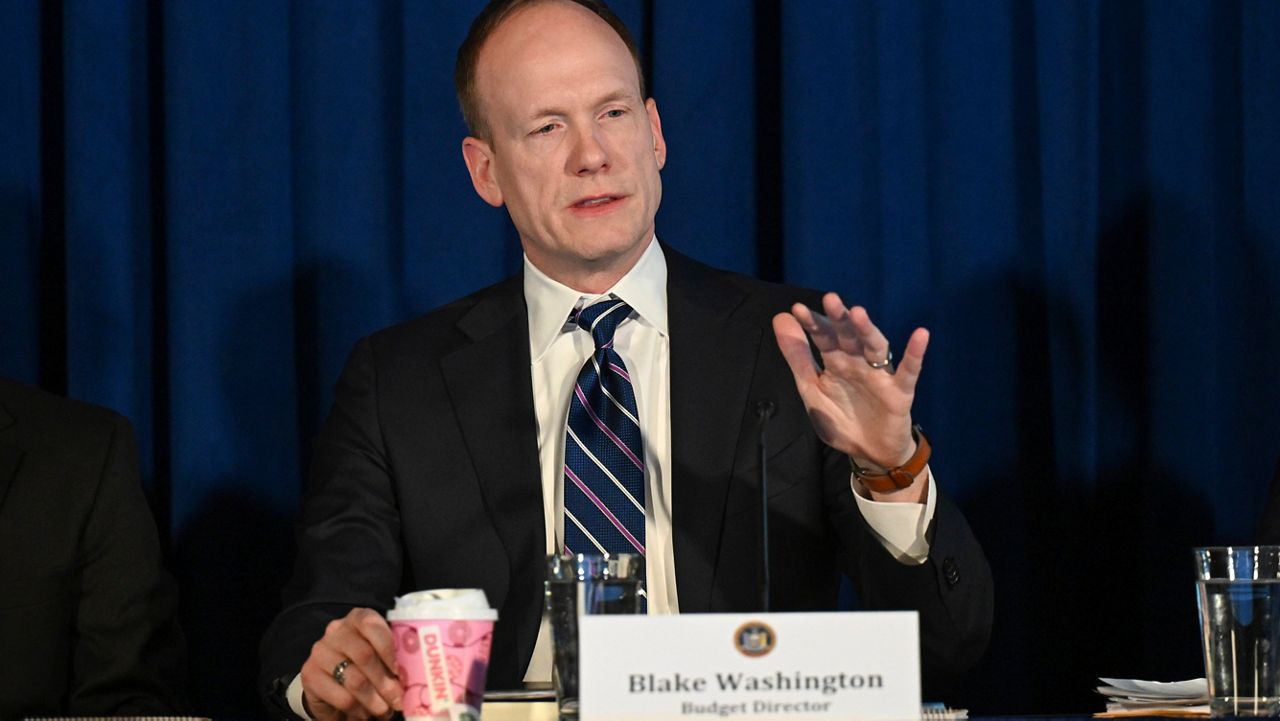
But despite the political headwinds, State Budget Director Blake Washington told reporters Monday that serious discussions about potential tax increases have not yet taken place.
Washington characterized those conversations as premature, pointing to the state’s improving fiscal outlook and the need to fully evaluate spending and revenue projections before considering additional taxes, declining to identify a specific threshold in which progressive tax policy could be used to fund the childcare initiative.
“The governor doesn’t see taxation as an ideological exercise. It’s one that we deploy when necessary to meet challenges,” Washington said. “We just did our quick start report and we are $8 billion up this year, so that will help us to approach any of these discussions with the temperance it requires.”
The state’s latest financial projections show that anticipated budget gaps have narrowed, providing some breathing room as officials prepare for negotiations.
Despite the seemingly sunny days ahead, Washington acknowledged the potential for fiscal instability and also indicated that the administration will continue looking for opportunities to control spending in some of the state’s most expensive programs.
One item often cited in critiques of New York’s budget in recent years has been the $500 billion annually that has been required to staff New York state prisons with National Guard troops in the wake of a three-week illegal correction officer strike in 2025 which Hochul fired around 2,000 officers who did not return to work after a deal to end the strike was reached.
Asked whether he expects the state could be on a pathway to begin reducing the cost of that deployment in the coming fiscal year, Washington said the administration intends to prioritize longer-term solutions to recruiting and staffing challenges but anticipates that some level of National Guard support will remain necessary.
Medicaid, one of the largest drivers of state spending, is another area where the administration expects to pursue additional changes.
Washington said the governor will continue targeting individual programs for reforms intended to control costs while preserving essential services.
“Those are the programs we’re going to keep watching, and to the extent we can modify them to make sure we can deliver them to the people who need them most — the nice-to-haves versus the must-haves — I think that’s where we’re going to keep our focus,” Washington said.
Those efforts follow previous changes to Medicaid programs, including the state’s controversial transition of the Consumer Directed Personal Assistance Program, or CDPAP, to a single statewide fiscal intermediary.
Hochul will formally outline her budget priorities early next year, setting the stage for negotiations with lawmakers ahead of the state’s April 1 budget deadline.