
Texas A&M-Fort Worth, smack dab between Fort Worth’s two downtown transit stations, is capitalizing on its strategic location in starting economic development projects and recruiting students and staff.
The school’s partnership in the burgeoning Switchyard Innovation District, launched in April, will bring researchers, state agencies and business partners together in a new $300 million campus facility, Research & Innovation Building-A, intended to be part of a district research-business hub.
Bobby Ahdieh, chief operating officer for Texas A&M-Fort Worth, said easy access to the Trinity Metro transit system will make it easier to develop the campus after the opening of the eight-story Law & Education Building in August.
“That kind of opportunity has a huge impact on recruitment,” he told members of the Commuter Rail Coalition Tuesday during the group’s 2026 summit at The Worthington Renaissance Fort Worth Hotel.
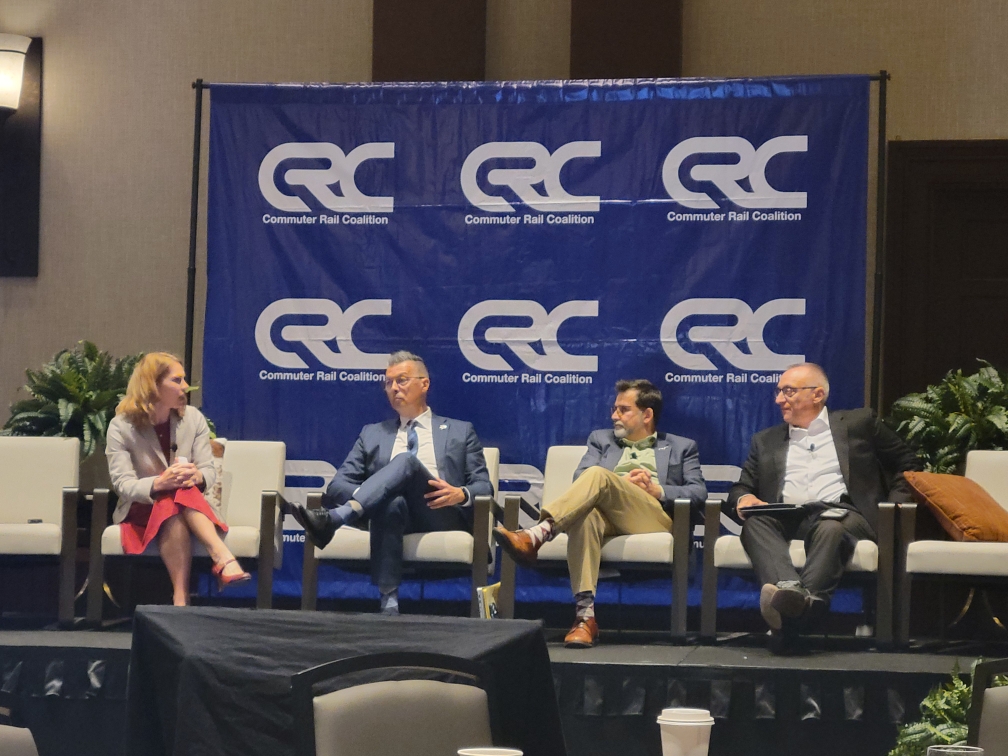 Caitlin Holland, vice president of real estate and economic development with Dallas Area Rapid Transit, left, moderates a Commuter Rail Summit panel in Fort Worth that included Rafael Martin, vice president for administration and chief of operations at the University of Texas at Dallas; Bobby Ahdieh, chief operating officer for Texas A&M-Fort Worth; and Jim Coffey, executive director of transportation for the University of North Texas. (Eric E. Garcia | Fort Worth Report)
Across North Texas, universities are embracing transportation systems as a tool to help recruit international students, handle on-campus traffic congestion and develop new facilities, leaders said.
Jim Coffey, executive director of transportation for the University of North Texas in Denton, urges students to ride the A-train — not for good grades, but to avoid on-campus parking issues.
“It’s really nice to have that asset,” he said, referring to the Denton County Transportation Authority’s 21-mile commuter train that runs between Denton and Carrollton.
When students commute by train, he said, it helps ease traffic congestion by reducing the number of cars on campus.
Officials with Dallas Area Rapid Transit spent years working with the community on developing the new Silver Line stop at the University of Texas at Dallas. The line connects Dallas and six other cities to Dallas Fort Worth International Airport.
The Richardson campus got its own UT Dallas-branded station — which “came off better than anyone could expect,” said Rafael Martin, the school’s vice president for administration and chief of operations.
North Dallas residents were concerned about flooding after a section of Hillcrest Road was depressed to allow for the train’s infrastructure. However, Martin said, “Not one of those fears has come to pass.”
“When you think about having an ambitious plan, I think that’s key for anything,” said Kay Shelton, the Dallas-area agency’s chief of staff and chief strategy officer. “It was key for DART.”
Officials are now planning development on 60 acres near the UT Dallas Station to serve as a northern gateway to the campus as they update the school’s master plan. The university, whose predecessor campus was established in 1961, originally had little development around it, Martin said.
“It really was in the country then,” he said. “Now it’s in the center of population growth.”
Fort Worth plans
 A rendering of Texas A&M University System’s vision for Fort Worth. Bobby Ahdieh, Texas A&M-Fort Worth chief operating officer, estimated the area could be completed within five to seven years, although demand and partnerships will determine the pace. (Courtesy | Texas A&M University System)
As Texas A&M-Fort Worth grows, Ahdieh said transportation will play a key role in campus development. Plans include additional academic buildings to be built on parking lots north of the campus. Those properties are across Jones Street from the Fort Worth Central Station and adjacent to the University of Texas at Arlington’s Fort Worth campus.
“To my mind, there is no (economic) model that does not have transit in it,” Ahdieh said.
Plans are in the works to develop the Switchyard district with transit-oriented mixed-use projects, including retail and residential units. Trinity Metro is developing similar projects at its stations and other properties in Fort Worth and other Tarrant County sites.
Those projects would be enhanced by Trinity Metro’s plans to extend the 27.2-mile TEXRail commuter line over 2 miles into south Fort Worth. The line, which currently runs from downtown Fort Worth to DFW Airport, will connect to 50,000 jobs in the Near Southside/Medical District when the extension is completed in mid- 2030.
 The TEXRail train pulls into the Fort Worth Central Station on June 12, 2025. (Mary Abby Goss | Fort Worth Report)
Eventually, officials plan to extend TEXRail farther south to TCU and Tarleton State University in southwest Fort Worth.
Rich Andreski, president and CEO of Trinity Metro and a Commuter Rail Coalition board member, said the double-track project of another transit service, the Trinity Railway Express train between Dallas and Fort Worth, will also benefit Tarrant college campuses while aiding in regional economic development. The train will be able to go faster by plugging in gaps where a single track exists.
Discussions with community stakeholders, institutions and partners are key to advancing transportation improvements, he said.
“Sit down early, before those projects are moving,” Andreski said.
Ahdieh said educators and students, especially from other countries, move to Texas with the expectation of having access to reliable public transit systems.
Universities are now partnered with transit agencies for economic development, he said.
“Trinity Metro is growing together (with us),” Ahdieh said. “We’re trying to figure out what is the vision for what the university, downtown Fort Worth will look like over the next 20, 30, 40 years. … In some ways, the partnership is a natural one because we tend to think in larger increments,” since long-term planning for substantial projects are years in the making.
Eric E. Garcia is senior business reporter at the Fort Worth Report. Contact him at eric.garcia@fortworthreport.org.
At the Report, news decisions are made independently of our board members and financial supporters. Read more about our editorial independence policy here.
This article first appeared on Fort Worth Report and is republished here under a Creative Commons Attribution-NoDerivatives 4.0 International License. 