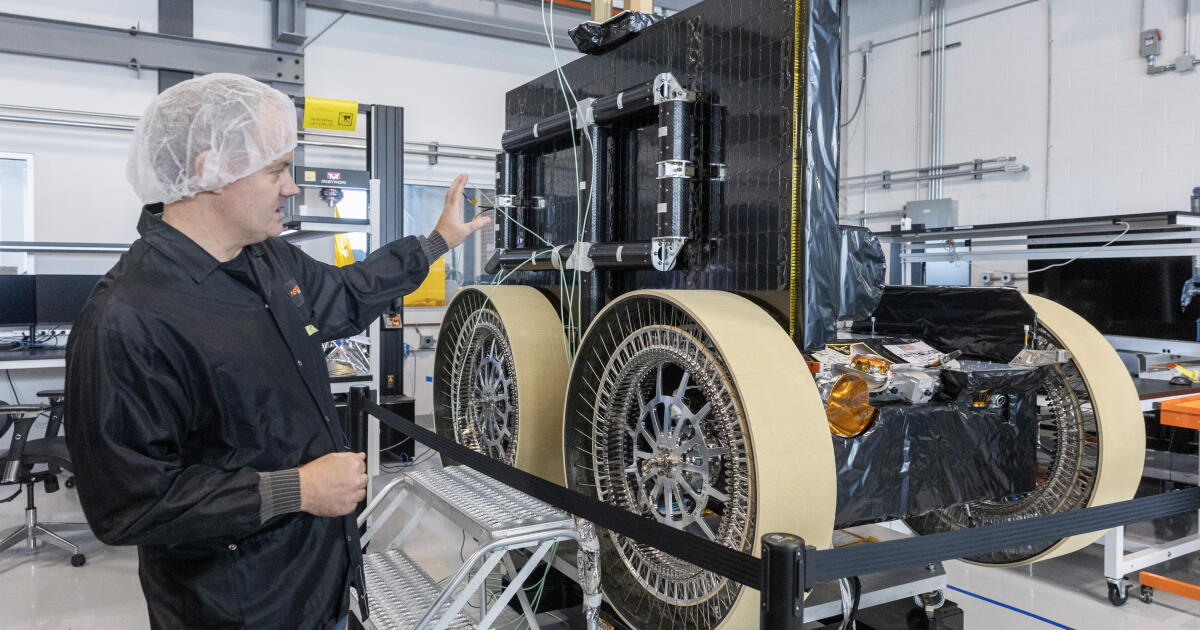
Its boxy frame, beige composite Kevlar tires and adjustable solar panel aren’t much to look at, and it won’t set speed records at 12 mph — but if Astrolab’s FLIP rover sets down on the moon in January and rumbles off as planned, none of that will matter.
The $50-million semi-autonomous demonstration machine developed by the Hawthorne startup is aiming to be among the first U.S. rovers to traverse the lunar surface since astronaut Eugene Cernan drove the last of three Apollo “Moon Buggies” in December 1972.
But while the Apollo 17 mission signified the end of the U.S.’s lunar ambitions, the uncrewed rover carrying scientific instruments will mark the country’s even greater ambitions today. NASA’s Artemis program has an aggressive goal of returning astronauts to the moon by 2028, building a permanent base on the lunar south pole early next decade and eventually landing humans on Mars.
“We went from blank sheets to the finished rover in about 18 months,” said Astrolab founder and Chief Executive Jaret Matthews, whose company also has a NASA contract to build a modern-day moon buggy the astronauts can drive when they arrive.
Just like the 1960s Cold War rivalry with Russia, international competition has fueled a race to the moon, but this time the leading challenger is China, though Russia still harbors lunar aspirations. India and Japan also have landed spacecraft there, and the European Union, South Korea and other nations have eyes on it.
And just like the 1960s when Southern California companies built key technology for the Apollo program, the local aerospace industry is once again getting a boost from the region’s high-tech startups, legacy suppliers and large prime contractors.
In Canoga Park, workers at an L3Harris Technologies plant are building components for the engines of NASA’s Space Launch System rocket sending the Artemis astronauts into space. In Rosemead, startup Cislune is developing lunar excavation equipment. And in Long Beach, space station developer Vast now wants to make astronaut habitats.
The surge in business follows a resurgence of the aerospace and defense sectors in Southern California that started with the founding of Elon Musk’s SpaceX in El Segundo in 2002, which drastically reduced launch costs with its resuable rockets, revolutionizing the industry while spinning off scores of startups by former employees.
NASA is expected to spend more than $100 billion to return astronauts to the moon and build a base, not counting what companies might spend on their own to develop infrastructure and other services.
A report by Deloitte estimated that by 2050, the lunar economy involving both government entities and private companies could top $500 billion globally, including mining rare materials and manufacturing goods in the advantageous microgravity environment for use on the moon and Earth.
“A permanent habitation on the moon, as our technology has advanced, is really the next phase of tremendous intellectual and technological advancement,” said Lesley Conn, director of strategic insights at the Space Foundation.
A new space race
The U.S. program to return to and establish a permanent presence on the moon echoes the Apollo era, when NASA spent $26 billion to launch and land men there for brief stays, working closely with prime contractors to develop the necessary technologies.
That strategy is similar to the Artemis program, which includes the giant SLS rocket built by Boeing, Northrop Grumman and other contractors, and Lockheed Martin’s Orion capsule, in which astronauts orbited the moon this year during the second Artemis voyage.
NASA is having Elon Musk’s SpaceX and Jeff Bezos’ Blue Origin build modern-day crewed lunar modules, with the SpaceX lander a version of the massive Starship rocket still under development in Texas.
But a second Artemis initiative, called the Commercial Lunar Payload Services (CLPS) program, shifts some of the financial burden and risks of building new technology onto the private sector, which ultimately may sell its products to customers other than NASA.

Griffin Mission One will deliver Astrolab’s FLIP (Flex Lunar Innovation Platform) rover to the moon’s south pole in early 2027.
(Myung J. Chun / Los Angeles Times)
“If NASA can be one customer of many … it drives costs down,” said NASA Administrator Jared Isaacman during a recent interview. “It helps us build the moon base better.”
The program envisions developing dozens or more autonomous and remote-controlled lunar landers and rovers to land on the moon, scout the topography, conduct experiments, deliver cargo and conduct other functions on the southern pole ahead and after human landings.
The pole is among the most desirable real estate on the moon, with direct lines of communication to Earth, long days to generate solar energy and permanently shadowed craters filled with ice for water, which can be converted into oxygen and hydrogen fuel.
However, it presents great technological challenges because of the extreme conditions, which include Fahrenheit temperatures varying from 103 degrees in sunlight to minus 400 degrees in the dark craters harboring the ice.
‘Caterpillar’ of the moon
Astrolab was founded in a garage six years ago by Matthews, a former SpaceX engineer who previously helped design Mars rovers at the Jet Propulsion Laboratory in La Cañada Flintridge. The premise was that large cargo deliveries to the moon would require vehicles to move equipment around, and he was able to raise $100 million in startup funding from an undisclosed New York investor.
The company’s first rover, a one-ton vehicle called FLEX completed in 2021, is capable of lifting more than 4,000 pounds over varied terrain. In 2023, the company secured a contract with SpaceX to put the vehicle on the moon in 2028 on an uncrewed Human Landing System test flight.
While Astrolab is paying for the ride, it has announced contracts to deploy payloads for multiple customers valued at more than $160 million.
“FLEX is the Caterpillar of the moon,” said Matthews, citing the construction equipment manufacturer.

Jaret Matthews, founder and CEO of Astrolab, shows the FLEX rover that will be used to carry cargo on the moon.
(Myung J. Chun / Los Angeles Times)
But before that happens, its demonstration FLIP rover should launch in January on Griffin-1, a CLPS mission being conducted by Voyager Technologies, a Denver company that this year opened a 140,000-square-foot innovation facility in Long Beach. Its lander completed three months of testing also this year at JPL, with Astrolab paying an undisclosed sum to Voyager to carry its rover.
The mission, to be launched into space in Florida by a SpaceX Falcon Heavy — the major components of which are built in the company’s Hawthorne plant — hopes to land the first two U.S. rovers on the moon since Apollo: Voyager’s own shoebox-sized CubeRover-1, envisioned as a low-cost science platform; and FLIP, an acronym for Flex Lunar Innovation Platform.
Success is not a certainty. Last year, three rovers carried by Houston-based Intuitive Machines’ lander did not make the surface after the lander tipped over on touchdown. However, China has landed three rovers since 2013, and India and Japan also have had successful rover flights.

An artist rendering of Astrolab’s FLIP rover next to Voyager Technologies’ Griffin Lander on a lunar surface.
(Voyager Technologies)
FLIP was built to test critical technologies for future rovers while also conducting key science experiments, including detecting lunar resources for future harvesting, creating a 3-D map of the region and measuring lunar dust, which is composed of sharp-edged silicon and other elements that can wreak havoc on machinery.
The go-kart-sized rover features a solar array that folds down for launch and deploys on the surface. A reflective radiator helps shed heat when the rover is operating, and batteries provide heat during the bitter cold lunar night to prevent the avionics from freezing. Its composite tires were built by Astrolab’s strategic partner, Venturi Space of Monaco.
It will operate semi-autonomously, using headlights and lidar laser sensing, the same technology on many new autonomous cars. Crews in Hawthorne will direct the vehicle to a destination, but it will choose the path to get there. The rover is expected to operate for at least a week, but might do so for months depending on its ability to make it through the lunar night.
“The sad kind of dilemma on the moon is you’re equally at risk of freezing as you are of overheating,” Matthew said.
The company got a big boost in May when NASA handed it a $219-million contract to build a new Crewed Lunar Vehicle, based on the FLEX architecture, for a 2028 mission to the moon on a Blue Origin lander, ahead of the arrival of Artemis astronauts that year.
The CLV-1 will remotely scout terrain and test systems, along with a rover built by Colorado competitor Lunar Outpost, also landed by Blue Origin. Future NASA contracts to build additional rovers could be worth billions.
Astrolab is headquartered in a 24,000-square-foot former neon sign factory, but it expects to double its 160-employee head count next year and will move to an 85,000-square-foot building in Torrance. It also has operations in Texas.
Habitats and tubing
While Astrolab is the highest-profile rover maker in Southern California, others are forging ahead without CLPS contracts.
GITAI USA, a 10-year-old venture-funded company that moved its headquarters from Japan to Torrance in 2023, is developing robotic lunar rovers for construction, mining and other tasks.
Cislune, which has received NASA research grants, is similarly developing technology to assist in the construction of a lunar base. The five-year-old Rosemead company with just six employees scored highly in a 2023 NASA competition to excavate simulated lunar ice in the Mojave Desert. It also is working on a project to optimize rover wheels to compact lunar soil for landing pads. And it has a Lockheed Martin contract to create bricks out of lunar materials.
“We’re out at the frontier, but I think all the intellectual property knowledge that we get from being out there is going to be extremely valuable back here on Earth for sustainabilty,” said founder and Chief Executive Erik Franks.

The “Messages to the Moon” children’s patch is a joint program between Uplift Aerospace and astronaut, scientist and artist Dr. Sian Proctor. The patch, which will travel to the moon aboard the FLIP rover, highlights the most common words used by the children in their letters.
(Myung J. Chun / Los Angeles Times)
Hawthorne-based GRU Space , which drew attention earlier this year when it announced it wanted to open the first lunar hotel, also is focusing on trying to build lunar bricks with robots.
Meanwhile, Vast in Long Beach — well along toward its goal of building a space station to replace the retiring International Space Station — recently announced plans to adapt its Haven space station architecture for a lunar habitat.
Joining scores of lunar startups in Southern California and nationwide are long-established companies working on getting astronauts to the moon. NASA has hundreds of Artemis suppliers in California alone.
Among them is LeFiell Manufacturing Co., a 96-year-old Santa Fe Springs firm owned by its more than 150 employees. It supplies the 1,080 coolant tubes for each of the RS-25 engines L3Harris is delivering to NASA for the first stage of the SLS rocket.
It also supplies tubing for the rocket’s second-stage engines and has a similar parts contract with the Japanese space program’s lunar and deep-space H3 rocket.
“If you go back and look at the gap between the space shuttle and Artemis, there was a lot of space suppliers that went out of business,” said LeFiell Chief Executive Raman Venkat. “So when the Artemis came back, we were happy to get back on the program.”