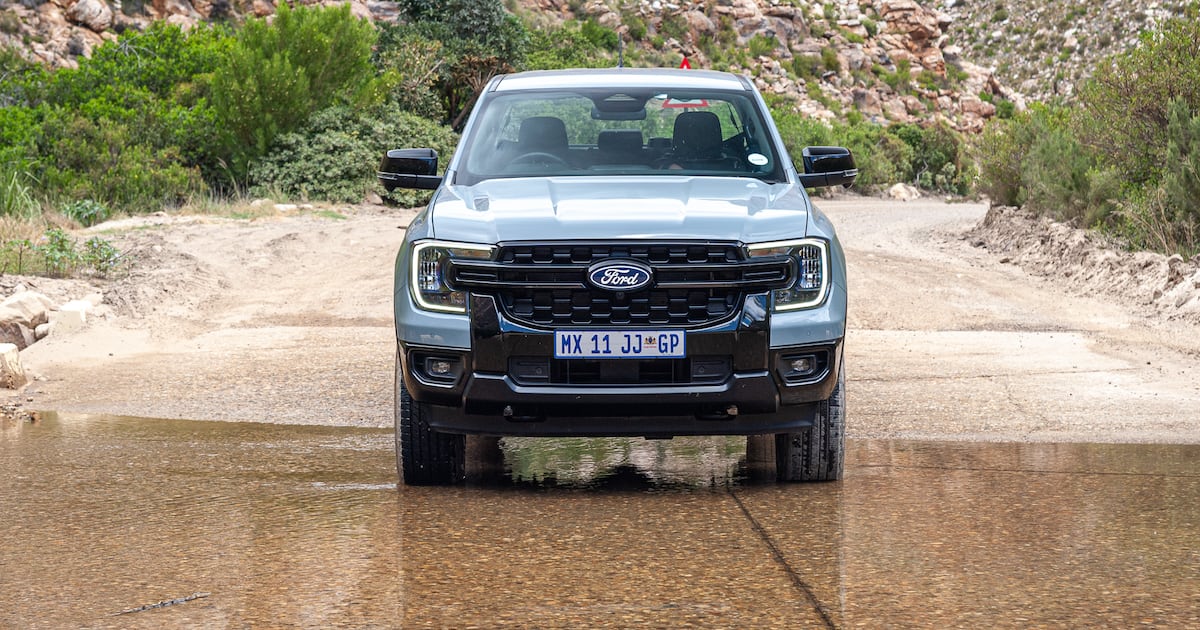
Old habits die hard. After turning into the fuel station forecourt, the attendant flips open the Ranger’s filler cap and asks whether I want to fill it all the way to the top with diesel. I tell him no, petrol, and he looks at me with a look of disbelief.
“Petrol, bra, I don’t want to break your car, are you sure?” he asks.
For a split second I second guess my request as I — like him — have spent years priming anything Ranger-shaped with the so-called Devil’s Fuel. But this is the recently launched Ranger Sport 2.3 and it most certainly combusts nothing but the finest 95-octane petrol.
So after Mr. Attendant’s muscle memory is momentarily challenged, I’m on my way again in this somewhat curious addition to the Blue Oval’s top-selling bakkie range.
 The Ford Ranger Sport 2.3 has 237mm of ground clearance.
I say curious because diesel has long been the fuel of choice when it comes to powering the legions of incredibly popular bakkies and bakkie-base SUVs that prowl South African roads.
And why not? — thanks to the mechanical alchemy of turbochargers and sophisticated common-rail injection systems, modern diesel engines deliver easy torque with economy figures that bely the size of the vehicles they’re bolted into.
I have had the Ford Ranger and Everest on long-term test, both equipped with Ford’s 2.0l four-cylinder turbodiesel motors in single and bi-turbo guise, and each was capable of achieving 7.3l/100km with little effort.
So why, then, would I want to opt for a petrol engine that is by design never going to come close to this impressive real world efficiency? I can understand the logic in relatively niche models like the Ranger Raptor — effectively a sports car for gravel/Joburg roads — but in the regular lifestyle-cum-workhorse Ranger line-up, it doesn’t seem to hold much appeal. Or does it?
 LED taillights are standard fitment. Maximum braked towing capacity is rated at 3,500kg.
One argument for the petrol lump lurking under the bonnet of my Command Grey Ranger Sport is that it won’t fall victim to the dodgy adulterated diesel that increasingly haunts our service stations: a malevolent concoction cut with cheaper, unauthorised substances like paraffin that have the potential to quickly kill your high-pressure injectors — and worse. So, one less thing to worry about.
Then there’s the added muscle. Compared to the 2.0l single-turbo diesel (remember the bi-turbo was culled earlier this year), the 2.3l EcoBoost makes an extra 97kW and 47Nm of torque. Those are some fairly substantial numbers and out on the highway — where I spent most of my 1,000+km test period — they make the Ranger platform feel significantly more spritely. Overtaking is a relative breeze for a vehicle with a claimed kerb weight of 2,055kg and you always seem to have enough power in reserve to blast past longer lines of slower moving traffic — an act that requires additional foresight and planning in its diesel-powered sibling.
 The Seweweeks Poort is a route well worth travelling if you ever have the time. Picture: Thomas Falkiner
Another plus is a more rorty soundtrack. While pleasantly hushed at lower RPMs, the 2.3 broadcasts a rather pleasing warble when you poke it with a stick and watch that digital tachometer needle rise towards 6,000rpm.
Now maybe it’s my imagination but I also thought Ford’s 10-speed automatic transmission seemed to mesh better with the EcoBoost motor, getting on with its cog-swapping duties with a lot less hunting than when paired with the single-turbo diesel. It’s a smooth and intuitive unit left to its own devices, though you can override it and select ratios manually by thumbing a rocker switch on the right side of the gear lever.
 The cabin is comfortable, well insulated and packed with most of the gizmos you want in 2026.
In Sport guise — a newcomer to the Ranger line-up designed to bridge the XLT and Wildtrak derivatives — it sends power to the rear wheels exclusively, meaning that any hardcore off-roading is unfortunately off the table. That said, with a locking rear differential and 237mm of ground clearance, you won’t have any issues rolling down some easy trails or exploring our country’s incredible and expansive gravel road network.
I embarked on the latter with my test unit and took a relaxed cruise down the R323 that threads through the magnificent Seweweeks Poort en route to the ever-melancholic agricultural/truckstop town of Laingsburg. Despite getting smothered in dust — rain’s been keeping a low profile in these parts — the Ranger Sport tackled this beguiling dirt drive with aplomb; its Goodyear Wrangler Territory HT tyres and robust suspension system soaking up and shrugging off all the rural chop and corrugations that came our way.
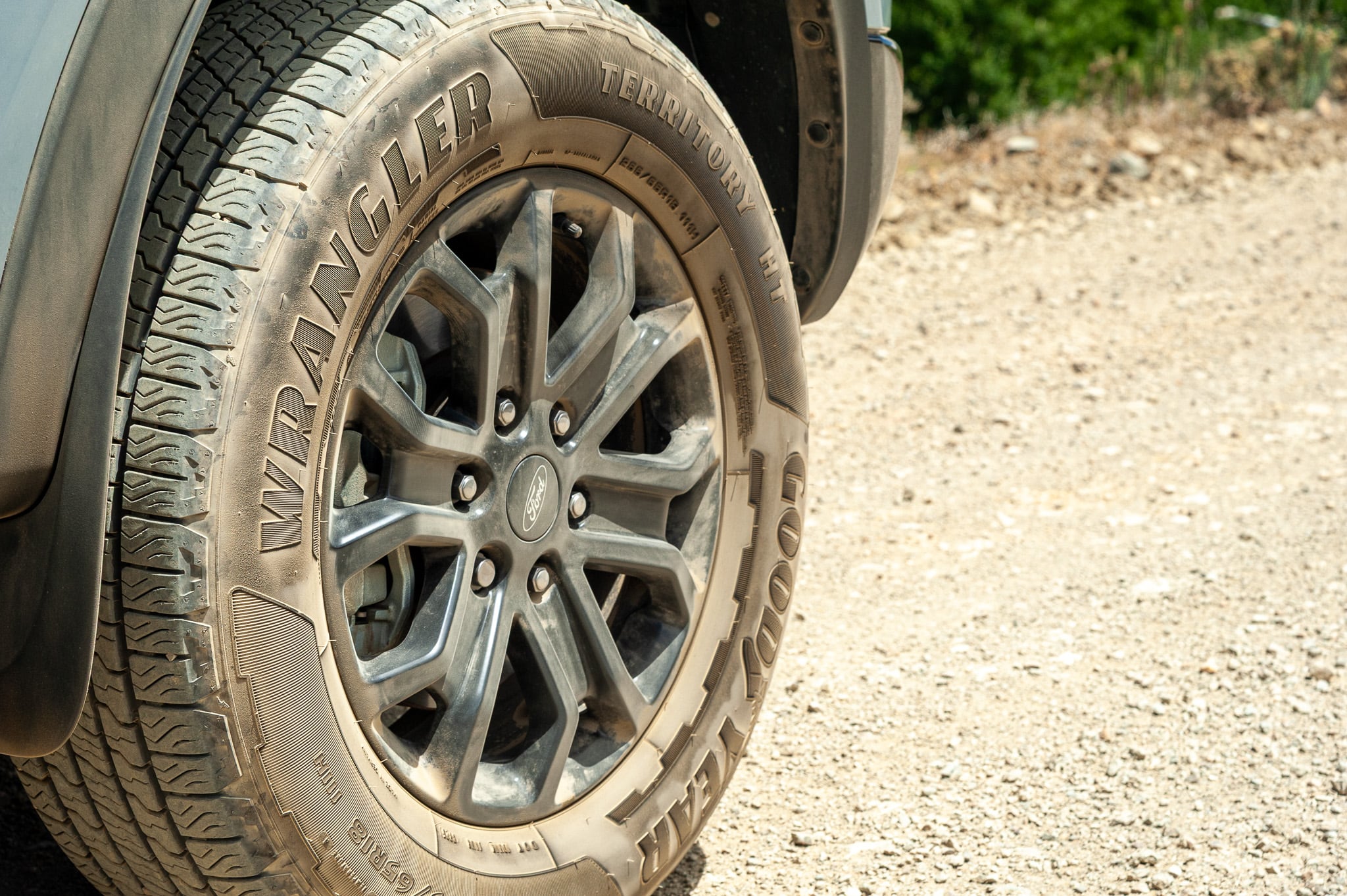 Goodyear Wrangler Territory HT tyres are fitted from the factory. Picture: Thomas Falkiner
Off it, back on the highway and rolling through the city on its black 18-inch alloy wheels, this macho-looking double cab proved equally liveable with sedan-like levels of refinement and noise suppression, comfy synthetic leather seats and pretty much all the modcons you could wish for in 2026.
I won’t list them all but the ones that stood out for me include the configurable eight-inch digital instrument cluster, 12-inch infotainment touchscreen running Ford’s excellent Sync4 operating system, wireless charging pad, 360º camera, dual-zone climate control and a suite of advanced driver assistance systems.
 The black sports bar bolted in behind the cab is a R6k option.
Though the wireless Apple CarPlay connection terminated too many times for my liking, I did appreciate the panel of physical switchgear present for controlling key functions like fan speed, recirculation, temperature and volume — the less screen-poking I have to do the happier I generally am.
So then, what about the elephant in the room — fuel consumption? I thought the 2.3 EcoBoost would be a thirsty unit when put to the test on everyday Western Cape roads, but with some careful use of my throttle foot and keeping the Drive Mode selector permanently dialled to Eco, I wrapped up my week-long test with the trip computer reading 9.7l/100km. When I worked it out manually, the final figure actually came in at 9.38l/100km, which is almost bang on Ford’s claim of 9.3l/100km.
While this is higher than what you’d achieve in a diesel-powered Ranger, it’s by no means a deal breaker if the majority of your driving consists of longer freeway distances. Around town, however, when stuck in the thirstier rigours of stop-start traffic, I would surmise this engine would quickly surpass the 10l/100km mark. If you can live with that, the Ranger Sport 2.3 makes a worthy alternative to its diesel counterparts.
And while it might take a little convincing at the fuel pumps, I suspect even my local petrol attendant would eventually come around to the idea.
 The Ford Ranger Sport 2.3 makes an excellent gravel road explorer. Picture: Thomas Falkiner
Fast Facts: 2026 Ford Ranger Sport 2.3 Double Cab
Engine: 2,261cc four-cylinder turbocharged petrol
Power: 222kW at 5,900rpm
Torque: 452Nm from 1,500 to 4,000rpm
Transmission: 10-speed automatic
0-100km/h: N/A
Top speed: N/A
Fuel: 9.38l/100km (achieved)
Price: From R844,900