
The total estimated cost of the Macquarie Point stadium precinct has risen to $1.54 billion, the Tasmanian government has revealed.
The 23,000-seat roofed stadium, which is a condition of Tasmania’s AFL deal, was approved by the Tasmanian parliament last December.
A new estimate revealed today has put the cost of stadium delivery at $1.23 billion.
But that figure does not include the wider precinct infrastructure costs needed to support the project that the government also announced today.
A car park and power supply for the precinct was budgeted at $132 million, while project delivery costs add another $183 million.
This brings the total to $1.54 billion.
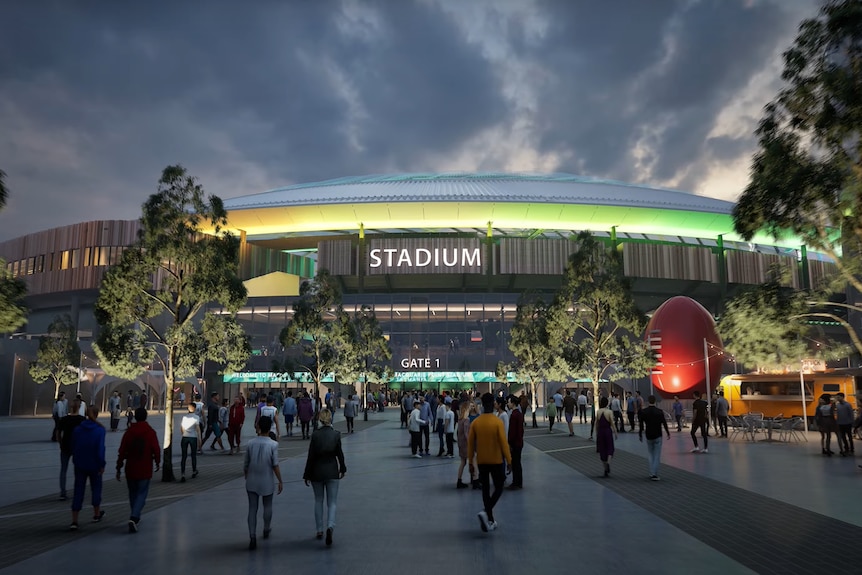
The government had previously estimated the stadium cost at $1.13 billion. (Supplied: MPDC)
Contingency costs not included
There is also a “client contingency” amount, which has not been revealed or included in costs.
It will cover any potential rise though the final stage of procurement negotiations and, if needed, would bring the project cost even higher.
Until today, the most recent stadium cost estimate had been from September, when the government priced the stadium at $1.13 billion, however this figure included project costs and contingencies.
Last week, the lower house of the Tasmanian parliament passed a motion calling for the “current estimated cost” of both “stadium delivery”, and “the broader Macquarie Point precinct-enabling infrastructure”, including power upgrades and a centralised car park.
In order to win over the votes needed for the approval order to pass the Legislative Council, the government made a number of commitments, including to limit the state’s contribution to $875 million.
Treasurer and Minister for Macquarie Point Urban Renewal Eric Abetz said the government would cover the shortfall from state funds, breaking the promised state contribution cap.
He said the state would then “look to what opportunities there are to gather the funding, and as a result reduce the borrowings that are necessary”.

The stadium will have a roof, which was a requirement of the agreement with the AFL for a state team. (Supplied: MPDC)
The federal government is chipping in $240 million, and the AFL $15 million.
Despite the US–Iran war pushing up construction costs worldwide, the government has only recently admitted the stadium would likely cost more than estimated last year.
Oil, material and labour costs blamed for price increase
Premier Jeremy Rockliff called the increases “unavoidable”, pointing to high oil and materials prices, higher labour costs and the “complexities driven by the parliamentary-driven order”.
He said the state was in conversation with its funding partners about them making larger contributions.
While some MPs had been calling for the parliament to be required to tick off any cost increase, Mr Rockliff said it would not be doing so.
“The parliament had its say last year in early December,” he said.
He remained committed to the project.
“Every generation gets a handful of opportunities to shape the future, and the stadium is one of those opportunities,”
he said.
The independent member for Clark, Kristie Johnston, told 936 ABC Hobart the state would be “on the hook” for significant amounts of borrowing.
“We will be borrowing $1.29 billion to cover the cost of the stadium … that’s a significant impost onto the state’s finances, particularly when we are in a budget crisis,” she said.
“That’s taxpayer’s money that will need to be paid back and remembering that the stadium will not be generating sufficient income to even cover the interest payments, let alone the principle.”
She said the government needed to explain the different contingencies regarding the estimated costs of the project.
“The job of parliament over the coming days will be to try and understand what those figures represent, what the value for money is, what they are including in those cost deliveries and what the contingencies might be, what risk sharing components they have between both the contractor and the government and indeed what’s the break down of those costs?”
Final contract negotiations
The Macquarie Point Development Corporation (MPDC) is in the final stage of negotiations with preferred tenderer BESIX Watpac, and hopes to sign a contract for the build by Christmas.
It submitted its final price to the government earlier this month.
MPDC chief executive Anne Beach said a “intensive, rigorous process” had been run to sign a contract this year.
“There are some risks that are carried by us, and some by the builder,” she said of the contract.
She said about $100 million had been saved through value management already, and that MPDC would keep looking for efficiencies.
Our Place Hobart, a community group opposed to the stadium project, said the $1.54 billion project figure was not the full picture.
“That’s not including a massive interest bill, the northern access road and contingencies,” the group’s Roland Browne said in a statement.
He said the government was hundreds of millions of dollars above the maximum state funding figure it promised parliament’s upper house.
“This is extraordinary. The government and MPDC have lost control of this project,” he said.
Tas stories you may have missed