
New York’s Court of Appeals ruled on Monday that landlords cannot refuse to rent to people using government housing assistance.
The state’s highest court, in its 4-3 decision overturning a lower appellate court’s ruling, indicated that it was not convinced by arguments from upstate landlords that allowing government officials to carry out the basic code inspections required by assistance programs violates their civil rights.
The decision comes in a lawsuit that state Attorney General Letitia James filed against Ithaca landlord Commons West after her office heard that Commons West was telling tenants using Section 8 housing subsidies it would not rent to them. The attorney general’s office said that violated the New York Human Rights Law, which holds that landlords cannot discriminate based on a person’s source of income.
The Appellate Division, Third Department, however, agreed in March with Commons West’s argument that the state law violated Fourth Amendment protections against unreasonable searches because it forced them to comply with federal regulations that require landlords to allow officials to inspect units rented by tenants using the Section 8 program.
“Because the Human Rights Law itself contains no search requirement and, even if the State and Federal laws could somehow be treated as a single statute, the combination would not be unlawful in every application, we hold that the Human Rights Law is not facially unconstitutional,” wrote Chief Judge Rowan Wilson for the majority opinion in the Nov. 23 Court of Appeals decision.
The inspections at issue are carried out with the purpose of preventing landlords from renting low-quality or illegal units specifically to low-income tenants using housing subsidies. The decision was applauded by James and the Legal Aid Society, whose housing attorney Evan Henley said he didn’t believe the landlords were genuinely concerned about their Fourth Amendment rights and simply didn’t want to deal with people receiving Section 8 vouchers.
“Landlords have continuously searched for ways to get around these laws,” Henley said. “The concern is not with any particular aspect of the program; the concern is with accepting Section Eight voucher holders. My hope is by rebuffing this challenge, the Court of Appeals has sent a signal that these types of challenges grounded in speculation are just not going to succeed, and that instead, what landlords need to do under the law is to engage with the particular facts of each application and evaluate these voucher holders fairly, and move on.”
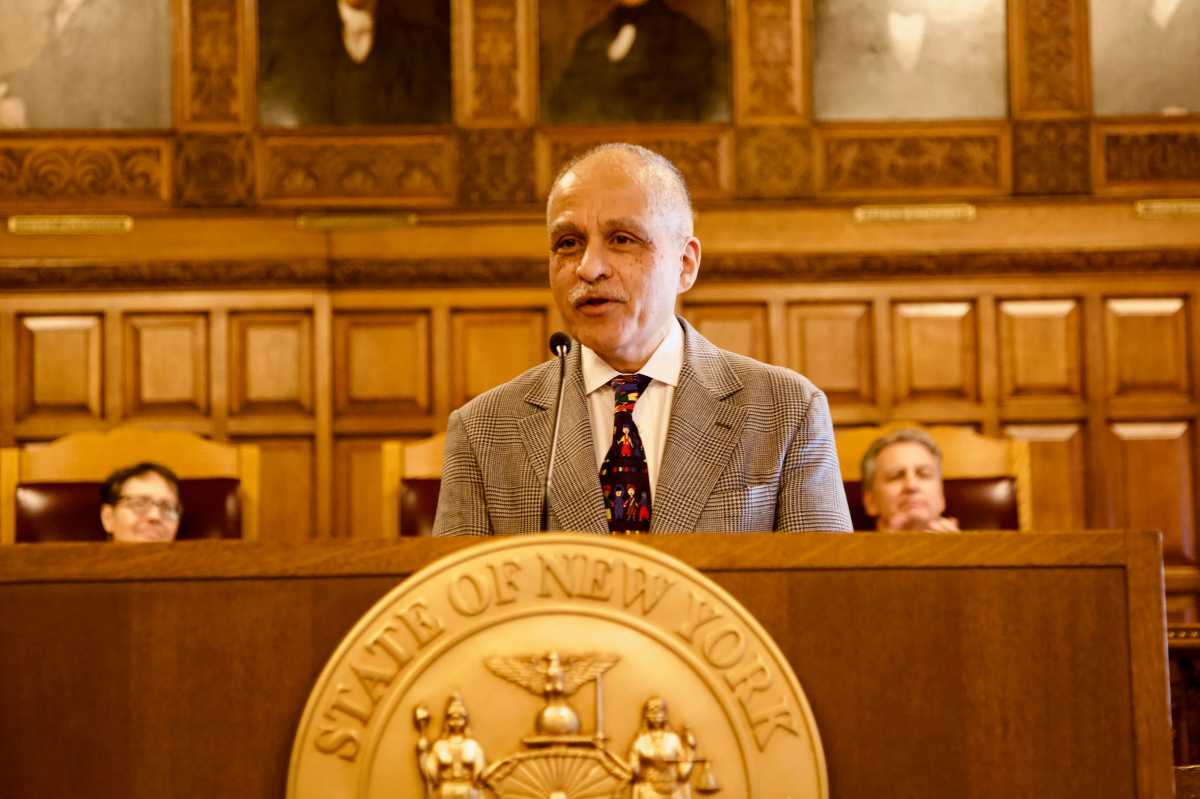 Court of Appeals Chief Judge Rowan WilsonPhoto by Max Parrott
Landlords involved considering Supreme Court appeal
The landlord’s lawyer, Curtis Johnson, said his client continues to believe the inspections have the ability to violate the Fourth Amendment. Therefore, they believe landlords should not be required by the state to not discriminate against tenants using federal assistance programs that trigger the inspections.
In a statement in which he said he was “considering” appealing to the U.S. Supreme Court, Johnson said he believed the legal question of whether a state law compelling participation in an optional federal program that requires property searches was “important.”
“The question of whether a state can compel participation in a federal program that conditions participation on coerced consent to searches is important and affects landlords across New York,” said Johnson, an attorney for Bond, Schoeneck and King.
Crucially, the landlord bringing the case had not themself experienced an unconstitutional inspection due to the program requirements, nor could they point the court to a situation where one had occurred in relation to the Section 8 program, which Henley said demonstrates that they simply wanted to be able to deny apartment rentals to people using housing assistance.
The judges also took issue with the fact that the landlords were bringing a broad legal challenge based on speculation, saying they could not challenge the law in its entirety — or bring a facial challenge — when they simply thought that the law could possibly result in an unconstitutional search with no proof of one happening.
“Here, no one has conducted any warrantless inspections, nor are any on the immediate horizon,” Wilson writes. “The landlords’ central claim is that the New York Human Rights Law is facially unconstitutional because ‘it is impossible for landlords to comply with the [law] without signing a contract consenting to [warrantless] searches’ in violation of their Fourth Amendment rights.”
“Statutes are presumptively constitutional; courts strike them down only as a last unavoidable result after every reasonable mode of reconciliation of the statute with the Constitution … has been found impossible,” Wilson continued. “A facial challenge requires the court to examine the words of the statute … we must be careful not to go beyond the statute’s facial requirements and speculate about ‘hypothetical’ or ‘imaginary’ cases.”
What the ruling means for New York landlords
The decision leaves the door open for landlords who believe they have actually experienced an unconstitutional search through this program to sue over that specific instance. Someone actually experiencing an unconstitutional search due to an inspection related to Section 8, however, is extremely unlikely, attorneys told amNewYork Law.
“The court’s decision means any challenge needs to be concrete and rooted in some actual search that the landlord has grounds to claim is unconstitutional,” Henley said. “When landlords are forced to consider voucher holders on their particular merits and engage with the program, they will find that these constitutional concerns are not real. In my experience, there are no forced inspections and no intrusions on landlords’ constitutional rights that occur within the operation of these programs.”
“These searches are done via consent, and if there is the case where a landlord is refusing to consent to an inspection, then the [government] would have means at its disposal to get a warrant and ensure that the landlord has the ability to exercise their constitutional rights,” he added. “I think those as-applied challenges will fail.”
Generally, the inspections are unlikely to present a legitimate Fourth Amendment issue, attorneys said. That’s because they’re occurring on the landlord’s commercial – not private – property and are typically only in the specific unit rented by a tenant using Section 8, not the entire building, making them limited in scope.
Johnson, however, said he believes further challenges of the law would hold merit, especially if brought on a case-specific basis where someone alleged they’d actually experienced an unconstitutional search.
“The Court did not hold that landlords can be required to consent to warrantless searches of their property and business records,” Johnson said. “It held only that the challenge, as framed, could not succeed on its face, and three judges would have upheld the unanimous decision of the Appellate Division.”
While Johnson and his landlord clients have held the concern that decisions against them could result in abuse of the Fourth Amendment, legal scholars told amNewYork Law they didn’t see this decision as one that could be used in other cases to chip away at Fourth Amendment protections and result in government overreach.
“I really don’t think that is in the realm of possibility because I don’t see this as a Fourth Amendment violation,” said New York Law School professor Andrew Scherer. “I just see it as a question of, ‘Does government have the authority to make sure that people aren’t discriminated against in their ability to get housing simply because they’re poor and need some support from government to be able to pay the rent?’”
“This is basically the landlord’s argument when you boil it down: ‘We want to be able to discriminate.’ They found a kind of a clever ruse for that basically by saying, ‘Well, we don’t want to have our property inspected,’” he continued. “The court’s saying, ‘That discrimination should not be allowed.”
Henley of Legal Aid – whose firm frequently defends clients in cases to push back against Fourth Amendment overreach – said also he didn’t see a problem here.
In terms of what the decision could mean for future tenant protections, Scherer said the decision’s narrow scope would likely similarly limit its use to prop up future tenant protections. However, he said he believes other efforts to support tenants are necessary – like requiring landlords to be licensed – and thinks that if the court had ruled the other way, governments may have become more hesitant in efforts to push additional tenant protections forward.
“It doesn’t shut down the possibility of more stringent tenant protections – which, had the landlords won, it could conceivably have been used in that way,” Scherer said.