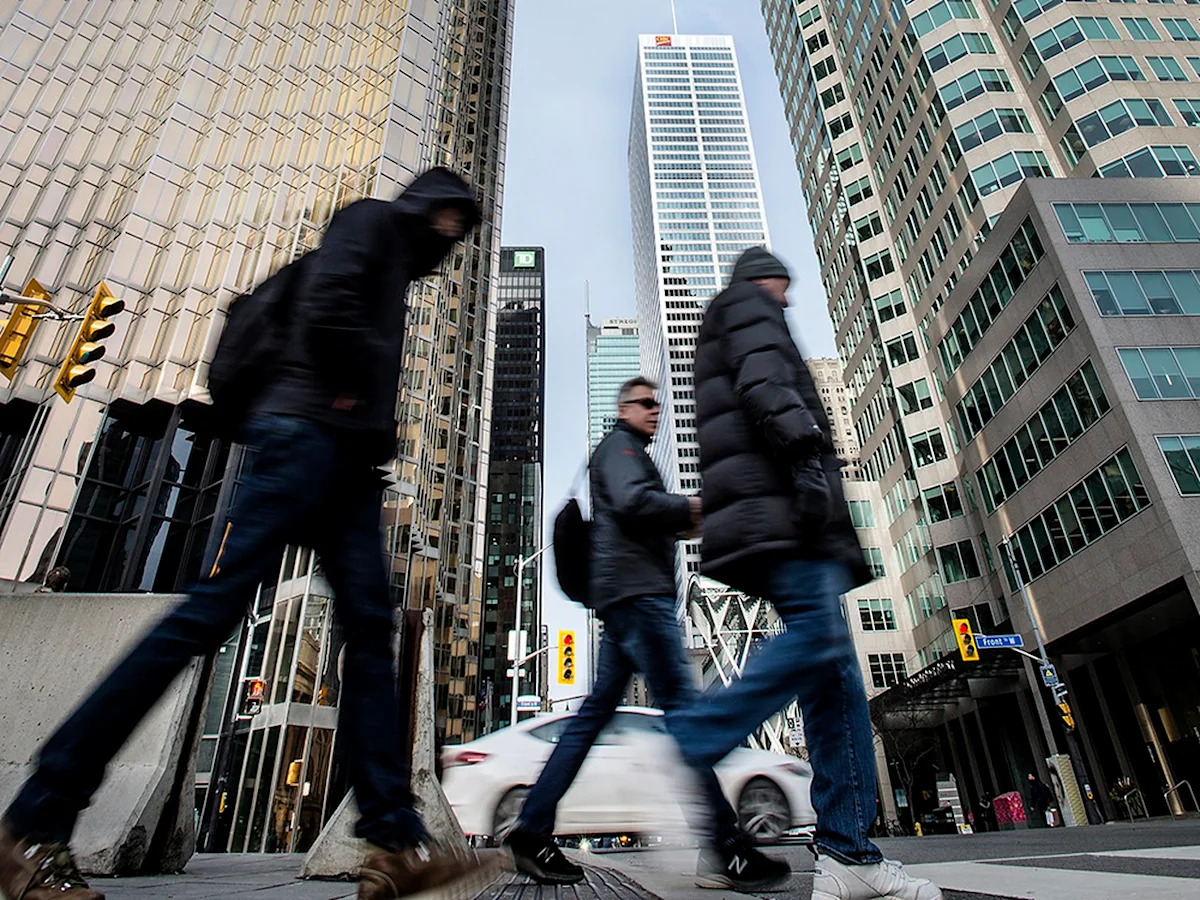
 Canada’s economy grew 3.1 per cent in the first quarter, falling short of expectations. (National Post)
Economists expect that data released on Monday by Statistics Canada will show that Canada’s gross domestic product growth slowed in the third quarter of 2026 as U.S. tariffs continued to weigh on activity.
Forecasts from several firms — including TD Economics, RBC Economics, Desjardins Group, BMO Capital Markets, Oxford Economics and CIBC Capital Markets — are putting real gross domestic product growth at between 1.3 and 1.5 per cent on an annualized basis for the third quarter of 2026.
The forecasts suggest a significant slowdown from the 3.3 per cent annualized growth in the second quarter, which marked the fastest quarterly expansion since 2023.
Many did not expect the momentum to be sustained and several indicators already showed growth slowing at the end of the summer.
Economic growth stalled in July and August, while flash estimates from Statistics Canada suggest that the economy likely contracted by 0.1 per cent in September.
The Canadian economy also lost a net 34,900 jobs in the period. Early third quarter indicators also showed monthly declines in wholesale and manufacturing sales.
Firms surveyed as part of the Bank of Canada’s third quarter Business Outlook Survey after trade talks broke down in late August reported weaker sentiment and lower expectations for export sales than firms that were surveyed before talks stalled. Respondents also said the trade tensions have weighed heavily on investment plans.
“(Second-quarter growth) was just unsustainably fast. It was not a good depiction of the economy’s underlying growth rate. Up until the second quarter, the economy basically flatlined,” said Sal Guatieri, senior economist and director at BMO Capital Markets.
“The new tariffs implemented in August seemed to put a new chill on business investment…. It seemed like we were getting some stability on the trade war front, but all of a sudden it came back with a vengeance in the summer.”
There were nevertheless signs of economic resilience for the third quarter.
LJ Valencia, an economist at Desjardins, said consumer spending remained strong throughout the quarter due to wealth effects — whereby households spend more when the value of assets such as stocks or home equity rises.
Nominal retail sales were up 1.2 per cent in the third quarter, according to recent data from Statistics Canada. In volume terms, quarterly sales increased by one per cent.
“That doesn’t mean households aren’t struggling. Higher interest rates and higher oil prices are going to impact household spending, but at the moment we’re seeing stronger household consumption,” Valencia said.
Stable business investment, from higher oil prices, especially in the oil and gas industry, alongside a broader push for artificial intelligence helped boost economic growth throughout the third quarter. Overall business sentiment improved since the early round of tariffs and geopolitical shocks, even after the trade talks fell apart, according to the October Business Outlook Survey.
“We’ve seen exports decline in the quarter, but we’ve also seen a reduction in imports during the quarter … It translates into a situation where net trade is positive to growth, and that’s really a reflection of much weaker domestic demand in the economy, but it’s still in positive territory” Valencia added.
BMO Capital Markets and Desjardins both expect economic growth to slow further in the fourth quarter of 2026 due to the U.S. tariffs, but base case forecasts are for some sort of resolution to the trade tensions.
Canada-U.S. Trade Minister Dominic LeBlanc told reporters at a post-caucus scrum on Wednesday afternoon that trade talks have resumed and Canadian officials will “continue to try and find a deal that we think is in Canada’s interest.”
However, he didn’t say whether an agreement will be reached before the Dec. 31 deadline.
“Those tariffs would clearly have a pretty devastating impact on Canada’s auto industry, and given the broad spillover effects to other industries, that would significantly slow Canada’s economy,” Guatieri said.
“It would play out over time, but it would not be a good development for Canada’s economy. The two per cent growth that we anticipate for Canadian real GDP in 2027 would have very little chance of materializing.”