
Why this matters
San Diego’s only Republican seat could be eliminated if voters approve the proposition. It could also change the balance of power in Washington.
California is asking voters to decide if two wrongs make a right this November.
The Election Rigging Response Act was signed Thursday by Gov. Gavin Newsom. It directs the state to hold a special election to let voters decide whether California will redraw congressional district lines to add five Democratic-leaning seats to the U.S. House of Representatives ahead of next year’s midterm elections to counterbalance the five Republican-leaning seats Texas is planning to add.
On Monday, state Republicans filed a second petition to the state Supreme Court seeking to block the redistricting effort, after the first one failed.
The plan, if it succeeds, will put “San Diego’s only Republican held district in play as a political battleground in 2026,” said Thad Kousser, a political science professor at the University of California, San Diego.
“San Diego’s often been a microcosm for the politics of California, and in this way, it will still be a microcosm,” Kousser said.
Proposition 50, if passed in the special election, would change the partisan balance of two districts in San Diego. Republican Rep. Darrell Issa’s District 48 would expand to include Palm Springs, Escondido and San Marcos while removing a large chunk of red East County including Poway.
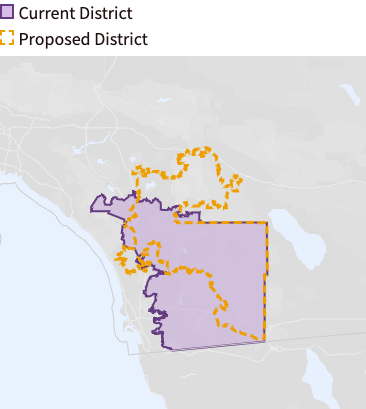 A map showing the current district 48 overlayed with the proposition 50 boundaries. Credit: Jeremia Kimelman, CalMatters
It would also make other districts in the area less competitive, like Democratic Rep. Dave Min’s District 47, which would include Long Beach.
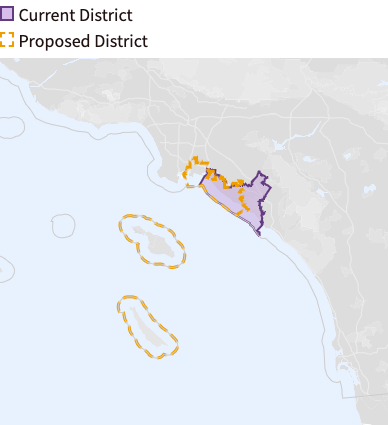 A map showing the current district 47 boundaries overlayed with the proposition 50 boundary. Credit: Jeremia Kimelman, CalMatters
“San Diego is blue-tinted, but there’s still many Republicans in San Diego and across the state of California. This district and these new maps would mean they have a much smaller chance of electing members of Congress who would voice their concerns and their perspectives in Washington,” Kousser said.
Newsom’s push to redraw congressional district lines is in retaliation to plans in Texas to redraw congressional district lines to add five Republican seats. California will only complete the redistricting if Texas or another state goes forward with their own.
What is gerrymandering?
Gerrymandering is when politicians draw voting district lines in a way that gives their party an advantage. They might group large numbers of the other party’s voters into a few districts (“packing”) or spread them thinly across many districts (“cracking”), making it harder for those voters to elect representatives. Supreme Court cases in the last decade have allowed for partisan gerrymandering, ruling that such claims can’t be challenged in court. To prevent this, California voters created an independent commission so that regular citizens, not politicians, draw district boundaries.
The house of representatives currently has 219 Republicans and 212 Democrats, a balance that could shift when all seats go up for reelection in 2026.
Kousser said that “Republicans barely won the overall vote and barely control Congress. President Trump sought to disrupt this symmetry by urging a mid-decade redistricting in Texas and other states that would deliver more Republican seats than there are votes. And California leaders are countering.”
Newsom said the special election will give voters a chance to “fight back” against the Trump administration, which has uniquely targeted California.
Newsom called on Republicans to call off the plan in a letter to the Trump administration.
“This attempt to rig congressional maps to hold onto power before a single vote is cast in the 2026 election is an affront to American democracy,” he said. “But if the other states call off their redistricting efforts, we will happily do the same.”
The chair of the Republican Party in San Diego Paula Whitsell said that the redrawn maps will make it difficult for Republicans to win District 48 in San Diego and any seat in the state of California.
“This is clearly a play by governor Gavin Newsom to do an end run around the voters. Clearly the wish of the voters doesn’t mean much because they voted twice to have an independent commission. So it’s not like their desire hasn’t been made perfectly clear. They don’t want politicians drawing these lines.”
Texas politicians came up with the proposal at President Trump’s request, and he has pressured other red states to do the same.
How we are covering the Trump administration
inewsource is reporting on the impacts of the Trump administration budget and federal funding cuts in San Diego. Has your organization or one you know lost funding? Have a tip and want to talk with a reporter? We want to hear from you.
The redistricting showdown between Texas and California is the latest episode in a partisan rivalry that started at the beginning of the 2000s, said Ken Miller, Director of the Rose Institute of State and Local Government at Claremont McKenna College.
At the time, California became overwhelmingly Democratic and Texas Republican, whereas previously they were more politically aligned.
“When that happened, the two states became leaders of Red and Blue America, and political rivals,” he said. “The measure will test whether California’s commitment to good government reform, which is part of the state’s political culture, will be overwhelmed by its powerful anti-Trump sentiment.”
How will the special election work?
On November 4, California will hold a special election alongside municipal elections, with Proposition 50 being the sole special election ballot measure. It will need a simple majority to pass. The new districts will be used in the upcoming 2026 congressional elections, with primaries starting in June.
A San Diego Registrar of Voters spokesperson told inewsource that the county is prepared to handle the statewide special election, but officials are still determining the cost to the county and the impact on voters whose district would change. Nearby Riverside County estimated that the special election would cost it up to $16 million.
The last time there was a special election was an unsuccessful 2021 attempt to remove Newsom as governor that cost the state about $200 million.
Redistricting in California
If passed, Proposition 50 would be a temporary reversal of the 2008 state constitutional amendment that set up an independent bipartisan commission to draw state and federal district lines approved by California voters. The last two new maps were drawn by the commission.
Across the country and in California, redistricting generally occurs at the end of each decade in response to the census. Mid-decade redistricting is uncommon. In California, the redistricting would only be in effect through 2030, when the independent commission would take charge again.
This isn’t the first time California politicians have tried to put partisan gerrymandering on the ballot in a special election. In 1983, a few years after Californians shot down a measure to allow an independent commission to set the district lines, Republican Gov. George Deukmejian tried to call a special election to redistrict California as a response to maps drawn in favor of Democrats. The initiative was shot down by the state Supreme Court, which called it a “novel” attempt in the history of the state.
Matt Barretto, a professor of political science at UCLA, said there should be no legal obstacles this time since a U.S. Supreme Court decision cleared gerrymandering on partisan lines.
“It’s unfair to California to allow states like Texas and Florida to have extreme partisan gerrymandering, and then California and Washington and other big states on the West coast are democratic and nonpartisan,” he said, adding there should be a national standard for nonpartisan redistricting.
Until then, he said, “California should do what’s in the best interest of California and not fight with one arm behind their back.”
Type of Content
News: Based on facts, either observed and verified directly by the reporter, or reported and verified from knowledgeable sources.
News Article: Article pages that do not meet specifications for other Trust Project Type of Work labels and also do not fit within the general news category.