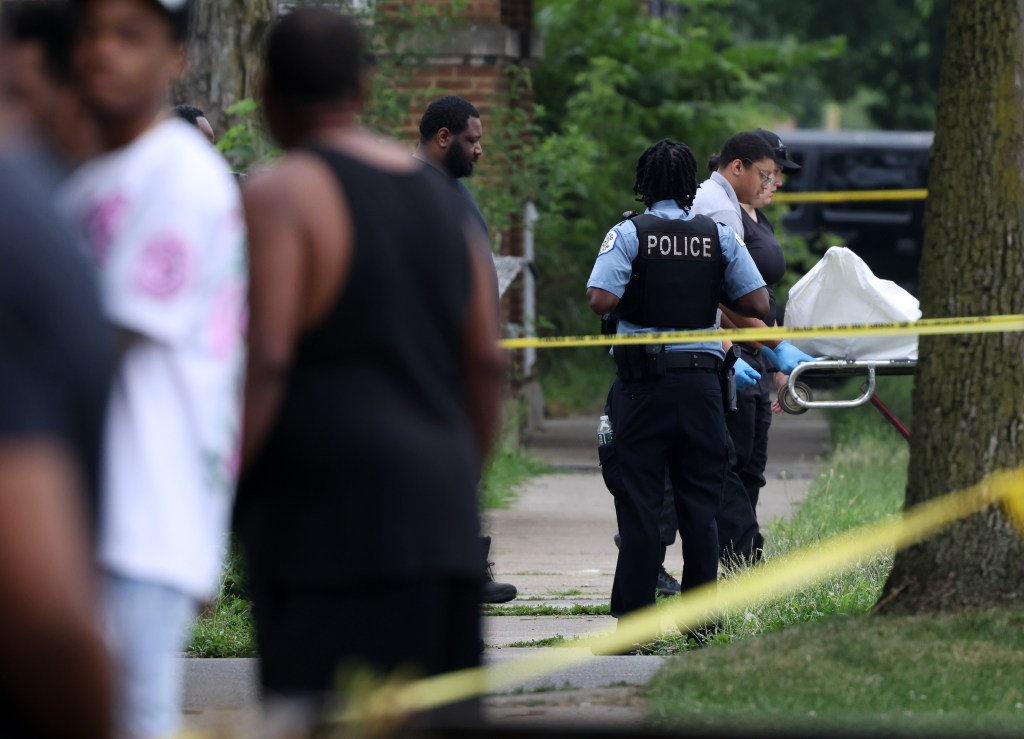
Illinois is facing a crisis of violent crime, and Chicago is its epicenter. While President Donald Trump’s crime initiative in Washington has delivered real results — hundreds of illegal firearm arrests and thousands overall — our state leaders continue to look the other way.
Gov. JB Pritzker recently went on national television and declared that “Chicago is fine.” He declared this after a bloody Labor Day weekend where more than 50 people were shot and eight were killed. For many families in Chicago, violence is not rare. Yet the governor’s instinct is to downplay the crisis rather than to confront it.
Even worse, his words rarely match his actions. Pritzker claims he supports federal cooperation with local police, yet his own Way Forward Act blocks exactly that. He defends Illinois’ gerrymandered maps — ranked among the most partisan in the nation — even floating the idea of redrawing them again. This isn’t leadership; it’s political spin designed to protect power while communities suffer.
Meanwhile, Trump is taking action. His administration has committed National Guard resources to Chicago to back up law enforcement and restore public safety. Democrats, however, seem more offended by Trump’s determination to fight crime than by the violence tearing apart city neighborhoods.
The facts speak loudly: Chicago has led the nation in the number of homicides for 13 consecutive years. In 2024, its per-capita homicide rate was three times higher than Los Angeles’ and nearly five times higher than New York’s. Fewer than 20% of reported crimes result in arrests. And more illegal guns are confiscated here than in New York and Los Angeles combined.
These aren’t just statistics — they represent lives cut short and communities living in fear. Illinoisans deserve leaders who acknowledge reality, back law enforcement and put public safety ahead of political ambition.
— Kathy Salvi, chair, Illinois Republican Party
Real solutions with impact
I am a born-and-raised Chicagoan; a South Sider, to be exact. I love this city. But I have also lived through many of the realities that make people feel unsafe here.
Like so many Chicagoans, I have lost loved ones to gun violence, had my car stolen and ducked for cover when bullets rang out outside my own window. And just like many of our violence prevention workers, I carry those experiences with me every day. We get it.
But I also know another truth. Despite the headlines, my team has created thousands of unbroken peace treaties. We’ve helped hundreds of young people find meaningful jobs. We’ve completed thousands of outreach visits, and we’ve stood in hundreds of courtrooms to help both perpetrators and victims find a reason to live and to hope.
Our team works 24 hours a day to make sure that communities remain unharmed, that families feel safe stepping out of their homes and that people can find a reason to smile again. That is what community violence intervention (CVI) is about — creating safe spaces, mitigating violence and keeping peace within our neighborhoods.
And the results are real. In the communities UCAN serves, shootings and homicides have dropped by 40% over the past two years. That’s nearly 25 lives saved. Twenty-five mothers, fathers, sons and daughters who still have the chance to live their lives. That is the impact of CVI. The evidence is in the numbers. The interventions are working. The investments are working.
Now, more than ever, we cannot afford to pull back. We need to double down on real solutions with proven impact, not chase new approaches that risk starting over. It took years to build the trust and momentum that are saving lives today. Our communities deserve the chance to continue moving forward.
I stand beside everyone who wants a safer Chicago. I am raising two children here, and I want the same future that every parent wants: for their kids to be safe, to thrive and to dream without fear. Trust us. We’ve been doing the work, and we will continue to put Chicago’s safety first.
— Christa Hamilton, CEO and president, UCAN, Chicago
Editorial board’s hysteria
I write in response to the Sept. 9 editorial (“‘For the Love of Chicago’ is a necessary counter to the hellhole nonsense”) in which the Tribune Editorial Board insists I owe it an apology for an opinion piece I wrote about Chicago’s crime rate and President Donald Trump’s legal grounds for deploying federal law enforcement there.
I am deeply sorry that the once-respected Tribune Editorial Board can offer no rational counterargument to my op-ed but instead indulged in petty personal insults against me, my state and my community, which has a murder rate of zero per 100,000. The board did so one day before a conservative critic was brutally gunned down while practicing his popular career of engaging in the reasoned debate the board’s overwrought members so obviously eschew.
I am sincerely sorry that the board’s hysteria helps explain why a record-high 69% of Americans place little or no trust in legacy media, another fact that I am sorry to say may have caused the Tribune’s newsworthy recent financial problems, layoffs and double-digit percentage-point decline in circulation.
I am even sorrier that America’s former second city has a mayor who is unfit for office, blinded by ideological excesses and completely insensitive to the massive loss of life among his citizens, with most victims being poor people of color, while he has a security detail.
I am truly sorry, indeed, that the board’s members are content to live in — or perhaps in the leafy suburbs of — a city where 58 people were shot over Labor Day weekend alone, a city that has had the highest number of homicides in America for 13 years.
I do most sincerely apologize for not having said more forcefully, with more facts that the editorial board is too uninformed or too emotional to refute, that Chicago is a hellhole.
May God and Trump save you. I am so very sorry that your mayor, governor and purportedly leading newspaper won’t.
— Paul du Quenoy, president, The Palm Beach Freedom Institute, Palm Beach, Florida
Chicago is a vibrant city
The editorial regarding combating President Donald Trump and Paul du Quenoy’s characterizations of Chicago being a “hellhole” and a “disastrous city” was on point. Having lived there for nearly 40 years, I always found Chicago to be a vibrant and fun city with much to offer its residents and tourists.
Yes, Trump and du Quenoy must not be allowed to define Chicago. Yet, many living outside the city let the statistics define Chicago. When non-Chicagoans address the city’s crime numbers to me, I point to the fact that, while the statistics are alarming, the majority of Chicago’s violent crime is committed in three to four city neighborhoods, some distances from downtown.
The truth is that data compiled by the Chicago Police Department and others reveals that downtown Chicago is a safe place to visit, with relatively little violence. Tourists must be made to know that most of the fun and action of Chicago is found downtown and the Near North Side, where they should feel safe and sound.
To be sure, every neighborhood in Chicago has something to offer. Just about every big city has neighborhoods that present risks of violence, and efforts are being made to reduce violence in the high-crime neighborhoods of Chicago.
Still, the truth is that downtown Chicago is full of culture, terrific dining, upscale shopping, fantastic entertainment and, most of all, great people. Tourism marketing must make it known that a wonderful time can be had by all in the heart of Chicago.
— Terry Takash, Western Springs
Submit a letter, of no more than 400 words, to the editor here or email letters@chicagotribune.com.