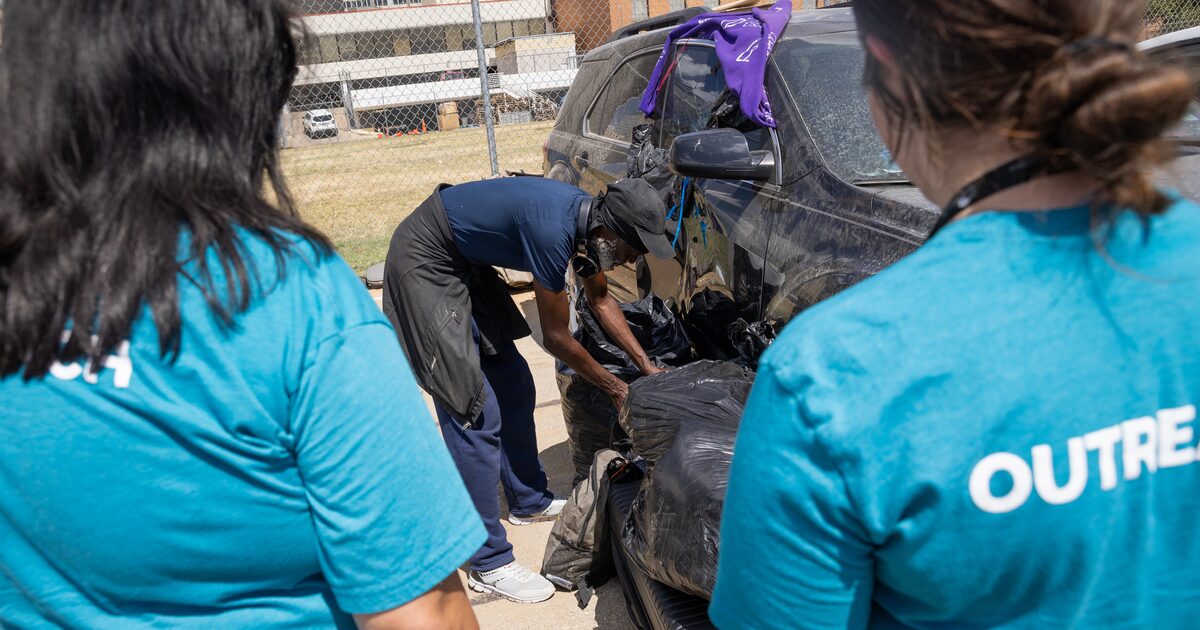
Two Dallas council members say four of their counterparts violated the Texas Open Meeting Act on Tuesday morning when they met with representatives from hotelier Monty Bennett’s Ashford Hospitality Trust, a real estate firm, to discuss homelessness in downtown Dallas.
One of the council members in the meeting said the discussion included a proposal to move The Bridge, a homeless service provider, out of downtown Dallas and establish a facility at the Dallas Executive Airport.
Council members Adam Bazaldua and Paula Blackmon said they learned of the meeting at 10:30 a.m. occurring in council member Cara Mendelsohn’s office.
Blackmon and Bazaldua said the presence of council members Mendelsohn, the housing and homelessness solutions committee’s chair and Lorie Blair, the vice chair, alongside Mayor pro tem Jesse Moreno and council member Zarin Gracey — four out of seven of the committee’s members — created the majority needed to conduct public business and broke the state’s opening meeting laws.
Political Points
Bazaldua is also a member of the housing committee.
Mendelsohn told The Dallas Morning News the meeting started at 10:23 a.m. and introductions lasted until 10:45 a.m., at which point Bazaldua and Blackmon came in. Mendelsohn said she left the meeting at that point.
“There were no meeting material discussed while a quorum was present. An outside group of philanthropists were pitching an idea for homeless services. There was no deliberation or vote or agreement on any course of action nor is there any open procurement. Councilmembers meet with third parties all the time,” Mendelsohn said.
“These are people who have a grudge because they aren’t a chairman or vice chairman of any committee,” she added.
Gracey said he was invited to the meeting to learn about a model similar to San Antonio’s Haven for Hope, which offers sleeping quarters and assistance with housing, education, counseling and support.
“My invitation was based on the proposal to potentially develop this model at the Executive Airport, which, according to the information I received during the meeting, would serve as a replacement for The Bridge (a homeless service provider) currently located in Dallas,” Gracey told The News. “While I can appreciate the Haven for Hope model, the idea of moving the Bridge to Dallas Executive Airport is not something the community or I support.”
The Bridge is located in downtown’s southern half, which is in the midst of a redevelopment plan anchored by a refurbished Kay Bailey Hutchison Convention Center. Parking lots behind City Hall could also see new housing and businesses after the City Council handed a $96 million incentive package to developer Mike Hoque.
Patrick Carreno, Dallas Aviation Department Director, said the Bridge was not moving to the Dallas Executive Airport. “I can assure you that is in fact a rumor and it is not happening,” Carreno said.
Language in the Texas Open Meetings Law handbook indicates that a committee may not be covered by the open meetings law if it is not making final decisions that are often “rubber-stamped” by the City Council.
Bill Aleshire, an Austin-based attorney associated with the Freedom of Information Foundation Texas, said if the committee is merely making recommendations and not approving policy, then it is not subject to the open meetings law. However, any meetings of major policy issues, such as homelessness, benefit from being open to the public.
“It may be legal, but it may not be right,” Aleshire said.
Blair said Mendelsohn invited her to the meeting the day before. “There was no agenda nor notification of who was invited to this meeting. I was not sitting in nor acting in any official capacity,” she said, adding that “any additional questions should be directed to the meeting organizer.”
Moreno, whose district includes The Bridge, did not immediately respond to questions from The News on Tuesday afternoon. City staff declined to comment on the meeting. Assistant City Manager Robin Bentley from the city manager’s office, who oversees departments related to economic development, housing, homeless services, as well as convention center services, was also present in the meeting.
“The public has every right to expect decisions to be made openly, where they can take part in the policymaking process, and not behind closed doors on the fifth floor, especially on an issue as critical as homelessness,” Blackmon and Bazaldua said in a news release.

Four council members met with officials from Ashford Hospitality Trust to discuss a homeless count initiative.
Paula Blackmon
In the picture, officials are seen holding a folder labeled “Homeless Count Initiative Dallas CBD” with the logo of Bennett’s company.
Allison Beach, a media spokesperson for Ashford Hospitality Trust, told The News the folder was a biweekly report sponsored by the Ashford Group of Companies on the current homeless count in the downtown central business district. The report is sent to all City Council members and other local officials who enforce the Safe in the City initiative, which was unveiled by Dallas leaders earlier this year, Beach said.
Safe in the City is a downtown public safety initiative launched in response to an increase in complaints of crime and the presence of homeless residents in public spaces, such as parks and libraries. The city was also investing resources in moving residents out of shelters quickly and freeing up shelter capacity to rehouse people.
Bennett has long called for decisive city action to tackle the persistent sight of homelessness downtown. At a Downtown Dallas Inc. luncheon in 2024, Bennett said he wanted to move his hotel and real estate firm’s office to the city’s core, but he felt that it was untenable as the central business district was not safe.
Local officials announced last year that the region had met national benchmarks to be recognized as having “effectively ended” veteran homelessness. This year, they announced a new milestone: ending chronic homelessness downtown.
However, earlier this year, an audit of the region’s lead homeless services agency, Housing Forward, raised questions about the reliability and transparency of the area’s annual count of people who are homeless and whether it aligned with federal standards.
The report said the city was not verifying the data it received from contractors about their work on addressing homelessness and required documents were missing from monthly reimbursement reports.
Everton Bailey Jr. contributed to this article.