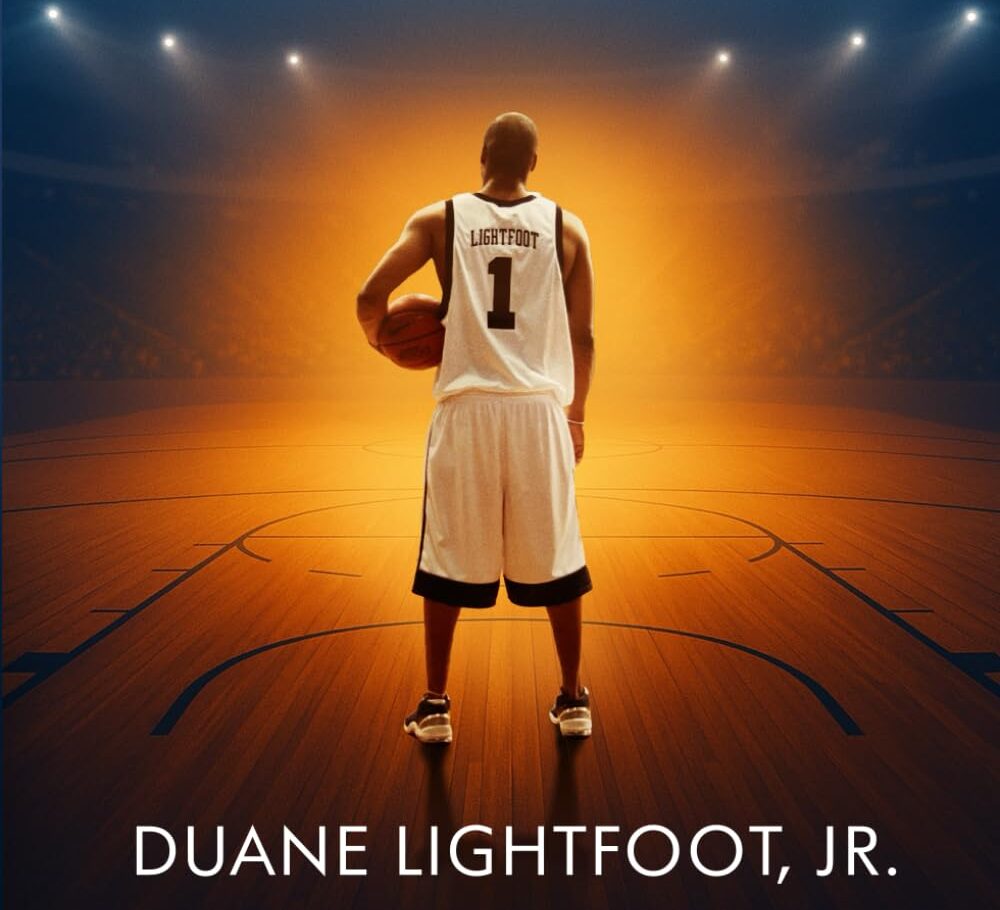
The cover of Duane Lightfoot Jr.’s book, “Beyond The Game.” Photo courtesy of Duane Lightfoot Jr.
DAVID JACOBS | MANAGING EDITOR | drjacobs@butler.edu
Duane Lightfoot Jr. sat toward the end of the bench during his first two years on the Butler basketball team, but quickly carved out a solidified role off the bench in his junior and senior seasons — averaging double-digit points in each campaign.
After being urged by his father, the 2004 Butler grad used his experiences to write his first book, “Beyond The Game”, which can be purchased for $24.99 on Amazon.
After officially publishing the book on Sept. 16, Lightfoot Jr. met with The Butler Collegian to discuss his journey that led him to become an author.
THE BUTLER COLLEGIAN: What caused you to want to write a book about your basketball experiences?
DUANE LIGHTFOOT JR.: I’ve gotten into coaching and have two sons who are going through the basketball journey themselves. It kind of became, ‘How could I use my story to help somebody else?’
I just thought that this game has given me so much because [I was] able to put a basketball in a hoop and jump. I was able to get a free education, go to school and meet my wife. This game taught me how to prepare for life.
TBC: What does your book title “Beyond The Game” mean?
DL: A lot of people look at sports, just in general, and they look at how many points I scored. They’re missing the big picture of what sports is about. In the very first chapter, I talk about how you get some parents who just get their kids signed up for something because they want them out of the house, not realizing the value they are getting out of that.
You’re going to learn how to work in teams and learn how to deal with adversity when your back is against the wall. So, [the title] symbolized the fact that sports is not just about the actual game you’re playing. There are many more things that you’re going to get from playing sports outside of trophies and ribbons.
TBC: How impactful of a role did your time at Butler have on both you and the lessons you share in your book?
DL: First and foremost, if not for the opportunities that the coaches gave me to play basketball, I wouldn’t have the nice life my wife and I have built for ourselves. I’ve got lifelong friends that I’ve met, teammates who have been there for me through a lot of things — whether it was during my playing days or after — so really, without Butler, I wouldn’t have anything I have in my life currently. Butler has given me the opportunity to play basketball, be on TV, travel the country and just have these memories with my teammates.
TBC: What are your favorite memories from your time at Butler?
DL: One of my favorite memories that I briefly touch on in the book was during my freshman year. I was in Ross Hall, and being one of only two freshmen on the team, along with Nick Gardner, I was the only person in the dorm for the entire Christmas break. There was a room down the hall that had left his alarm clock set. So, the very first Monday of Christmas break, his alarm goes off, and it continues to go off for an entire month straight. I could hear the alarm for 24 hours a day, seven days a week.
TBC: What is the biggest lesson you learned during your career?
DL: I don’t want to ruin the book, but in the very last chapter, it talks a lot about how I realize I am more than just a basketball player. So, that overall self-worth of realizing that you’re not tied to how many points or what your average was per game. I’m more than that. I’m a husband, a father, a son, an employee, a coach and a trainer. I never wanted [basketball] to be the only legacy I left.
TBC: If you could go back to when you were a first-year on the basketball team, what would you do differently?
DL: My biggest regret is that I was immature. Mentally, physically and emotionally. I’ll never forget that I was talking to four teammates in the locker room: Brandon Miller, Joel Cornette, Mike Monserez and Mike Moore. I told them that I’m glad to be here and that they brought me here to help you guys get over the hump. I’m going to be the best basketball player to ever play at this school.
They looked at me kind of funny, and I told them, ‘Yeah, man, I averaged 19 [points] in high school.’
Then one by one, they go around the room and start giving me accolades. Brandon was telling me how he scored 2,000 points, [Mike] Moore was telling me he won two state championships. I was just not really prepared for the fact that I’m just an 18-year-old kid and I’m out there with 22-year-olds who have been through this ringer of college basketball.
TBC: How much does it mean to you to be able to share your stories in your book?
DL: Being able to tell my story literally means the world to me. I didn’t write this book to be rich or make money. It was something that was presented to me and gave me a new challenge.
Related