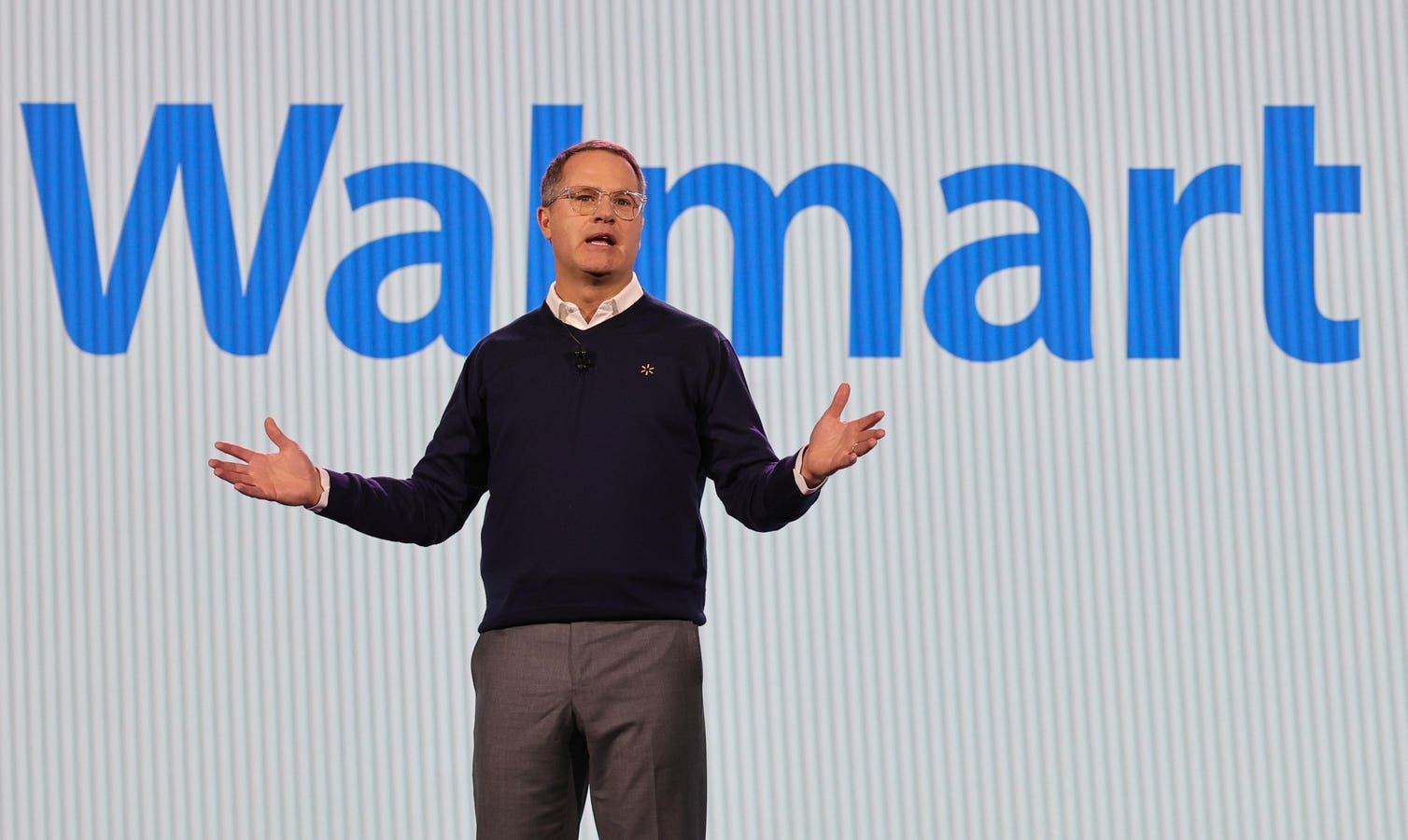
Walmart CEO Doug McMillon echoes other CEOs same sentiment on AI.
Getty Images
When Walmart CEO Doug McMillon recently told conference attendees that “artificial intelligence is going to change literally every job,” remarks later reported by The Wall Street Journal, it was easy to interpret his words as a dire warning. And it is, but hidden in that warning is a benefit CEOs can’t afford to ignore.
AI isn’t just another tech wave, as it’s a force already reshaping skills, workflows, cultures, and career paths across industries. The question isn’t whether disruption will hit your company; it’s whether your organization can adapt fast enough to stay relevant and competitive.
Much like in health, where stress can either accelerate decline or build strength depending on the quality of preparation, AI presents leaders with the same choice. Viewed reactively, it erodes, but viewed proactively, it strengthens.
The Hidden Benefit Behind The Warning
In an interview with The Associated Press, McMillon stressed that many roles aren’t disappearing. Instead, they’re being “plussed up.” Rather than imagining a hollowed-out workforce, leaders can see AI as an amplifier that reshapes jobs rather than eliminates them.
This reframing is significant as it shifts the narrative from one of scarcity to one of abundance. If jobs evolve instead of disappear, organizations gain the opportunity to redesign how work is done, how employees develop, and how performance is evaluated.
It mirrors what happens in health and performance: stressors are neutral. A workout can build strength or cause injury, depending on proper preparation and a solid initial foundation. Likewise, AI can either expand opportunities or create obsolescence, depending on whether leaders build organizations resilient enough to adapt.
The Core Traits Of A Future-Ready Workplace
McMillon’s warning is ultimately a reminder that organizational relevance in the AI era depends on three traits: skill diversification, adaptability, and continuous learning. They are the workplace equivalents of oxygen, metabolism, and muscle growth. And together, they protect an organization’s most valuable currency: its people.
1. Skill Diversification
A diverse nutritional palate strengthens your body, and diverse skills strengthen your workplace. Walmart has leaned into skills-based training, even offering truck drivers advanced technical courses to ensure roles evolve rather than disappear.
The same pattern is happening everywhere. According to LinkedIn’s 2025 Guide to Future-Proofing Your Career, 85% of U.S. professionals could see at least a quarter of their skills reshaped by AI. Organizations that cling to static job descriptions, credential-based hiring, and outdated cultural norms risk fragility. Those who build broad skill ecosystems create antifragility and ultimately stand out in the market.
2. Adaptability
In biology, metabolism determines whether stress fuels growth or decline. In organizations, adaptability plays the same role. McMillon’s framing of jobs as “plussed up” depicts how disruption can be reframed as evolution.
Instead of defaulting to mass layoffs, an adaptable organization can redesign workflows that complement human judgment, creativity, empathy, and other unique human traits with AI’s speed and scale. These companies can thus further improve their performance while also attracting top talent.
3. Continuous Learning
Humans extend their healthspan and lifespan through lifelong learning, which involves exercising their muscles, training their brains, and refining habits over the course of decades. Organizations extend their relevance in the same way. LinkedIn data reveals AI literacy has grown 100% year-over-year, with certifications and retraining surging among other developments.
Continuous learning is no longer optional; it’s an essential compounding mechanism for corporate survival. Companies that fail to embed it into their organizational DNA risk stagnant performance and losing top talent to competitors who prioritize growth.
What Doug McMillon’s AI Warning Means For Today’s Workplace
McMillon isn’t alone. Nvidia CEO Jensen Huang and Amazon CEO Andy Jassy have echoed similar views: AI will stress every workplace system. But stress itself is neutral, as the outcome depends on whether CEOs have built the infrastructure to turn it into growth.
Just as individuals extend their healthspan by investing in habits that pay dividends over time, leaders must extend their organization’s relevance by treating skills, adaptability, and learning as core assets. Doug McMillon’s warning is worth heeding not because it signals an end, but because it offers a blueprint for the evolution required in the next era of business.