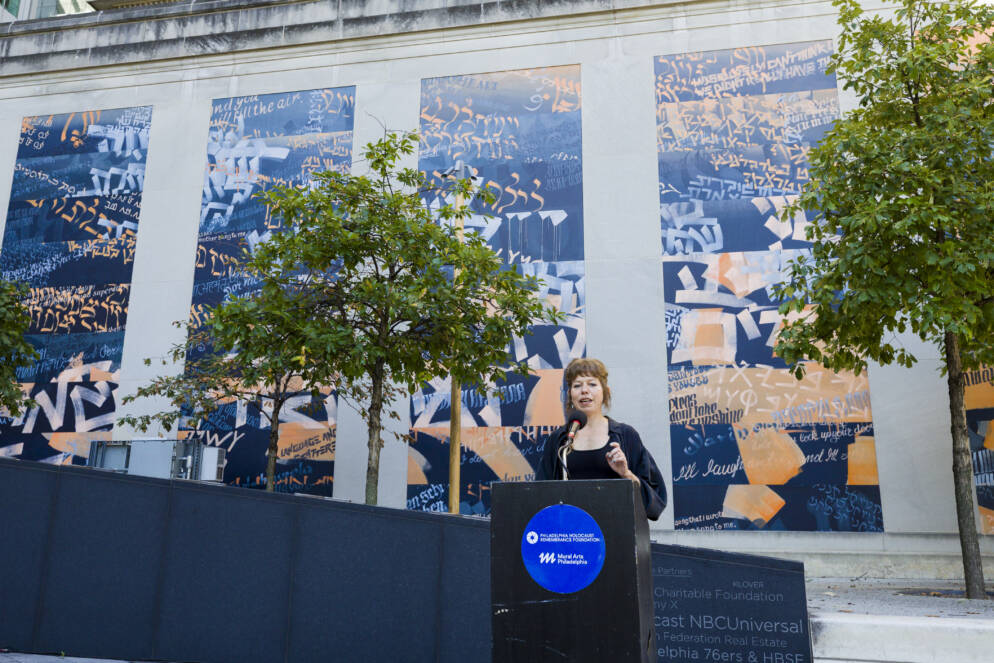
 Mural Artist Ella Ponizovsky Bergelson in front of the mural. (Photo by Jon Marks)
It took a few years from the time of planning to the unveiling of a Holocaust mural in Philadelphia on Sept. 26. So, having a pro-Palestinian protest group spontaneously show up playing Jewish music just as the program was set to begin wasn’t about to spoil it.
Besides, as mural artist Ella Ponizovsky Bergelson was quick to point out, Jews should be used to these kinds of distractions by now, especially when the topic is something as volatile as the Holocaust.
“In my speech, I was talking about facing complexity and many perspectives trying to coexist, and this was an example of it,” she said moments after the conclusion of the program that took place at the Horwitz-Wasserman Holocaust Memorial Plaza on the Benjamin Franklin Parkway. “We’re all here together and can share space without running each other over, because eventually, we all work for the same cause: to make the world a more peaceful place.”
Earlier, she expounded on her process in which the words of Philadelphians are inscribed on the 2,000-square-foot mural in 20 different languages titled “Lay-Lah Lay-Lah” (“Night Night”). “I wanted to tap into the experience of those who had settled here,” explained Ponizovsky Bergelson, who was born in Israel after her parents fled Russia, and currently lives in Germany, where much of the work for the project was done. “Many of them were shaped by the Holocaust and built their home here. This mural was created by your voices.
I reached out for their memories, their stories, poems, prayers. These contributions in many languages is where this story begins. The Holocaust has always been a complex topic. Never more so than now.”
Ponizovsky Bergelson was selected among 54 applicants for the project. Her transformative work drew rave reviews from Jane Golden, executive director of Mural Arts Philadelphia. “To bring art to life takes an artist willing to shoulder the responsibility with vision, courage and creativity,” said Golden, speaking before the few hundred people who turned out for the occasion. “When a mural comes alive, which this one does, it is more than paint on a wall.
It is a civic act, a social compact and a testament to collectivity, cooperation and collaboration. That’s exactly what has happened here. Murals bring history into our everyday lives. They don’t hide in archives or museums. They stand in our streets. They speak to us lyrically. They proclaim our resilience, our dreams, our fears, our longing for a better world.”
While unable to attend, Pennsylvania Gov. Josh Shapiro sent a letter expressing his feelings. “William Penn founded our Commonwealth on principles of fairness, tolerance and understanding when faced with discrimination and adversity,” it said. “Jewish people have embodied those principles and demonstrated remarkable resilience. It is fitting that the city now proudly displays the nation’s first large-scale Holocaust mural. It reminds us that we thrive when we celebrate the diversity that makes our community stronger.”
A number of other dignitaries were present, including Pennsylvania Reps. Ben Waxman and Jared Solomon, along with Pennsylvania Sen. Nikil Saval and Philadelphia Parks and Recreation Commissioner Susan Slawson. But it was left to Golden to sum up the event, which began with speakers having to shout over the protesters, who held signs that said, “There is a Shoah in Gaza” and “We are haunted by what we See in Gaza” while singing “Etz Chayim” and improvised words from “The Fiddler on the Roof.” The event ended, however, with cheers from those observing the mural.
“I think this went beautifully, more than I could’ve imagined,” Golden said, smiling. “The victory feels sweeter with all the obstacles we had to overcome. I always say public art is not for the faint of heart. Every step of the way, things were done with passion, integrity and love. I could not be prouder.”
Jon Marks is a Philadelphia-area freelance writer.