Fitness trends come and go, but combining cardio and strength training is all the rage right now. Tonal is doing it with its Aero workouts, and now Peloton is banking on the fad with its new Cross Training Series of fitness machines.
Launching today, the Peloton Cross Training Series consists of new versions of the Bike, Bike+, Tread, Tread+, and Row+. Each Plus model features a built-in AI camera, similar to the discontinued Peloton Guide, to analyze your movements, track your reps, and provide form corrections to help you train safely. Trained on years of member data with input from Peloton instructors and powered by a new chipset, Peloton IQ is the AI brain of the system.
I visited Peloton Studios in New York to try out Peloton IQ and the new Cross Training Series models, and am here to walk you through all the new features and hardware.
Peloton IQ: A Smarter Way to Train
“The Guide was great; we learned a lot from it,” Peloton chief product officer Nick Caldwell told me. “Peloton IQ with Cross Training is next level.”
Available on Plus models in the Cross Training Series, Peloton’s machine vision technology uses a skeletal keypoints model to track and analyze your form, similar to what Tempo has been doing for years. For instance, based on your shoulders and other skeletal data points, the system can determine if you aren’t lowering yourself enough in a pushup.

The camera on the Cross Training Series Row+ (Credit: Angela Moscaritolo)
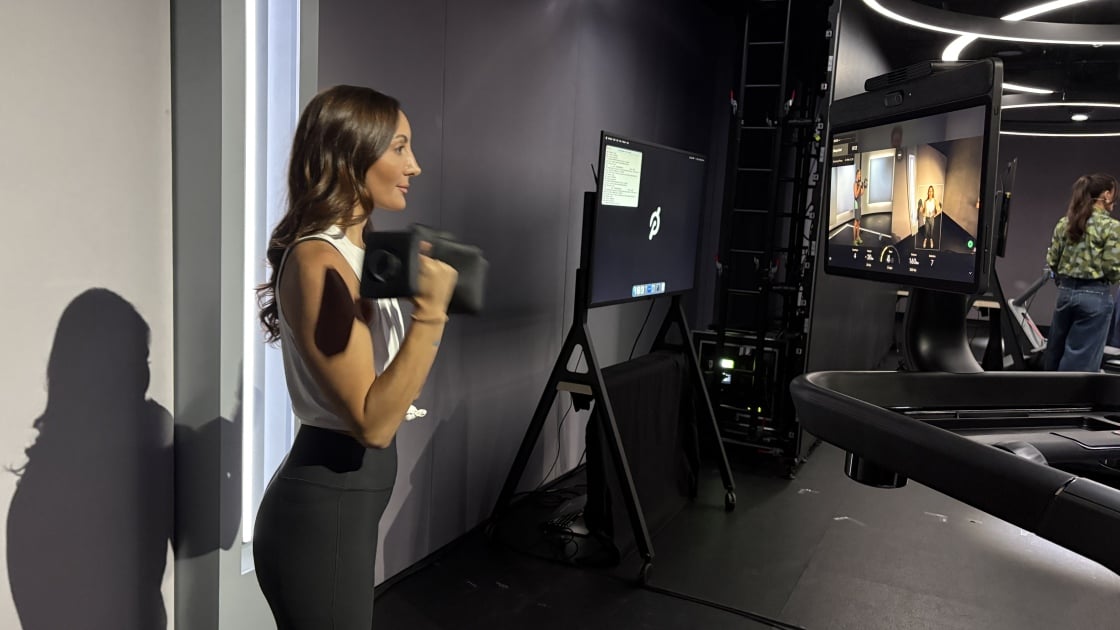
I tested Peloton IQ on the new Cross Training Series Tread+ and found it to accurately track my reps for exercises like dumbbell curls and dumbbell squats. Thanks to the new AI camera, you can see yourself on the Tread+ screen while working out. Form feedback appears on the right side of the screen in real-time when the AI detects an error. When you’re doing an overhead press, for example, it might advise you to “Avoid swinging your body for momentum.” Or while doing dumbbell squats, it might tell you to “Keep your chest lifted.”
At launch, the system can track your reps for 12 movements, including some compound exercises, and provide form feedback for more than 50 exercises. Peloton hopes to scale that up quickly and is planning to launch form feedback for yoga in the future.
“We have, by far, the best ability to train these movement detectors,” Caldwell told me.

Peloton IQ builds you a personalized workout plan based on your goals and performance (Credit: Angela Moscaritolo)
With Peloton IQ, AI is involved in every stage of the workout. Before you work out, you can set goals (such as strength building or weight management), your time commitment, and music preferences. It then builds you a personalized weekly plan, integrated into the hardware experience and Peloton’s mobile app.
The AI keeps track of your output performance and can leverage data from a connected Apple Health, Fitbit, or Garmin account as part of its recommendations. It will tell you whether a workout will be too hard, too easy, or just right.

Get Our Best Stories!
Your Daily Dose of Our Top Tech News

Sign up for our What’s New Now newsletter to receive the latest news, best new products, and expert advice from the editors of PCMag.
Sign up for our What’s New Now newsletter to receive the latest news, best new products, and expert advice from the editors of PCMag.
By clicking Sign Me Up, you confirm you are 16+ and agree to our Terms of Use and Privacy Policy.
Thanks for signing up!
Your subscription has been confirmed. Keep an eye on your inbox!

(Credit: Angela Moscaritolo)
Peloton’s AI can’t detect how much weight you are lifting, but you can input that information during setup and use voice controls to log any changes. Your light, medium, and heavy dumbbells make up your virtual weight rack, and throughout the exercise, Peloton IQ will suggest adjustments as needed. If it tracks 20 reps when 10 were prescribed, for instance, it will suggest you increase your dumbbell weight. If it senses you’re struggling, it will suggest that you decrease the weight. If you do change the weight, you can just tell the AI, “Hey Peloton, I’m switching to 15 pounds,” for instance, and it will log that.

The Cross Training Series Row+ (Credit: Peloton/PCMag)
Similar to its Strength+ app, you can now do strength classes on Cross Training Series Plus models in self-paced mode. Peloton is also integrating the Strength+ dynamic workout generator into the hardware experience, allowing you to customize these sessions by adding specific exercises you want to do and removing the ones you want to skip.
The AI will also offer a weekly summary to highlight personal records and help you stay on track. If all you’ve been doing is walking workouts, it might suggest that you take a run. Or, if you’re the type of person who goes hard every day, it might suggest incorporating active recovery practices like yoga or mobility exercises.
Recommended by Our Editors
The Cross Training Series: An Entire Hardware Refresh
(Credit: Angela Moscaritolo)
Peloton is refreshing its entire hardware line with this launch, including the base Bike and Tread, their Plus versions, and the Row, which is now renamed the Row+. All Cross Training Series models feature a swiveling screen to encourage floor-based strength training workouts, a feature missing from the original Peloton Bike and Tread. Most of the other hardware upgrades are reserved for the Plus models.

The Cross Training Series Bike+ (Credit: Angela Moscaritolo)
Besides the built-in AI-powered camera for movement tracking, the Plus models offer improved sound quality, tuned by Sonos, featuring the first subwoofer Peloton has incorporated into a fitness machine. Peloton has also added a microphone for voice control, allowing you to pause workouts and interact with the new AI during strength training sessions.
This release addresses some of the biggest comfort requests, Caldwell says. The base Bike has a softer seat with improved ergonomics. On all Plus models, there’s a fan you can adjust with dedicated buttons or on-screen controls. And finally, the new Bike+ features a phone holder that can be used in either vertical or horizontal orientation.

The base Bike and Tread now have a swiveling screen, but no AI camera (Credit: Angela Moscaritolo)
In terms of pricing for the Cross Training Series, the Bike costs $1,695, the Bike+ is $2,695, the Tread is $3,295, the Tread+ is $6,695, and the Row+ is $3,495.
All Peloton machines require a $49.99 monthly All-Access Membership, up from $44. The price hike will apply to all All-Access members, including those with older equipment.
Is It Worth Upgrading?
If you already own a Peloton bike, treadmill, or rower and aren’t really interested in strength training, it’s probably not worth upgrading your machine to one of the new models. Whether the Peloton IQ movement tracking features for strength training are helpful and engaging enough to warrant an upgrade is still up for debate. I look forward to testing all the new Peloton Cross Training Series machines to offer definitive buying and upgrade advice in the near future, so stay tuned for more.
About Our Expert

Angela Moscaritolo
Managing Editor, Consumer Electronics
Experience
I’m PCMag’s managing editor for consumer electronics, overseeing an experienced team of analysts covering smart home, home entertainment, wearables, fitness and health tech, and various other product categories. I have been with PCMag for more than 10 years, and in that time have written more than 6,000 articles and reviews for the site. I previously served as an analyst focused on smart home and wearable devices, and before that I was a reporter covering consumer tech news. I’m also a yoga instructor, and have been actively teaching group and private classes for nearly a decade.
Prior to joining PCMag, I was a reporter for SC Magazine, focusing on hackers and computer security. I earned a BS in journalism from West Virginia University, and started my career writing for newspapers in New Jersey, Pennsylvania, and West Virginia.
Wearables: fitness trackers, heart rate monitors, and smartwatches
Smart home devices: air purifiers, kitchen appliances, light bulbs, robot vacuums, smart scales, and more
Smart fitness machines: rowing machines, stationary bikes, strength training equipment, treadmills, and workout mirrors
Pet tech: connected cameras and GPS trackers
E-bikes
My little Florida beach bungalow is brimming with smart home tech. I have a smart speaker or display in every room, allowing me to control other connected devices by voice. The Nest Hub on my bedside table lets me set wake-up alarms, control my Wyze Light Bulbs, and set the temperature on my Nest Thermostat. I use the Amazon Echo Show 8 on my kitchen counter to browse recipes, reorder protein powder, check the weather, and watch the news while I do dishes.
Because I suffer from allergies, air purifiers are essential. My favorite model is the Dyson Purifier Cool TP07, which doubles as a fan and continuously sends indoor pollution data to its companion mobile app.
My pitbull Bradley sheds, so a good robot vacuum is a must. I currently use a premium Ecovacs Deebot that can both vacuum and mop, empty its own dustbin, and wash its own mop cloth.
For fitness, I like to mix up my routine with cycling, indoor rowing, running, and strength training in addition to yoga. I take classes on the Tonal smart strength training machine, but I prefer using the NordicTrack iSelect adjustable dumbbells when lifting heavy. I row indoors on an Aviron machine, and track my beach runs with an Apple Watch while listening to music on my Apple AirPods Pro. On the weekends I love riding e-bikes like the rugged, beach-friendly Aventon Aventure for fun and fitness.
My job involves a lot of virtual meetings, so a quality webcam, microphone, and ring light are important. I use the Jabra PanaCast 20 webcam, the Elgato Wave: 3 microphone, and a Yesker tripod ring light.
As for my preferred phone platform, I’m an iPhone person, but I’ve also extensively used Android for product testing.
Latest By Angela Moscaritolo