Twenty-five years. That’s how long the Chicago Public Library Foundation Awards have been honoring writers, artists and local changemakers. In a quarter of a century, the honorees have been many.
This year, Pulitzer Prize and National Book Award-winning author Percival Everett is receiving the Carl Sandburg Literary Award, Calumet City poet José Olivarez is the recipient of the 21st Century Award and Mary Dempsey, former commissioner of the Chicago Public Library, is taking home the Civic Award.
“It does kind of feel like fate … when we identify what it means to lift up an author in a certain moment in time,” CPLF president and CEO Brenda Langstraat Bui said about the choice of the awardees.
On Percival Everett: “This is the first time that somebody is receiving the Sandburg award in the same year they won the Pulitzer. He’s such a prolific author; the narrative of the library is always in his work. His characters explore libraries, have this curiosity, this understanding of what it means to learn. This is a moment where this book (‘James’) needs to be lifted up.”
We spoke with Olivarez and Dempsey, Chicago-area natives, ahead of the Oct. 21 award ceremony. The following conversations have been edited for length and clarity.
José Olivarez
Olivarez, the son of Mexican immigrants, graduated from Harvard University and lives in Jersey City, New Jersey. A marketing manager of Young Chicago Authors, his two collections of poems are “Citizen Illegal” and “Promises of Gold.” His work has been long-listed for a National Book Award, a finalist for the PEN/Jean Stein Book Award and was a winner of the Chicago Review of Books Poetry Prize. A recipient of a Ruth Lilly and Dorothy Sargent Rosenberg Poetry Fellowship from the Poetry Foundation in 2019, Olivarez is hoping his first novel — one on reverse migration — will hit shelves in the fall of 2026.
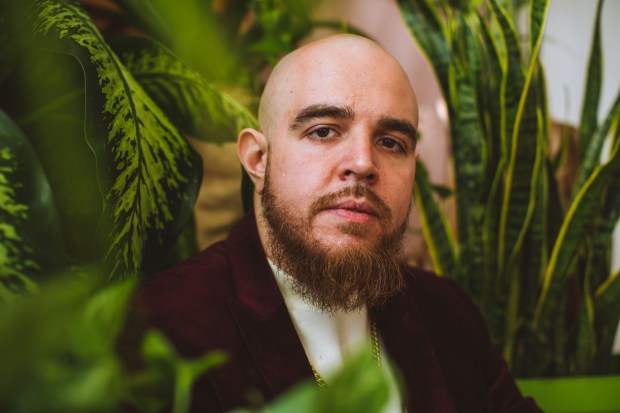 Poet and Calumet City native José Olivarez.
Q: What does it mean to get this award now?
A: I lost my mind. For me, this is the most meaningful award that I’ve received. To be recognized by the Chicago Public Library Foundation, for it to be home, it means everything to me, especially because I spent so many hours as a child at the library. To have it come full circle like this… I couldn’t believe it. Growing up, my parents were undocumented for a long time, and a lot of what I write about is what it means to be living in the United States and not have the full protection of the state that one might expect here. To receive this award in this particular moment, I’m thinking about how I can continue to make my writing sharper, offer words that are meaningful for the communities and the people that I love to keep them inspired and insisting that there will be a day after this — we will continue to fight, plant our roots and make Chicago the beautiful city that it is.
Q: In your first poem collection, we are introduced to the poem “Mexican Heaven.” You revisit it in your recent collection. Why do you keep coming back to it?
A: My initial inspiration was, I wanted to find a way to write about immigration the United States, but I didn’t want to do it straightforwardly. One day, it hit me, ‘what’s another place that promises to be perfect when you get there, but there are gates and there’s someone holding a list to check to see if your name is on it?’ That classical interpretation of heaven also has a border… it was a way to write about the United States, and a way to mischievously play with some of the classical figures in Christian theology. I love the idea that Jesus, Lord and Savior, gets reborn in the palms every day as Jesus, who’s just your cousin from down the street, and he’s got a big back tattoo. To me, it makes sense. Why shouldn’t we treat each other as though we have that kind of holiness and special features about us? Why shouldn’t we treat each other like we are all the children of God? It is my favorite poem I’ve ever written. ‘Mexican Heaven’ exists not only in the first collection, but in the second collection, because it’s one of those imaginative places like Chicago that I can come back to and reassess how I’m feeling about the world and about the people that I love in this very creative and generative way.
Mary Dempsey
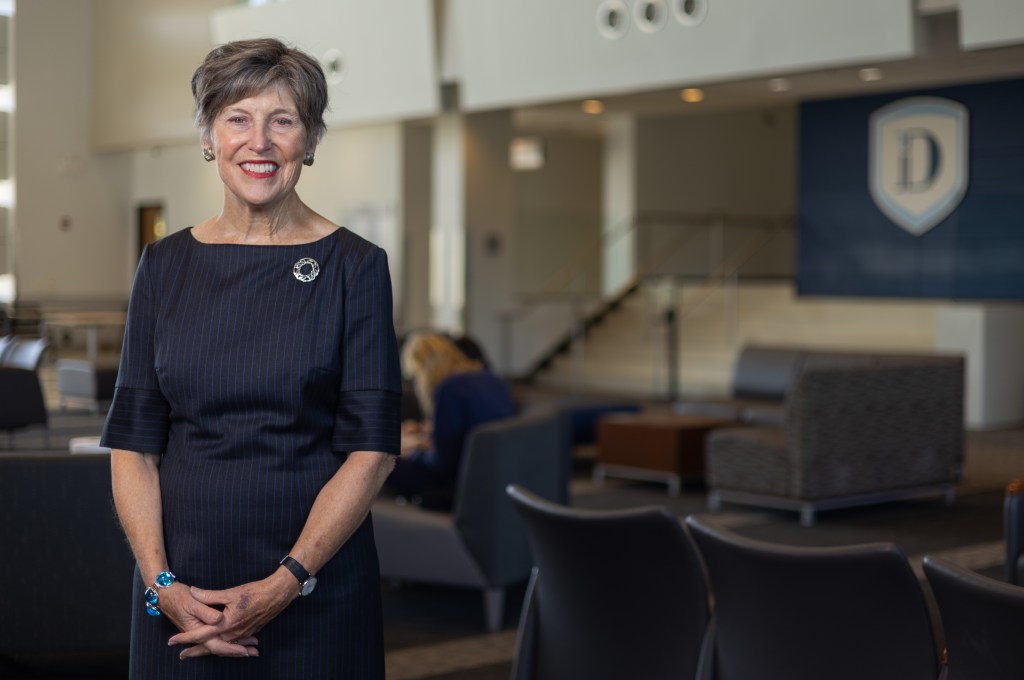
Reared in Hillside, Dempsey has had many roles in life — librarian, lawyer, and president of DePaul College Prep and the Philip H. Corboy Foundation. From 1994 to 2012, she served as Commissioner of the Chicago Public Library where she was responsible for the construction of 44 neighborhood branch libraries (currently there are 81 branches).
“A place of lifelong learning for the people — that’s what a library is. Libraries are the centerpiece of democracy. They are the people’s university, and thanks to the leadership of Mayor Daley and his support, we were able to bring that to so many neighborhoods in Chicago,” she said.
During her tenure, she introduced programs and technology that still resonate — such as One Book, One Chicago and the YOUmedia initiative. To this day, Dempsey considers working in public service a privilege.
Q: One Book, One Chicago and YOUmedia started while you were commissioner. What’s the next iteration of the Dempsey CPL legacy?
A: I can talk to the CPL legacy, and that is, it is more relevant than ever, because libraries still serve as a great third place where people gather — where people can come together with differing ideas or similar ideas and interact. They’re not judgmental. Everybody’s welcome to use the resources as they see fit … serving as community anchors in every single neighborhood in Chicago. We all have our library story. We can all remember what it meant to us when we got our library card, how important it was for each and every one of us to say, no one’s going to judge me because I want to read this, as opposed to that. And it hasn’t changed. (All CPS students receive a library card.)
Q: In these unprecedented times, where places of learning are under attack, what advice do you have?
A: You have to be clear about what your mission is and collaborate with others to determine how best to achieve that mission in a way that you may have to shift, especially if resources are trimmed. How do you make your mission attractive to people who have the ability to perhaps assist financially or in other ways, politically? We can’t control everything, but we can control our little piece. We’re all being challenged right now, are we up to the challenge? Are we willing to work together as a city, as people from every different corner of the city, to say, ‘This matters to me. You matter to me. This institution matters to me. The person down the block matters to me. I am my brother’s keeper?’